Hello and welcome back! Thank you for joining me for episode forty-five of AI Solutions: The Pathway to Profit. Today, we’re diving into a topic that is the quiet, unsung hero—or sometimes the frustrating bottleneck—of every great tech business: quality assurance.
Let me paint a painfully common picture for you. A brilliant development team has just built an amazing new feature. Excitement is high. But then, it hits the QA wall. A massive, multi-week process of manual checks begins. Teams of talented people click through every screen, follow every user path, and meticulously document their findings. It’s well-intentioned, of course, but it’s a system that is inherently slow, expensive, and frankly, a creativity killer. It’s a bottleneck that can delay your launch and drain your budget.
And the scale of this problem is staggering. Recent studies suggest the economic impact of software bugs is in the trillions of dollars annually. Trillions! That’s a figure that represents lost productivity, damaged reputations, and squandered potential. But I’m not here to dwell on the problem. I’m here to guide you through a fundamental shift in thinking. A move towards a faster, smarter, and profoundly more profitable solution. A solution powered by AI.
The Old World of Click-and-Pray
To really appreciate the leap we’re about to take, we have to understand where we’re coming from. What I often see in traditional QA is that reliance on manual testing. It’s painstaking, important work, but its scope is always limited by human capacity. We simply can’t check everything.
The first attempt to solve this, of course, was script-based automation. We wrote scripts to tell a machine, “Click here, then check for this text.” And for a moment, it felt like progress! But you might have found, as so many did, that these scripts were incredibly brittle. They were like building a house of cards on shifting sand. A developer makes a minor, logical update to an application’s interface, and poof—an entire test suite breaks down, creating a costly and frustrating maintenance headache.
The Leap from Automation to Autonomy
This is where the paradigm truly shifts. We’re moving away from rigid, pre-defined instructions and toward intelligent, autonomous systems. Think of it this way: traditional automation is like giving someone a very specific recipe. It can only produce one dish, and if you change a single ingredient, the whole thing might fail. AI-driven testing is like teaching a chef how to cook. The chef understands the ingredients, the techniques, and the principles. They can adapt, improvise, and create new things you never even thought to ask for.
This isn’t just automation; it’s autonomy. We’re building systems that don’t just follow a script but can actually learn an application, understand its context, and test it dynamically. So how does this autonomy actually manifest? Let’s get practical.
Meet Your New AI Testers
I want you to imagine two new members of your QA team. They’re a little different, but they’re about to become your MVPs:
- The Visual Virtuoso: First, we have an AI equipped with computer vision. This AI doesn’t just check code; it looks at your application the way a user does. It can scan thousands of screen variations across different devices in minutes, instantly identifying subtle visual bugs that a human team could spend weeks trying to find. A misaligned button, an inconsistent logo, a color that’s just one shade off. It’s like having a million detail-obsessed interns who never get tired and never miss a thing.
- The Curious Explorer: Then, there’s a concept that truly changes the game: exploratory testing. Your human testers, by their very nature, tend to follow predictable paths. But what happens when we set an AI model loose on the application? It behaves like a brand-new, endlessly curious user. It autonomously navigates, clicks, and explores, discovering user journeys you never designed. It’s like a digital Indiana Jones, finding hidden bugs and potential crashes in the forgotten temples and back alleys of your system—the places no one ever thought to check.
The Magic of Self-Healing Tests
Now, let’s talk about that maintenance nightmare I mentioned. My unbreakable rule for modern automation is this: your testing framework should not be more fragile than the application it’s testing. For years, this was an impossible standard.
What I often see is a huge amount of engineering time wasted on this. A developer changes a button label from “Submit” to “Continue.” It’s a small, logical change. In the old model, this simple update can break dozens of automated tests, all of which were hard-coded to look for the word “Submit.”
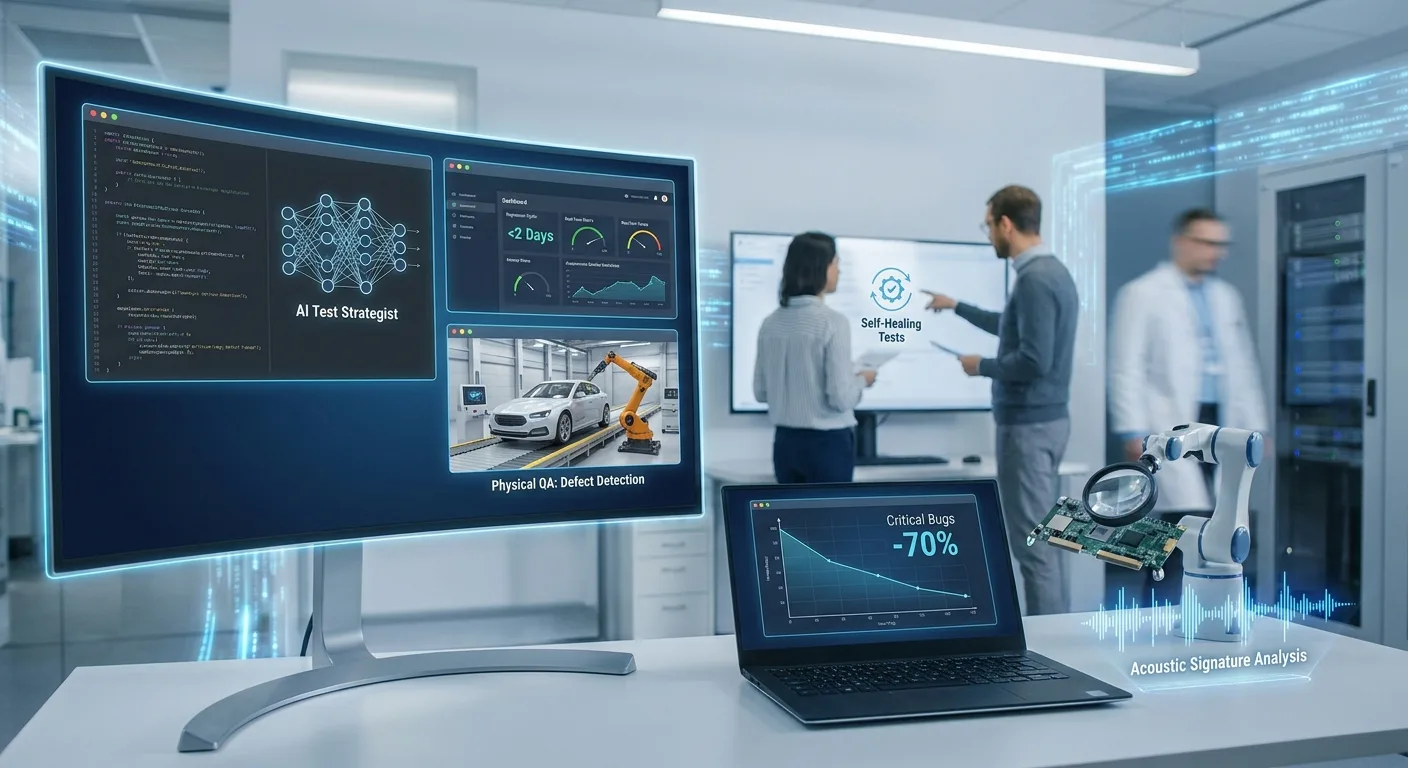
But what I absolutely love to see now is a concept that feels like magic: self-healing tests. An AI-powered tool doesn’t just look for an element with a specific name. It understands the element contextually—its position, its function, its relationship to other objects on the page. So when the label changes, the AI correctly identifies that it’s the same button, just with a new name. And then—this is the incredible part—it automatically updates the test script on the fly. It heals itself.
You might find that this single capability eliminates the vast majority of your test maintenance costs. It’s a true game-changer.
Beyond the Screen: When AI Gets Physical
What I find so exciting is how these principles extend far beyond the software on our screens. The most profound applications of AI for quality are happening in the physical world.
Picture an assembly line for complex circuit boards. A human inspector, no matter how skilled, can miss a microscopic flaw. But an AI vision system? It doesn’t blink. It sees every single board, every connection, and it detects defects smaller than a human hair at a speed that is simply superhuman.
Or let’s move beyond sight. Think about the unique sound a brand-new car engine makes. An AI can listen to that acoustic signature, analyzing frequencies we can’t even perceive. It can identify a subtle vibration that indicates a potential mechanical fault long before it ever becomes a problem for the driver. This isn’t just quality control; it’s predictive quality assurance.
The Direct Path to Profit: A Real-World Story
Let’s make these concepts tangible. I often guide companies through this transition, so let’s imagine a mid-sized software firm I worked with. They were caught in that familiar cycle: their releases were constantly delayed by a three-week manual QA process. They were losing ground to more agile competitors.
After implementing an intelligent automation platform, the shift was fundamental. That regression testing cycle, which once consumed three weeks of their calendar, is now completed in under two days. But the results go far beyond speed. You’ll find, as they did, that the number of critical bugs reaching customers plummets—in their case, by over seventy percent.
And this is the direct path to profit. Your developers are freed from constant firefighting, allowing them to innovate. You get your product to market weeks, or even months, earlier than your competition. You lower your development costs. And you build a reputation for rock-solid quality that becomes your most valuable asset.
The QA Pro of the Future: Your New Superpower
This brings us to a crucial question I often hear. People get worried: “Will this technology replace our skilled QA engineers?” What I believe, and what I see happen in practice, is not a replacement, but a powerful evolution. The role elevates.
You’ll find the focus shifts from repetitive, manual execution to a new, more strategic role: the AI Test Strategist. The QA professional’s deep domain knowledge is now used to train the AI models and guide their learning. Their expertise is spent analyzing the complex, nuanced results the AI uncovers, and performing the creative, intuitive testing that explores the human side of user experience—something a machine cannot yet grasp. Your QA team gets a superpower, and their work becomes more valuable than ever.
Your Strategic Advantage
So, as we wrap up, I hope you see the clear, beautiful logic of this journey. You might find it begins with increased speed and far wider test coverage, but it results in a tangible reduction in costs and a profoundly higher quality product that your customers will love.
What I really want you to take away today is this: adopting intelligent quality assurance is not just a technical upgrade. It’s a direct, strategic pathway to greater profitability and a stronger competitive edge.
Thank you for walking this path with me today. I hope you’ll join me next week as we dive into a completely different world—“AI for Content Creators: Personalization, Discovery, and Monetization.”
Until then, I’d love to hear your thoughts. Have you started exploring AI in your QA process? What are your biggest challenges? Drop a comment below!