Hello and welcome back!
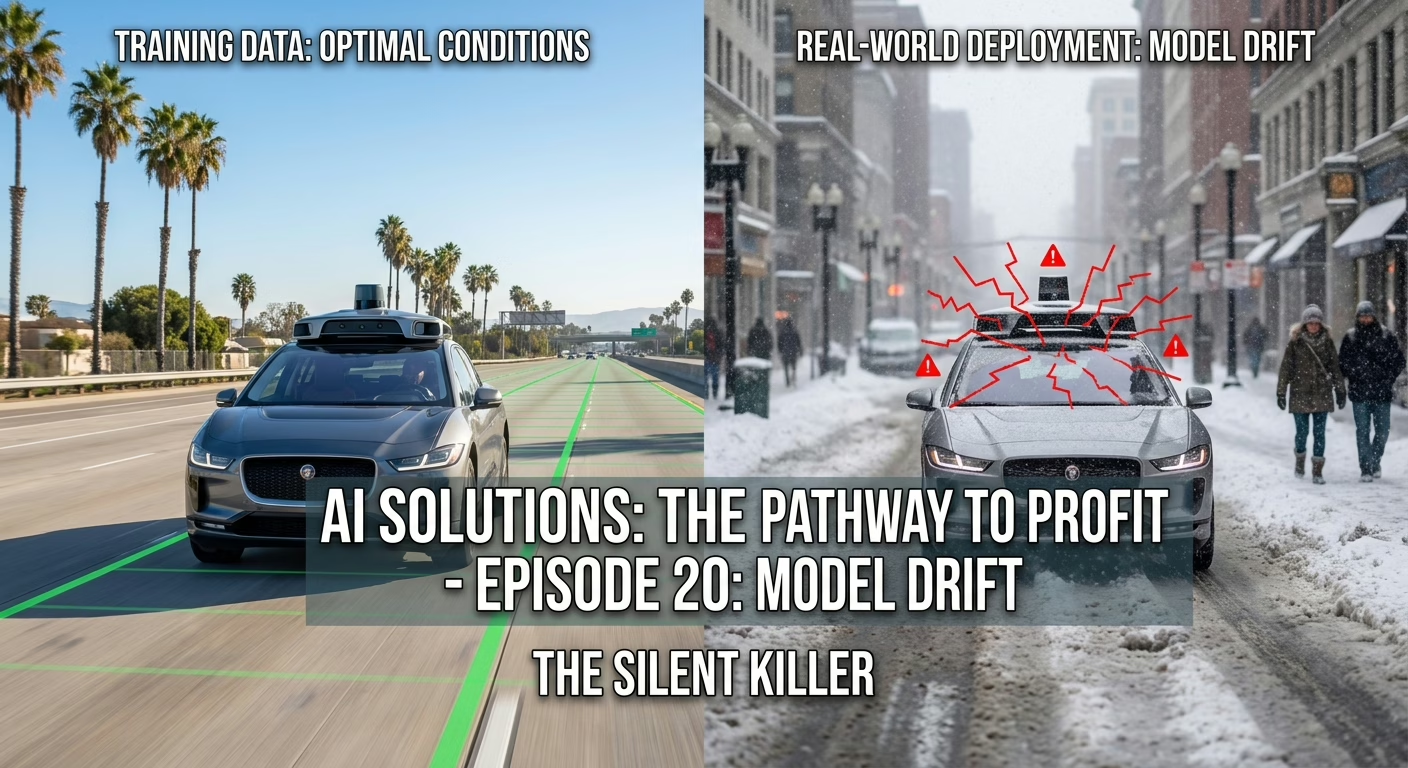
Let me paint a vivid picture for you. You’ve just built a gorgeous self-driving car. It’s been trained on millions of miles of perfect, sunny California highways. The engineers are popping champagne. The model is a masterpiece.
Then you ship it to Boston.
The first winter storm hits and suddenly your brilliant AI is sliding across black ice, staring at slush like it’s an alien life form. The world it learned no longer exists. That, my friend, is model drift — and it might be the most expensive silent killer in AI today.
I see it constantly. Teams pour six or seven figures into an AI project, celebrate a successful launch, then quietly watch their ROI bleed out over the next twelve months because nobody planned for the inevitable.
Today we’re tackling this head-on. By the end of this post, you’ll understand exactly what model drift is, how to catch it before it costs you real money, and the professional system you need to keep your AI valuable long after launch.
What Model Drift Actually Is (And Why It’s Inevitable)
Model drift isn’t a bug in your code or a failure of your data science team. It’s an operational reality — as certain as taxes and software updates.
Here’s how I explain it to clients: Your model is a highly specialized apprentice. You trained it during a specific time, in a specific environment, under specific conditions. The moment the world changes, that apprentice starts getting outdated.
I break drift into two main types that every leader should know.
Concept Drift is the sneaky one. This happens when the relationship between your inputs and the outcome fundamentally changes. The “rules of the game” shift.
Take a retail recommendation model that learned “customer buys hiking boots” usually means “customer is probably also interested in camping gear.” Then a fashion trend explodes and suddenly hip city kids are wearing hiking boots with designer jackets. The input (boot purchase) is the same, but the concept behind it has completely changed. Your model is now clueless, pushing tents to people heading to rooftop parties.
Data Drift is more obvious but equally dangerous. This is when the actual statistical properties of your incoming data change from what the model was trained on.
I once worked with a loan approval model built during a stable economy. It knew exactly what a low-risk applicant looked like. Then a recession hit. Job titles, income patterns, and spending behaviors all shifted dramatically. The model was still applying “good times” logic to “tight times” applicants. Like trying to navigate today’s Boston using a 1987 street map.
The Painfully Expensive Consequences Nobody Talks About
This isn’t just a technical curiosity for your data team. Model drift hits your P&L with surgical precision.
I’ve watched a fraud detection system slowly start missing sophisticated new scams, causing chargeback rates to explode. I’ve seen dynamic pricing engines in ride-sharing apps start suggesting bizarre prices during unexpected traffic patterns, destroying customer trust overnight.
But the one that hurts the most? Supply chain forecasting models.
When these drift, you either end up with warehouses full of products nobody wants or you’re chronically sold out of the exact items flying off the shelves. Both scenarios are expensive. One just looks better on a balance sheet until the write-downs hit.
The brutal truth? Many organizations have expensive AI systems that are quietly getting dumber every single day — and leadership has no idea until the damage shows up in quarterly results.
How to Become a Professional Drift Detective
The difference between amateurs and pros isn’t that pros prevent drift. (You can’t.) It’s that pros expect it and build systems to catch it early.
My unbreakable rule: Never trust a model you aren’t actively monitoring.
You need a two-pronged attack.
First, monitor your model’s outputs. Track your key metrics (accuracy, precision, F1, revenue lift, whatever actually matters for your use case) over time. A sudden drop is an obvious red flag.
But here’s the pro move: monitor your inputs before they even reach the model.
My favorite tool for this is the Population Stability Index (PSI). It’s a statistical test that compares the distribution of new data against your training data. When the world starts changing, the PSI score spikes like a canary in a coal mine.
Set up automated alerts. When that score crosses your threshold, your system should start screaming. This is early warning that gives you time to act before bad predictions start costing real money.
The Retraining Dilemma (And Why “Just Retrain It” Is Bad Advice)
So your alert fires. The obvious answer is to retrain the model on fresh data, right?
Not so fast.
Scheduled retraining (every month, every quarter) is the lazy approach I see most often. It’s easy to put on a calendar but it’s a blunt instrument. Sometimes you’re retraining when you don’t need to. Other times you’re waiting too long while your model fails.
I strongly prefer performance-triggered retraining. Your monitoring system says “accuracy has dropped below our threshold” — that’s when you act.
For certain high-frequency applications (think algorithmic trading), you might even move to continuous or online learning.
But retraining comes with its own demons. The scariest one I’ve seen torpedo projects is catastrophic forgetting — where the model learns the new patterns so well that it completely forgets critical old ones.
I watched a fraud model get retrained on a wave of sophisticated new scams only to become vulnerable again to the simple attacks it had previously mastered perfectly. The balancing act is real.
The Real Solution: MLOps as a Discipline
This is where we separate the serious organizations from the ones just playing with AI.
The professional answer isn’t just “monitor better.” It’s building a complete MLOps (Machine Learning Operations) system that treats drift as a first-class citizen from day one.
Let me be crystal clear: MLOps is not just a fancy word for deploying a model. I see too many teams misuse the term this way.
True MLOps is an automated lifecycle that manages the entire journey of your model, including drift.
Here’s what a mature system actually looks like:
- It continuously monitors for both data and concept drift
- When thresholds are breached, it automatically kicks off a retraining pipeline with fresh, validated data
- It creates a “challenger” model and rigorously tests it against the current “champion” model in a staging environment
- Only when the challenger proves superiority does it get promoted to production — with zero downtime
This is how you move from constantly fighting fires to running a self-healing, professional AI operation.
The Fast-Fashion Retailer That Got This Right
Let me make this concrete with a story I love telling.
I was working with a major fast-fashion e-commerce client. Their recommendation engine — the heart of their entire sales funnel — started seeing a slow but steady erosion in click-through rates. Death by a thousand cuts.
When we looked at their monitoring dashboard, it was a textbook case of data drift. A viral fashion trend had completely rewritten what was “cool” literally overnight. Their model was still pushing last month’s aesthetic.
But here’s where their investment in MLOps paid for itself many times over.
The system automatically triggered a retraining pipeline. It ran the champion-challenger test. The new model destroyed the old one. It was seamlessly deployed. Within a week they saw a 15% uplift in both engagement and sales.
They didn’t just fix a leak. They turned a potential crisis into a genuine competitive advantage.
Your Takeaway: Treat AI Like a Living System
If you remember only one thing from this episode, make it this:
Model drift isn’t a possibility — it’s a certainty. It’s a law of nature in the AI world.
The difference between AI that delivers sustained value and AI that quietly bleeds your ROI is preparation. You need relentless monitoring to see when the world is changing, and a disciplined MLOps framework to respond automatically and intelligently.
AI isn’t a “set it and forget it” project. It’s a living system that requires continuous care and adaptation.
And this need for continuous adaptation? It reveals a much deeper problem with how most companies approach AI development. That’s exactly why next week we’re diving into Episode 21: “Agile for AI: Why Traditional Software Cycles Are Broken.”
You won’t want to miss it.
Until then, I’d love to hear from you. Have you discovered model drift in one of your systems? How did you catch it? Drop your stories or questions in the comments — I read every single one.
Talk soon,
Your AI mentor who’s seen too many great models go to Boston in winter
P.S. If you’re currently running production AI systems without proper drift monitoring, do yourself a favor and audit that this week. The earlier you look, the less painful the conversation will be.