Hello and welcome back!
Today we’re diving into one of my favorite topics: how artificial intelligence can transform the most human part of your business—your people.
I’ve sat through too many post-mortems where leaders finally tallied the real cost of a bad hire. The studies that say “30% of first-year salary” are being wildly optimistic. When you add up recruiter fees, training time, severance, lost productivity, and the quiet damage to team morale, you’re often looking at double the person’s salary. That’s not a hiring mistake. That’s a six-figure oops that happens every single day.
So let’s fix it.
In this episode, we’re going far beyond the hype to explore how AI is quietly becoming one of the most powerful tools in modern HR—from removing bias in recruiting to predicting who might leave before they’ve even updated their LinkedIn profile. This isn’t science fiction. It’s happening right now, and the companies using it well are building stronger, happier, and significantly more profitable teams.
The Traditional HR Playbook Is Broken
Let’s be painfully honest for a moment.
I’ve been in rooms with executives who swear they hire purely on merit, yet their leadership team looks suspiciously like a college reunion from their alma mater. That’s unconscious bias at work, and it’s incredibly expensive.
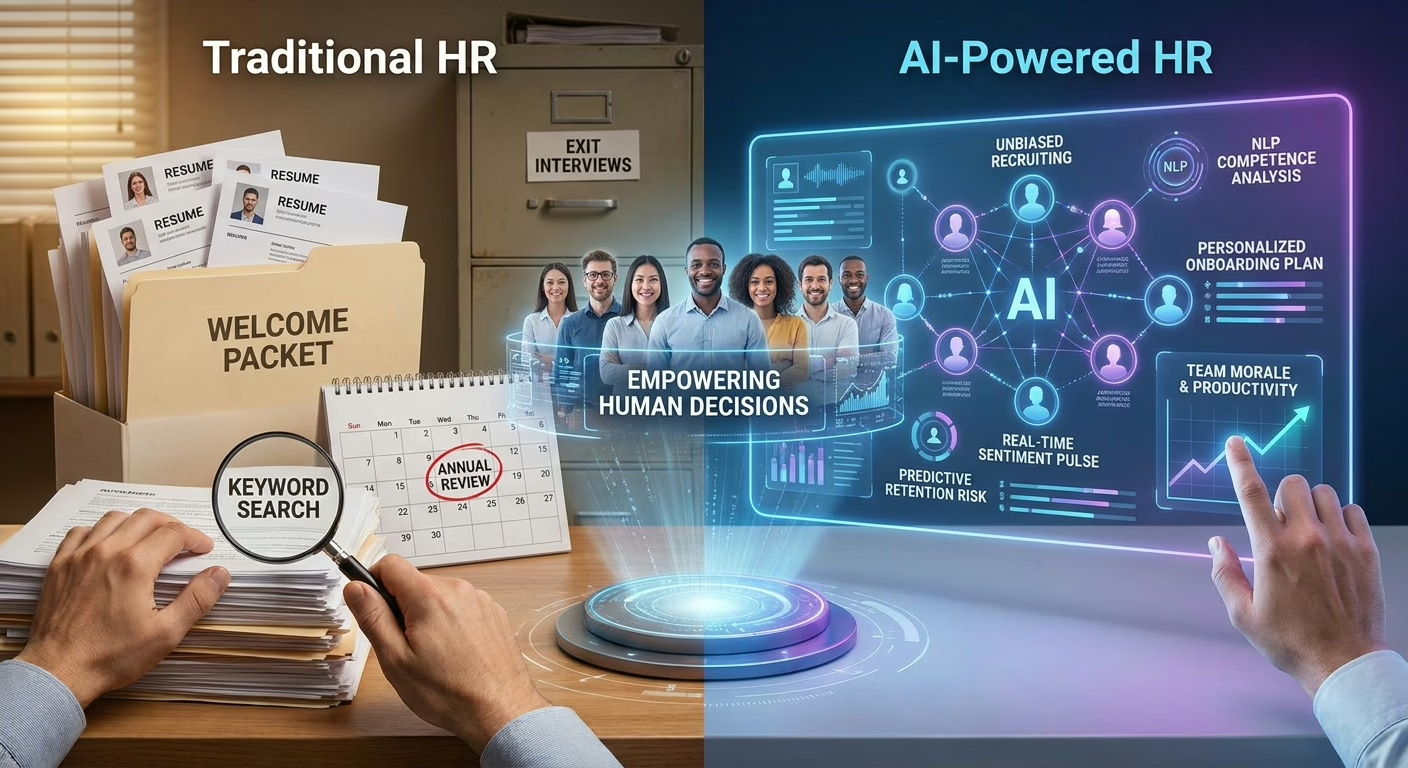
Then there’s the volume problem. Four hundred applications for one role. Your talent team spends roughly eight to ten seconds scanning each resume. They’re not actually reading—they’re keyword hunting. It’s less a selection process and more a lottery with terrible odds.
And once someone’s hired? The engagement survey once a year is the equivalent of a doctor checking your pulse annually and calling it preventative care. By the time the results come in, your best performer has already accepted another offer.
We’ve been playing defense in HR for decades. It’s time to start playing offense.
Blind Screening: The Great Equalizer
The first rule I give every HR leader is this: make the first screen completely blind.
Modern AI tools can strip names, photos, graduation years, addresses, and even subtle signals that trigger bias in less than a second. What remains is a clean profile of skills, experience, and demonstrated competence.
Suddenly you’re not looking at “Jane from down the street who went to your rival university.” You’re looking at what actually matters.
My personal rule of thumb: if your screening process could identify your next superstar from a spreadsheet with no names attached, you’ve built something special.
Stop Hunting Keywords, Start Understanding Meaning
Here’s where it gets fun.
The best AI recruiting tools today use Natural Language Processing (NLP) that actually understands context. It knows that someone who “managed a P&L for a product launch that grew 340% in 18 months” has the exact financial intuition you’re looking for—even if they never used the sacred words “budget forecasting.”
It’s like having a ridiculously well-read colleague review every application instead of an exhausted recruiter on their third coffee.
And while the AI does the heavy lifting, smart chatbots handle the frontline work—answering candidate questions at 2 a.m., scheduling interviews with the strongest matches, and keeping top talent warm. Your recruiters finally get to do what they were hired for: building relationships with exceptional humans instead of drowning in their inbox.
Personalized Onboarding That Actually Accelerates Impact
Congratulations. You’ve made a great hire.
Now don’t fumble the ball with a generic onboarding packet that treats your new senior engineer exactly like the marketing intern.
I once watched a brilliant software architect sit through the same two-day orientation as recent graduates. The look on his face said everything. He was insulted, bored, and already wondering if he’d made a mistake.
Here’s what great looks like instead:
The moment the offer is signed, AI builds a custom 90-day success plan. It looks at their role, their experience, the skill gaps identified during interviews, and even their stated career goals. Then it creates something dynamic:
- “Here are the three people you should meet this week.”
- “Here’s the project architecture documentation you’ll want to review.”
- “Sarah navigated a similar career path—here’s her calendar for a mentoring coffee.”
This isn’t a checklist. It’s a living, breathing development system that adapts as the person grows. The result? Dramatically faster time-to-impact and an employee who feels genuinely seen from day one.
The Real-Time Pulse (Goodbye Annual Surveys)
Let’s talk about those annual engagement surveys for a second.
They’re corporate theater. Everyone rates everything a polite 4 out of 5 because they’re smart enough to know “honest” answers have consequences. It’s about as useful as a smoke detector that only goes off after the house has burned down.
Instead, forward-thinking companies are using sentiment analysis across anonymized communication channels and feedback tools. The AI isn’t spying—it’s reading the aggregate emotional temperature of the organization.
It can tell you that morale in logistics dropped 22% this week. That’s not an autopsy report six months too late. That’s an early warning system.
Predictive Retention: Your New Superpower
This is where AI moves from helpful to borderline magical.
Rather than asking “Why did they leave?” during a sad exit interview, the best systems are now asking “Who is likely to leave in the next 90 days?”
These models look at dozens of factors: time since last promotion, changes in commute, manager transitions, even something as subtle as suddenly stopping participation in optional training. (That last one, by the way, was the strongest predictor in one company I worked with.)
The system doesn’t create a blacklist. It creates a watchlist for support. A risk score that prompts a manager to have a real, human conversation before the employee starts polishing their resume.
The Big Warning: Your AI Is Only as Good as Your Past
Now let me put on my serious hat for a moment.
This technology can go wrong very quickly if you’re not careful.
My unbreakable rule: Your AI will amplify whatever patterns exist in your historical data.
If you’ve spent ten years hiring from the same three universities, your algorithm will simply learn to do that faster and more efficiently. You must audit it. You must challenge its recommendations. And you absolutely must be transparent with your team about what data you’re using and why.
Data privacy isn’t a checkbox—it’s table stakes for trust.
The Human Element Still Wins
Let me be crystal clear about something.
AI will never replace the manager who sits down with an employee and genuinely asks, “How can I help you succeed?” An algorithm can flag a retention risk. Only a human can show up with empathy, creativity, and real support.
The AI gives you the signal. The human has the conversation.
That’s the partnership that creates extraordinary teams.
Your New HR Playbook
So what does all of this actually look like in practice?
You stop playing the hiring lottery and start building a process that’s fundamentally fairer and dramatically more effective at finding real competence.
You stop treating new hires like identical widgets and instead create personalized paths that accelerate their growth and connection to your mission.
And most importantly, you stop being reactive. You move from conducting exit interviews to preventing the exits that matter most.
The result isn’t just better retention numbers. It’s a genuine competitive advantage built on stronger culture and better talent.
Thanks for spending this time with me today.
Next time, we’re taking AI out of the data center and putting it where the work actually happens. Episode 23 is all about Edge AI—running intelligence on the factory floor, in delivery trucks, and even in your pocket. It’s going to change how you think about operations.
You won’t want to miss it.
In the meantime, I’d love to hear from you. What’s the biggest HR challenge you’re facing right now? Have you started experimenting with AI in recruiting or retention? Drop your thoughts in the comments—I read every single one.
Until next time, keep building,
— Your AI Solutions Guide