Hello and welcome back, friend!
For years we’ve been playing the same expensive game: grab data, ship it halfway across the country to a cloud server, wait for an answer, then hope the decision still matters when it finally arrives.
I’m done with that game. And if you run any kind of physical operation—manufacturing, retail, logistics, healthcare—I bet you’re tired of it too.
Today we’re talking about Edge AI: the powerful idea of putting intelligence right where your business happens instead of outsourcing every decision to a distant server farm. When you master this, you get faster action, stronger privacy, bulletproof resilience, and—most importantly—dramatically better profits.
Let me paint a vivid picture.
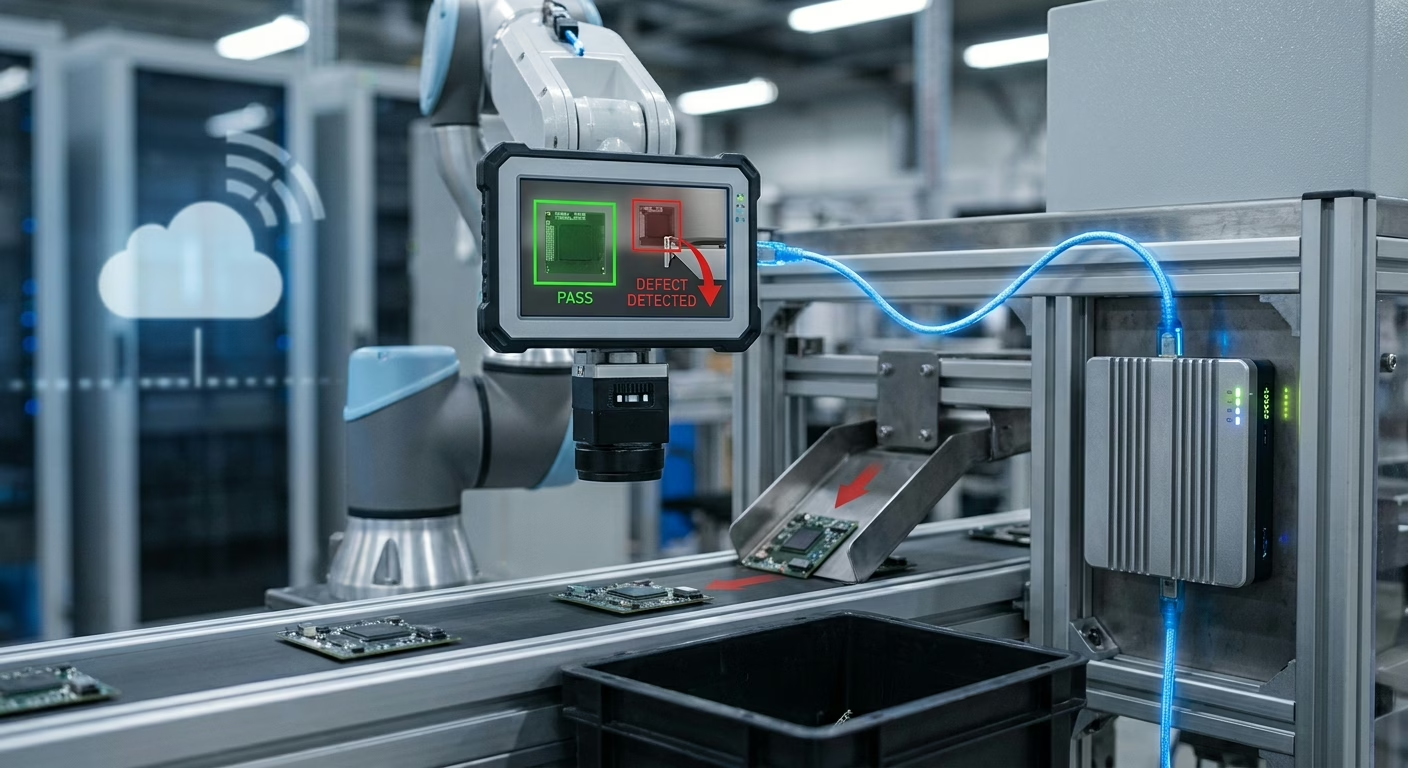
Imagine a smart camera on your factory floor. It doesn’t just record video like some passive security guard. It understands what it sees. The moment it spots a defect or hears the tell-tale whine of a failing bearing, it stops the production line in a fraction of a second. No lag. No Wi-Fi dropout. No sensitive data leaving your building.
That, my friend, is Edge AI. And it’s one of the smartest moves you can make in 2025.
What Edge AI Actually Is (The Manager Analogy)
I’ve used this analogy with clients for years because it instantly clicks:
Think of the cloud as corporate headquarters. Every little decision on the factory floor has to be radioed back to HQ, debated by a committee, and sent back down the chain of command.
By the time the answer arrives, the opportunity (or the crisis) has already passed. It’s absolute madness.
Edge AI is like installing a sharp, well-trained manager right on the factory floor. This “manager” — your edge device — has enough brainpower (an optimized AI model) to make high-quality decisions using local data immediately. No committee required.
The results speak for themselves:
- Ridiculously low latency — real-time action instead of delayed reaction
- Privacy by design — sensitive data never leaves your premises
- Resilience — your operations keep running even if the network dies
Why Edge AI Is Exploding Right Now
A client asked me this exact question last month: “Gavin, this sounds fantastic… but why couldn’t we do this five years ago?”
Fair question. The answer is that we’ve finally hit the perfect storm.
First, the data is everywhere. Your factory, store, truck, and even your employees’ wrists are bristling with sensors. What used to be an expensive IoT headache has become pure rocket fuel once you process it locally.
Second, the hardware finally grew up. We now have tiny, power-sipping processors (NPUs and specialized chips) that can run serious AI while fitting in the palm of your hand. No dedicated server room required.
And the real magic? We’ve learned how to put our AI models on a strict diet. Through techniques like pruning and quantization, we shrink massive cloud models into lean, mean versions that run efficiently on edge devices.
The result? What used to be science fiction is now practical, profitable, and increasingly necessary.
Real Stories From the Trenches
Let me share a couple of my favorite examples.
I worked with a manufacturer whose production line would occasionally go down for hours when a specific bearing failed. We’re talking six-figure mistakes. We installed a small Edge AI device with an acoustic sensor that wasn’t recording everything — it was listening for one specific high-pitched whine that signalled imminent disaster.
The moment it heard that sound, it alerted maintenance. Problem solved before it became a catastrophe. The best part? Zero cloud dependency. Just pure, local intelligence.
In retail, I’m seeing smart cameras that are far more than security tools. An edge-enabled camera can notice that your hottest product is missing from shelf three and immediately ping the stock clerk’s device. It can also detect customer traffic bottlenecks in real time so managers can adjust staffing or layout on the fly.
All of this happens without streaming hours of video to the cloud — which means dramatically lower costs and much better privacy protection.
Where Edge AI Becomes Non-Negotiable
Some situations don’t just prefer edge intelligence — they demand it.
Would you get into a self-driving car that needed to call the cloud before hitting the brakes?
Of course not. When that car’s cameras and LiDAR see a cyclist swerve into traffic, the decision to stop must happen in milliseconds, right there in the vehicle. Waiting for a server response isn’t just inefficient — it’s dangerous.
The same principle applies to healthcare wearables. The most advanced devices aren’t sending every heartbeat to the cloud. They’re running a tiny but powerful model right on your wrist, capable of spotting dangerous arrhythmias in real time and alerting you immediately.
That’s not data collection. That’s life-saving intervention.
The Gritty Realities (Let’s Be Honest)
Now, I’d be doing you a disservice if I made this sound like magic. I’ve watched Edge AI projects stumble, and they usually trip over the same three rocks.
1. Hardware constraints are real. You have a tiny power budget and limited memory. You can’t just throw a massive model at the problem and hope for the best. You have to be clever.
2. Management is harder than it looks. Updating models across ten thousand devices scattered across a hundred stores isn’t trivial. This is where proper Edge MLOps becomes make-or-break.
3. Security looks different at the edge. Your cloud servers sit behind digital fortresses. Your edge device might be bolted to a pole in a parking lot at 2am. Assume someone will try to physically tamper with it — because they will.
The Smart Play: Hybrid Intelligence
Here’s my unbreakable rule: Stop thinking in terms of “edge versus cloud.” That’s a false choice.
The winning move is building hybrid systems. The edge device acts as the soldier on the front lines — making immediate, real-time decisions. The cloud serves as command center — training better models using aggregated, anonymized data from the entire fleet.
We’re also seeing incredible results with Federated Learning, where models learn from local data but only share the lessons, never the raw sensitive information. And TinyML is pushing the boundary even further — we’re now running useful AI on processors that can survive a full year on a coin battery.
The edge isn’t just a device anymore. It’s becoming the actual fabric of intelligent operations.
Your Next Move
Here’s the single most important idea I want you to take away:
Edge AI isn’t about replacing the cloud. It’s about putting intelligence exactly where it creates the most value.
It’s about acting in real time instead of waiting for permission from a server. It’s about keeping your sensitive data on your own turf. And it’s about building systems so resilient that a network outage doesn’t bring your operation to its knees.
Stop shipping your problems to the cloud.
Start solving them right where they happen.
That’s how you turn AI from an interesting experiment into a genuine competitive advantage.
Thanks for spending this time with me today! I genuinely love geeking out about this stuff with you.
In our next episode, we’re diving into something that feels almost like cheating: Synthetic Data. Is it a powerful accelerator for your AI projects, or a dangerous shortcut that can lead you off a cliff?
You’ll want to hear this one.
Drop your thoughts in the comments — have you already started experimenting with Edge AI? What’s holding you back? I read every comment and love hearing what’s actually happening in your world.
Until next time, keep building smart.
— Gavin