Hello and welcome back to the blog! It’s so good to have you here for another episode of AI Solutions: The Pathway to Profit. Today, we are diving into a topic that’s near and dear to my heart because I’ve seen the incredible transformation it can bring: using AI to revolutionize physical retail.
Let’s be blunt. For years, brick-and-mortar retail has been fighting the e-commerce giants with one hand tied behind its back. Online stores have this incredible advantage: they can track every click, every hover, and every pause. They A/B test their layouts in real-time to see what drives more sales. Meanwhile, I’ve walked into far too many physical stores that feel like they were designed in a vacuum, completely disconnected from how people actually shop.
But what if your store could learn and adapt, just like a website? What if the space itself could tell you what’s working and what isn’t, right now? That’s not science fiction anymore. AI is finally giving physical retail the tools to turn static floor plans into dynamic, intelligent environments. It’s time to make our dumb spaces smart.
Step 1: Giving Your Store Senses with a ‘Digital Twin’
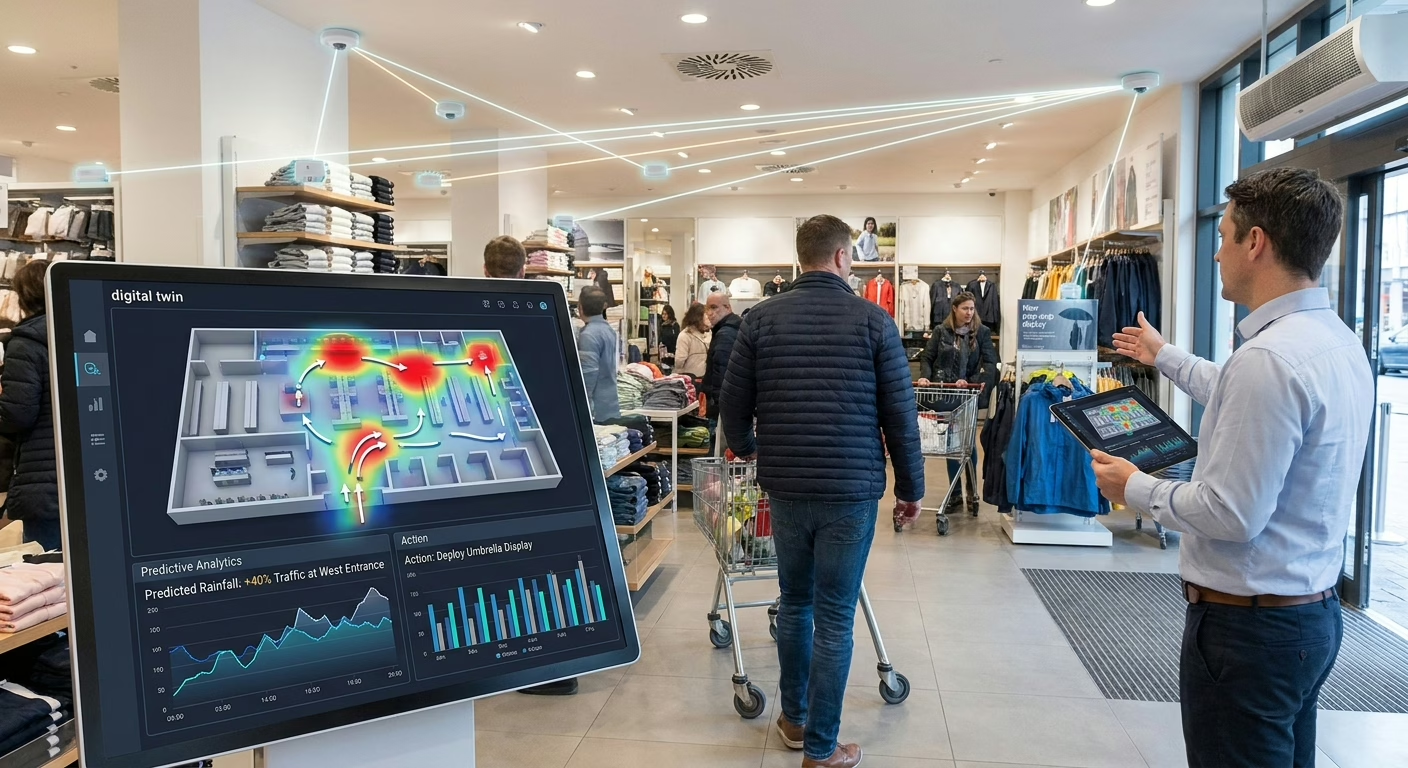
So, how do we do it? You have to give the space senses. To make intelligent decisions, we first need to understand what’s happening. This is where we build what’s called a “digital twin” of the store. Think of it as a real-time, data-driven blueprint of your entire operation. It’s a living model that mirrors the pulse of your store.
My process for this is always a layered approach. You can’t rely on just one source of data. Here’s how we build the full picture:
- Anonymized Video Analytics: First things first, let me be crystal clear. I’m not talking about facial recognition or anything that feels like Big Brother. That’s an ethical and legal nightmare waiting to happen. We’re talking about using cameras to generate anonymous heatmaps—seeing where people congregate, which aisles are ghost towns, and where the bottlenecks form.
- Wi-Fi and Bluetooth Signals: Next, we tap into the ambient signals from shoppers’ devices to understand the general flow. This gives us the major currents of movement—how people travel from the entrance to the back, which paths are most common, and how long they tend to dwell in certain zones.
- IoT Shelf Sensors: This is critical. It’s completely pointless to know where your customers are if you don’t know what’s actually on the shelves. Smart sensors can tell you when a product is running low or, worse, completely out of stock, allowing you to react before a customer is met with a disappointing empty space.
Again, this isn’t about tracking you, the individual shopper. It’s about understanding the aggregate behavior of the crowd to create a living, breathing model of your store’s daily life.
Step 2: From Seeing the Present to Predicting the Future
Once you have that digital twin, the real fun begins. This is where we move from simply reacting to what’s happening to actively predicting what’s about to happen. A store shouldn’t exist in a vacuum, so its data model shouldn’t either.
What I love to see is a predictive model that ingests not just your own historical sales data, but a whole cocktail of external variables. We feed the system things like weather forecasts, the schedule for the concert venue down the street, local traffic reports, and even public transport disruptions. I had one client, a large urban store, that could never figure out their random Tuesday afternoon rushes. The model we built for them found the culprit: half-price matinees at the local cinema were releasing a flood of potential shoppers right at their doorstep.
The goal isn’t just to get a vague “it might be busy today” forecast. The goal is to know that because of a predicted downpour at 3 PM, the west entrance will see a 40% traffic increase, and you need to staff up the nearby registers before the rush hits. It’s about turning data into a specific, actionable directive for your store manager.
Step 3: Let AI Be Your Genius Store Designer
Alright, so we’re predicting foot traffic. Now, let’s get really innovative. Forget just looking at heatmaps—frankly, that’s just a colorful way of stating the obvious. We can now use generative AI to actually design the store’s layout for maximum impact.
Let me paint a vivid picture for you. Imagine the AI playing a video game with your floor plan. It runs thousands, even millions, of virtual simulations, trying every possible combination to find the optimal placement for promotions, your high-margin products, and the everyday essentials. It’s designing for both profit and customer flow.
Sometimes, the AI might suggest something that feels completely wrong to a seasoned retailer. For example, moving a high-demand item away from its “traditional” spot. Why on earth would it do that? Because the simulation shows that this non-intuitive move breaks up a common bottleneck near the checkout and subtly guides shoppers past a new product line, boosting discovery and ultimately adding more to the basket. It’s about letting data challenge our assumptions.
A Real-World Win: Turning Chaos into Opportunity
Let’s make this real. I worked with a legacy department store that was constantly getting caught flat-footed. They’d staff based on last year’s data, so an unexpected rainstorm on a quiet Tuesday meant pure chaos. Customers were miserable, staff were stressed, and sales were lost. It was a mess.
After we implemented their new AI system, it flagged an updated weather forecast: a severe downpour was set to hit right at lunchtime. But it didn’t just send a vague warning. It alerted the manager with a specific, two-part plan:
- Reallocate Staff: Move two associates from the quiet garden section to the main entrance immediately.
- Capitalize on the Moment: Create a pop-up display of umbrellas and raincoats in the front power aisle before the rain starts.
The result? Instead of a chaotic rush of damp, grumpy customers, they had their most profitable Tuesday of the quarter. That’s the difference. That’s not just managing traffic; it’s actively capitalizing on it.
The Unbreakable Rules: Privacy and Soul
Now, we have to talk about the guardrails, because this can go wrong, fast. My unbreakable rule is this: the moment you cross the line from tracking anonymous blobs of people to tracking individuals, you have failed. Privacy is non-negotiable. What I insist on seeing is clear signage explaining what data is being gathered and why, in plain, simple English. No customer should ever feel like they’re being spied on.
Then there’s the risk of over-optimization. If you let an algorithm design everything, every store starts to feel the same: sterile, predictable, and completely devoid of character. It becomes a spreadsheet you can walk through. This is why the “human-in-the-loop” approach is essential. The AI is your brilliant analyst, not your creative director. A great system proposes three data-backed options, and a manager makes the final, brand-aligned decision. The machine provides the intelligence; the human provides the soul.
Putting It All Together
So let’s pull this all together. The biggest takeaway here is that physical retail no longer has to operate on gut feel and last year’s sales reports. When a business stops guessing and starts knowing, everything changes. AI allows your stores to become as data-rich and adaptable as any e-commerce site out there.
You use it to predict traffic. You use it to generate smarter layouts. And the result is a powerful one-two punch: massive gains in operational efficiency and a customer experience that feels intuitive, respectful, and genuinely helpful. The best part? For the shopper, all this complexity is invisible. The store just works better.
Deploying a brilliant solution like this is fantastic, but how do you scale that intelligence across an entire organization? That’s a whole different beast.
We’ll tackle that very question in our next episode, where we’ll explore “Creating an AI Center of Excellence (CoE).” We’ll break down how to build the team, the strategy, and the culture to make AI a core part of your company’s DNA.
Thanks so much for reading. As always, I love hearing from you, so drop your questions and comments below. See you next time!