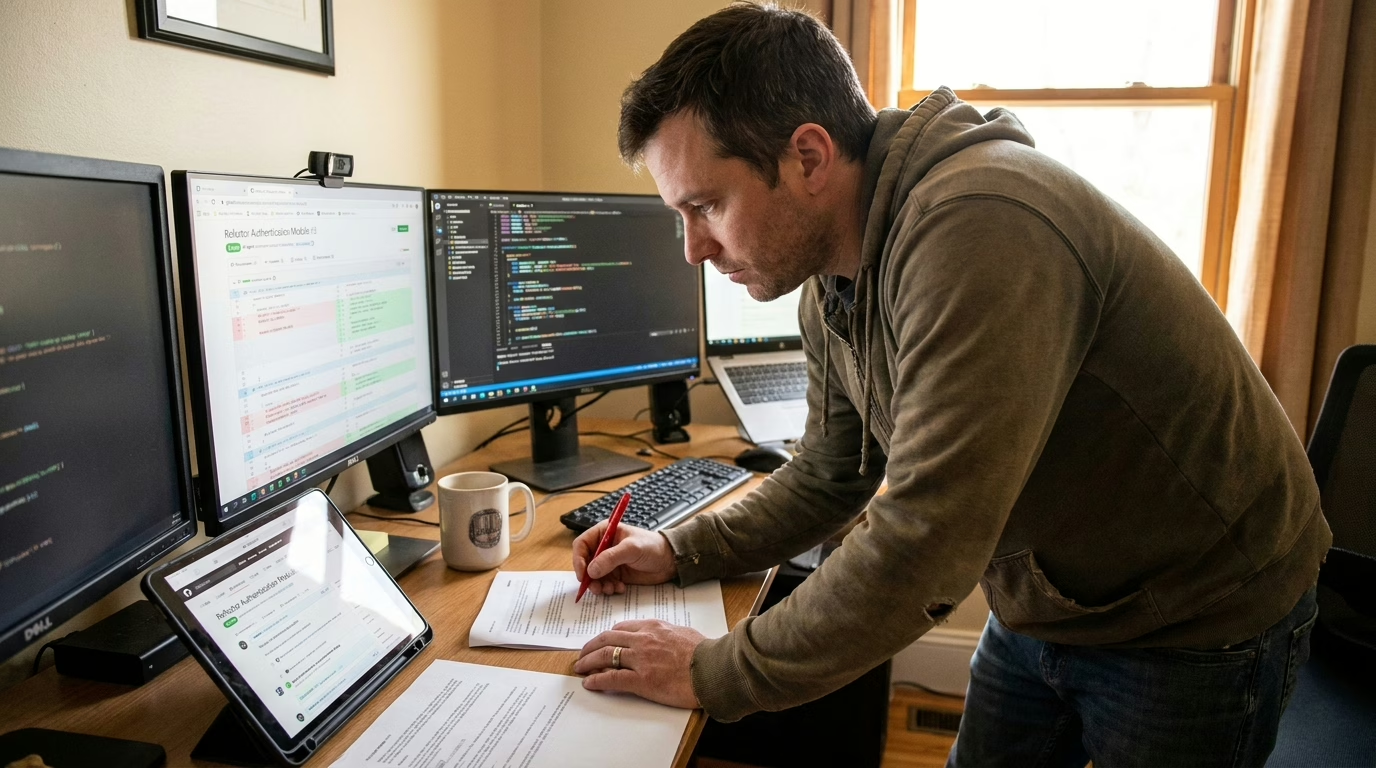
Here is the scenario: A pull request pings your notification tray. The description is pristine. The tests are green. The code is clean. Did your colleague pull an all-nighter? Did a secret weapon finally join the org? Or did your AI coding agent just finish its shift while you were buying coffee? More often than not, you open the diff, and you realize the digital ghost in the machine wrote the code. But here’s the twist: the ghost can’t merge the PR. You can.
Research from Rochester Institute of Technology by Maliha Noushin Raida and Daqing Hou has dissected 25,264 agentic pull requests, and the verdict is in. AI coding agents are the digital equivalent of a hyper-caffeinated intern who writes the entire report but still expects you to be the one holding the red pen and the “I take full responsibility” stamp. And guess who’s wielding the stamp? Usually, just you.
I recall a late night a few months back, wrestling with a stubborn bug in a personal project. I prompted the agent, watched it spin up a solution, and merged it. I felt like a cybernetic wizard conducting an orchestra of silicon. Then, three hours later, the build failed because the agent had hallucinated a library dependency that didn’t exist. I wasn’t a wizard; I was a glorified spell-checker for a robot with a vocabulary problem. We’ve all been there—that moment where you realize the “automation” is just a faster way to create work for your future self.
The data backs up this solo dance. In the study covering May through July 2025, a whopping 78.9% of agentic PRs passed through the hands of a single developer. Small teams are the undisputed champions here. Repositories with one to five contributors averaged 50.2 agentic PRs per quarter, driven by a few power users pushing the limits. Meanwhile, the median project sees only one or two agentic PRs in three months. The AI turns up, says its piece, and goes quiet.
What’s fascinating is how rigid the workflow remains. Raida noted that even among small teams clearing more than 30 agentic PRs, the majority stuck to the single-reviewer routine. The agent scales up output, but the review desk stays one person wide. This makes sense; code review already eats a chunk of the workweek, and every line of agent-generated code still demands human judgment. The bottleneck isn’t writing code anymore; it’s trusting it.
Interestingly, solo reviews and group reviews merge at nearly identical rates (81.2% vs 80.3%). However, the flavor differs: solo maintainers use agents to build new features, while multi-human groups tend to deploy agents for fixes. It seems we trust the robot to help us fix what’s broken in a crowd, but we go solo when we want to build something new.
The era of the AI coding agent isn’t about replacing the team; it’s about empowering the lone ranger. Small teams are leveraging agents to punch above their weight, but until we figure out how to distribute the review burden, the one-person review desk remains the ceiling. So, keep your red pen handy. The intern might write the code, but you’re still the boss.