Nov 22, 2026
Every few months someone announces that RAG is dead. Context windows are a million tokens now. Agents can search for themselves. Just stuff the whole knowledge base in and let the model sort it out.
Lovely idea. Try it on 40,000 policy documents and a cost-per-conversation target, then get back to me.
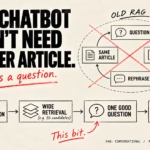
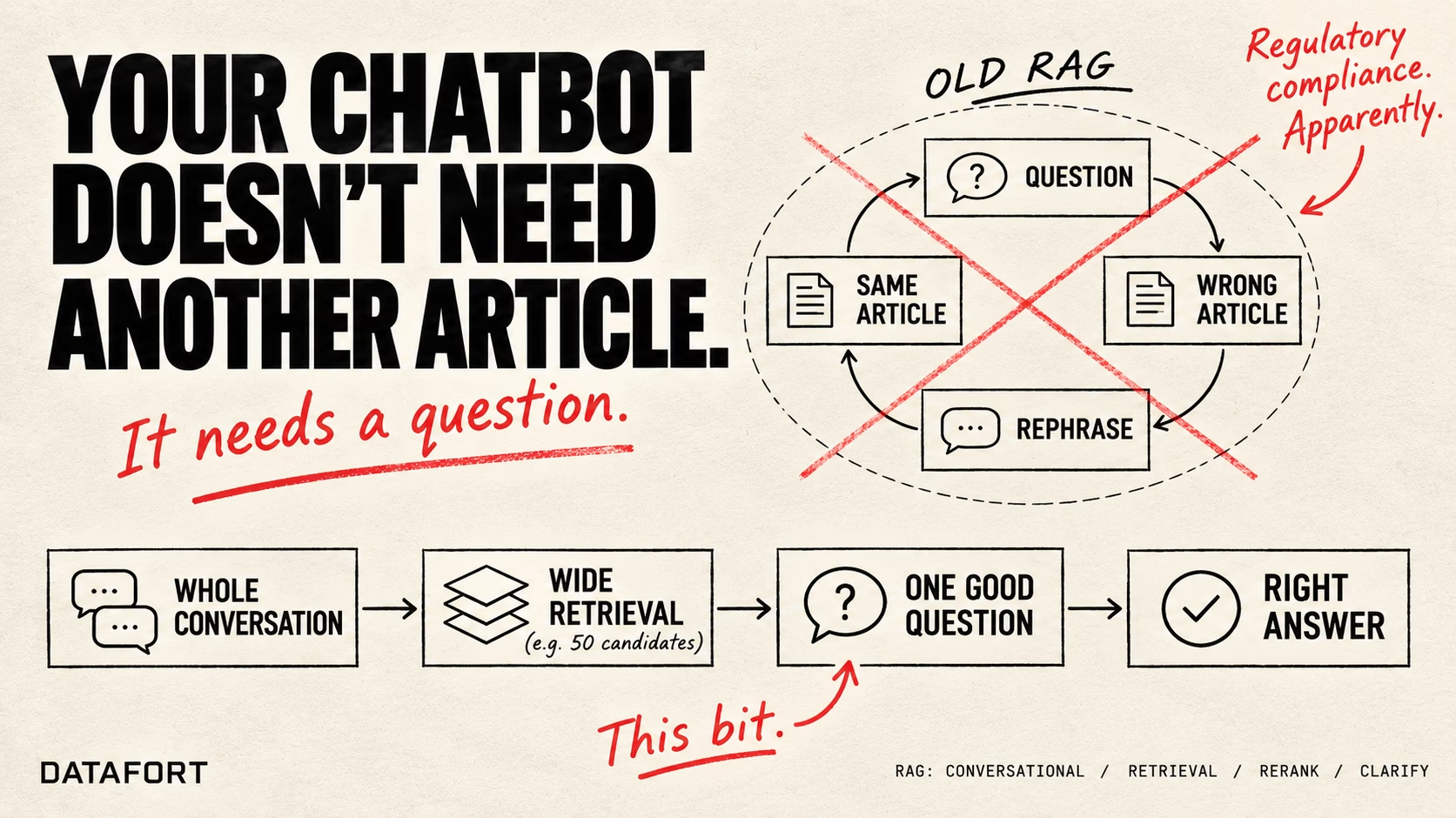
Retrieval-augmented generation isn’t dead. It’s grown up. What should be dead is the version most people have actually met: the support bot. You know the one. You ask a perfectly clear question. It replies with an article about something adjacent. You rephrase. It replies with the same article, more confidently. You type “speak to a human”. It asks whether you’d like to read an article. Twenty minutes later you’re on hold anyway, now in a worse mood and with less battery.
That bot isn’t a failure of AI. It’s a failure of design. And the gap between it and what’s now possible is enormous.
How RAG grew up
The idea is older than most people think. Lewis and colleagues at Facebook AI named it in 2020: pair a language model with a searchable index so it can look things up rather than rely on what it memorised in training. Sensible. Then everyone implemented it the same way, and that’s where the trouble started.
Generation one: naive top-k. Chop documents into chunks. Embed each chunk as a vector. When a question arrives, embed that too, grab the five nearest chunks, paste them into the prompt, and hope. It works brilliantly in demos, because demo questions are written by people who’ve read the documents. Real customers haven’t. They say “my card thing isn’t working”, which is semantically close to roughly half your knowledge base.
Generation two: hybrid search and reranking. People noticed vectors are rubbish at exact terms: product codes, error numbers, the name of a specific fee. So keyword search (BM25, the workhorse of 1990s search engines) came back alongside vectors, with a reranking model to sort the combined results. Anthropic’s write-up on its “contextual retrieval” approach is a good illustration. Adding context to chunks and combining embeddings with BM25 cut failed retrievals by 49%. Add a reranker and it was 67%. Not glamorous. Very effective.
Generation three: conversational. Retrieval stopped treating every message as a fresh question and started using the conversation. More on that shortly, because it’s where most bots still fall over.
Generation four: agentic. The model decides when to search, what to search for, whether the results are any good, and whether to search again. Retrieval becomes a tool the model uses, not a step bolted on the front.
And no, big context windows didn’t kill any of this. Research on long contexts (“Lost in the Middle”, Liu et al.) found models are noticeably worse at using information buried in the middle of a long prompt than at the start or end. Dumping everything in costs more and often works worse. Choosing what to show the model is still the whole game.
“Regulatory compliance”, apparently
Banks are the worst offenders. Not occasionally. Consistently. And it isn’t just my opinion. In 2023 the US Consumer Financial Protection Bureau published a report on chatbots in consumer finance. It found that around 37% of the US population had used a bank’s chatbot in 2022, and described customers getting trapped in “doom loops” of repetitive, unhelpful answers with no way through to a human. That’s the regulator’s phrase, not mine. I just wish I’d thought of it.
Ask the IT Director why their bot behaves like this and you’ll usually hear two words: regulatory compliance. We can’t let it say anything that isn’t pre-approved. We can’t risk it giving advice. Hence the loop.
Bunkum. It’s laziness with a compliance badge pinned on.
Here’s the awkward bit for anyone using that line in the UK. The FCA’s Consumer Duty, in force since July 2023, includes a consumer support outcome. Firms must make sure customers “do not face unreasonable barriers when they need to access support”. A bot that walks you round the same three articles until you give up is pretty much the definition of an unreasonable barrier. The CFPB was equally blunt: chatbots must comply with consumer financial law, and firms may be liable when they don’t. The doom loop isn’t the compliant option. It may well be the non-compliant one.
There is one real constraint, to be fair. Banks have to keep a clear line between regulated advice and general guidance. That limits what a bot can recommend. It doesn’t stop the bot understanding the question. Every technique in the rest of this article works entirely on the understanding side. You can keep every answer pre-approved, word for word, and still get the customer to the right one in two exchanges instead of twenty.
Step one: the whole conversation is the query
The single most common failure in old-style bots is embarrassingly simple. They search on the last message only.
Customer: “I’ve been charged twice for my hotel in Lisbon.” Bot retrieves articles about duplicate card payments. Fine. Customer: “It was booked through your travel portal, not on my card.” Bot embeds that sentence on its own, finds an article about the travel portal’s opening hours, and confidently explains the opening hours. The customer’s opinion of your brand drops a couple of notches. Possibly more.
The fix is to build the retrieval query from the conversation, not the latest line:
- Rewrite before you retrieve. A small, fast model turns the conversation so far into a standalone query: “duplicate charge on a hotel booking made through the travel portal”. That’s what gets searched.
- Carry facts as filters, not just words. Once the customer has said “travel portal”, that isn’t a search term any more. It’s a constraint. Apply it as a metadata filter so portal articles stay in and card-dispute articles drop out.
- Use what you already know. If they’re logged in, you know which products they hold, which channel they’re on, and what they did in the last ten minutes. Filter on it before asking anything. Asking a customer something your own systems could have told you is just a more polite way of wasting their time.
That alone fixes a surprising share of the loop. But it still assumes the system can work out the right answer from what the customer happened to say. Often it can’t, because the customer hasn’t said the thing that matters. Which brings us to the interesting part.
Widen, then narrow
Traditional RAG tunes retrieval to be tight. Few results, high similarity, answer immediately. The thinking is that fewer, closer matches mean less noise.
In our implementations we do the opposite. We widen the net on purpose.
Instead of the five nearest chunks we pull back something like fifty, using a wider similarity range and hybrid keyword-plus-vector search, then rerank. That set will include the right answer far more often. It will also include a lot of plausible wrong ones. In a traditional bot that’s a disaster: the model picks one, presents it with total confidence, and if it’s wrong you’re back in the loop.
But a broad candidate set is only a problem if your plan is to answer straight away. Ours isn’t. Our plan is to ask.
Think about what a good human agent does. They don’t recite the first policy that springs to mind and wait to see if you look happy. They ask one or two sharp questions. “Was this a one-off payment or a recurring one?” “Did it go through the app or online banking?” Each question rules out most of the possibilities, and within a couple of exchanges they’re looking at the right page. That’s what the wide candidate set enables. Because the system can see all the plausible answers at once, it can work out exactly which question tells them apart.
This isn’t a new instinct, by the way. A 2019 study by Aliannejadi and colleagues on clarifying questions in conversational search found that, in an idealised setting, asking a single good clarifying question improved the precision of the top result by more than 170%. Real systems won’t hit that ceiling. But it tells you where the value is hiding.
Choosing the questions: twenty questions, minus seventeen
The clever part isn’t asking questions. Any bot can ask questions. Bad bots ask lots of them. The clever part is asking the fewest questions that get you to the answer.
Here’s how it works under the bonnet.
- Describe the candidates. A small, cheap model tags each of the fifty candidates with the attributes that matter: product, channel, customer type, one-off or recurring, before or after a date, and so on. Often that metadata already exists. Sometimes you extract it once, at indexing time, and store it.
- Score every possible question. For each attribute, ask: if the customer told us this, how much of the candidate set would it rule out? A question that splits fifty candidates into two groups of twenty-five is gold. A question where forty-eight candidates share the same answer is useless. Formally, you’re picking the question with the highest expected information gain, weighting each candidate by how relevant the reranker thinks it is, so you don’t waste a question splitting off things that were never likely.
- Split on the answers, not the documents. This is the bit most people miss. If twelve candidates remain but all twelve lead to the same resolution, stop asking. You’re done. Only ask questions that change what you’d actually tell the customer.
- Ask, update, repeat, with a strict limit. Apply the customer’s reply as a filter, rescore, and pick the next question. Two questions is typical, three is the ceiling. After that, answer with the best match and say what you’ve assumed, or hand over to a human with the full context. No customer should ever have to repeat themselves.
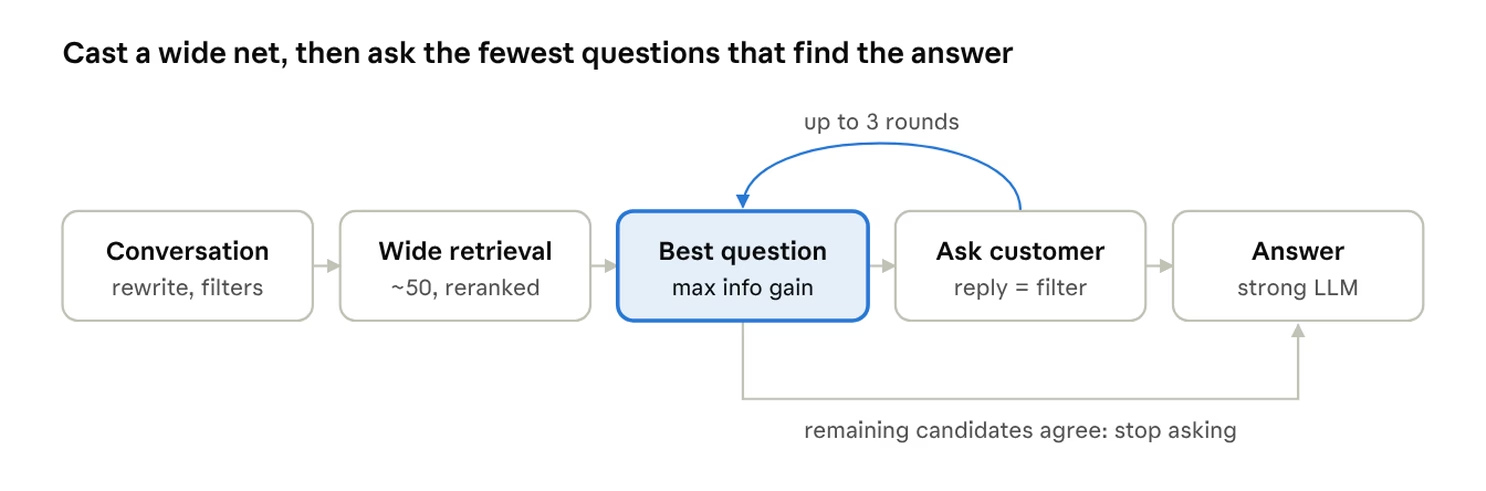
widen-then-narrow retrieval · the question loop
Why greedy, one question at a time? Because finding the mathematically optimal sequence of questions is a known hard problem. Building a minimal decision tree was proved NP-complete back in 1976 (Hyafil and Rivest). The greedy approach, always picking the question that splits the remaining set most evenly, is provably close to optimal. Dasgupta’s 2004 analysis put it within a logarithmic factor of the best possible strategy. In plain English: it’s very nearly as good as perfect, and it runs in milliseconds.
Three practical rules keep it human:
- Soft, not hard. “I’m not sure” or “a bit of both” shouldn’t delete candidates. It should down-weight them.
- Only ask what a customer can answer. “Is this a Section 75 claim?” is a question for the bank, not the customer. “Did you pay more than £100 by credit card?” is the same question in human.
- Never ask what you could have looked up. See above.
Then the expensive model earns its keep. A capable LLM takes the chosen attribute and turns it into a natural question, holds the thread of the whole conversation, and, once the set is narrow enough, writes the final answer from the right source material, in the customer’s terms. Cheap models do the sorting. The clever model does the talking. Your cost per conversation stays sensible and the customer feels like they spoke to someone who was listening.
Answers are cheap. Questions are the product.
The old RAG bot had one move. Guess, and see if the customer complains. Every time it guessed wrong it guessed again, and the customer did all the work of steering.
The modern version flips that. Read the whole conversation. Cast a wide net. Work out which question splits the possibilities. Ask it in plain English. Two exchanges later, give one answer that’s actually right. Same knowledge base. Same approved content. Dramatically different experience.
So is RAG still relevant in the age of agents? Obviously. Agents need to know things, and your business’s knowledge doesn’t live in a model’s training data. What’s changed is that retrieval stopped being a lookup and became a conversation.
If your bot still can’t manage that, it isn’t the regulator’s fault.
References
- Lewis et al., Retrieval-Augmented Generation for Knowledge-Intensive NLP Tasks, NeurIPS 2020
- Anthropic, Introducing Contextual Retrieval, September 2024
- Liu et al., Lost in the Middle: How Language Models Use Long Contexts, TACL
- Consumer Financial Protection Bureau, Chatbots in consumer finance, June 2023
- Financial Conduct Authority, Consumer Duty and PS22/9: A new Consumer Duty
- Aliannejadi et al., Asking Clarifying Questions in Open-Domain Information-Seeking Conversations, SIGIR 2019
- Hyafil and Rivest, Constructing optimal binary decision trees is NP-complete, Information Processing Letters, 1976
- Dasgupta, Analysis of a greedy active learning strategy, NIPS 2004