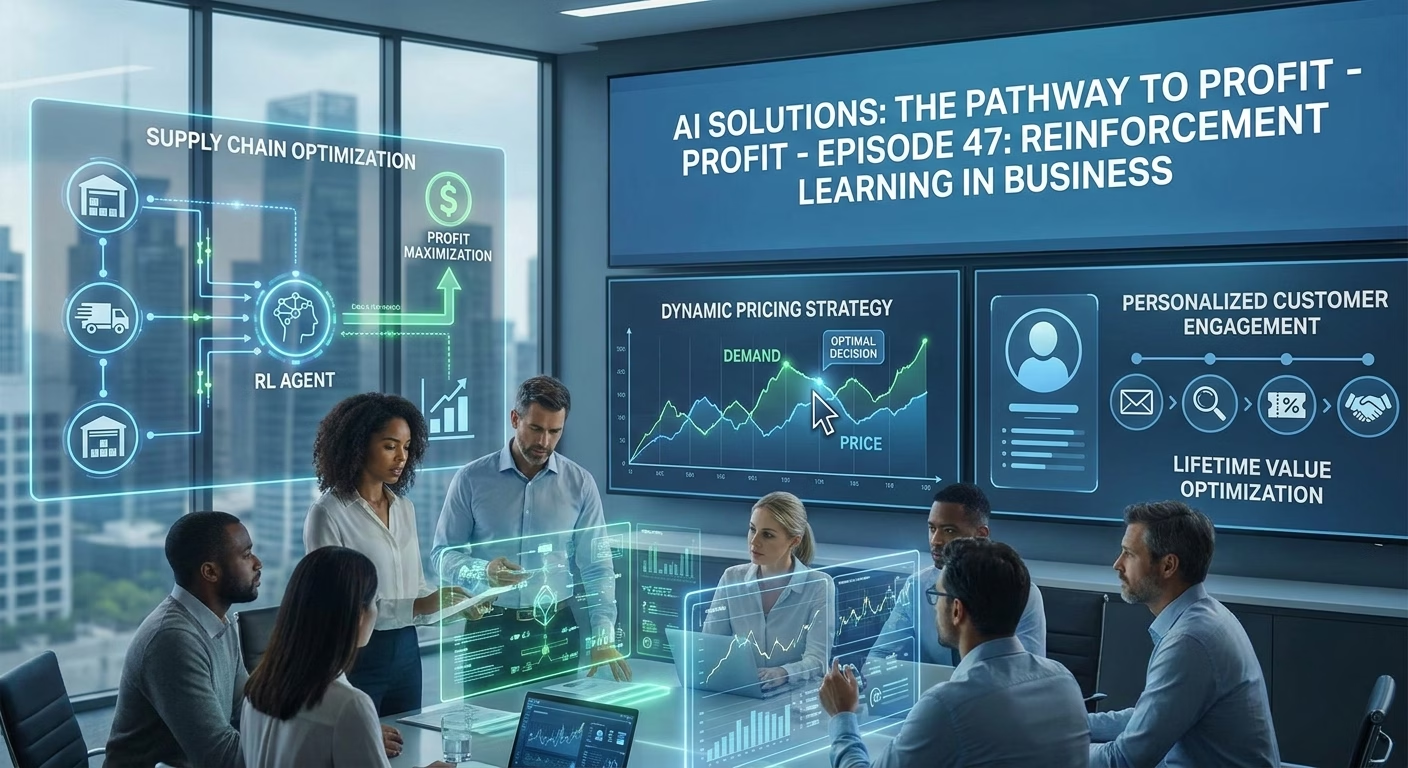
Hello and welcome back to AI Solutions: The Pathway to Profit! It’s great to have you here with me again.
Today, we’re diving into a topic that often feels a little bit like science fiction: Reinforcement Learning (RL). Now, when I say that term, what comes to mind? For many of us, our minds immediately jump to a specific place. We picture a supercomputer like DeepMind’s AlphaGo defeating a world champion, or maybe a complex robotic arm learning to assemble a product with uncanny precision.
And while those achievements are absolutely remarkable, they can make the technology feel… distant. Unattainable. What I want to do today is bring Reinforcement Learning down to earth. I want to show you how this powerful branch of AI is actively, and often quietly, optimizing business processes, shaping strategies, and driving real-world profit, right now.
What Is Reinforcement Learning, Really?
So, what is this all about at its core? The way I love to explain it is to imagine we’ve just hired a brand-new, completely fresh digital sales trainee. It’s an AI agent, and we put it in charge of a single online ad campaign.
That campaign… that’s its entire world, its environment.
Now, here’s the key: we don’t hand it a thick instruction manual detailing every rule of marketing. Instead, we give it a set of tools—its actions. It can try different ad creatives, adjust the audience targeting, change the call-to-action button, or tweak the daily budget. For every single choice it makes, it observes the result:
- A user clicking the ad is a small, positive reward.
- A completed sale is a much bigger reward.
- Wasted budget with zero engagement… well, that’s powerful feedback, too.
Through this continuous cycle of trial, error, and feedback, the system learns. It’s not just about finding one good ad that works today. It’s about discovering the optimal strategy over time to maximize the total reward—the ultimate return on investment. It learns the rules of success for itself, rather than just being told them.
That’s the magic. Now, let’s see how it works in the real world.
Application #1: The Art of Dynamic Pricing
Let’s take that idea of learning and apply it to a core business function: pricing. For a long time, what I would see in most businesses are pricing strategies built on static, human-defined rules. You have your simple cost-plus model, or maybe some preset seasonal adjustments. It’s predictable, sure, but it’s also incredibly rigid. It’s leaving money on the table.
A Reinforcement Learning agent, on the other hand, sees pricing as a dynamic, ever-changing puzzle. It’s constantly observing the environment: watching customer demand fluctuate in real-time, tracking competitor prices as they change, and monitoring your own inventory levels.
Think about the last time you booked an airline ticket or a hotel room. The price you saw wasn’t an accident; it was a strategic decision made by an algorithm in that exact moment. The system is constantly asking itself questions: If I lower the price right now, will I sell more units and maximize today’s revenue? Or should I hold the price firm, anticipating a surge in last-minute demand in the next hour?
Each choice is an action, and the resulting profit is the reward. Over millions of such decisions, it learns a pricing policy that is far more nuanced, responsive, and ultimately more profitable than any human-written rulebook could ever hope to be.
Application #2: Taming the Supply Chain Beast
Now, let’s zoom out from a single price to something vastly more complex: your entire supply chain. I’ve seen so many companies struggle with inventory. It’s this constant, painful balancing act. If you hold too much stock, your capital is tied up, and warehousing costs eat away at your margins. But if you hold too little, you risk a stockout, losing a sale and, even worse, damaging precious customer trust.
This is where RL shines. An RL agent views this not as a static problem to be solved once a quarter, but as a continuous sequence of decisions to be made every single day. For every single product in your catalog, it learns to ask: Based on current demand, the predicted forecast, the supplier’s lead time, and even the season… should I reorder now? And if so, how much?
It learns the optimal reordering policy over time, one that minimizes total costs across the whole network. The result? It ensures products are exactly where they need to be, right when they’re needed, almost like magic.
Application #3: From Checkers to Chess in Customer Engagement
We can take this same concept of smart, sequential decisions and apply it to the customer relationship itself. So many recommendation engines I see are pretty simple. They look at a single action—you watched a movie, so you might like this other one—and try to predict the very next one. Frankly, they’re playing checkers.
What I want you to start thinking about is a system that plays chess.
Reinforcement Learning treats the entire customer journey as a strategic game. For each individual user, it asks: What is the right sequence of actions to build a lasting, valuable relationship? Should I show this person a social media ad today? Perhaps send a follow-up email in three days with genuinely useful content? Or maybe… the best move is to do nothing at all for a week, and then present a small, personalized discount.
The system learns which sequence, for which type of person, maximizes not just the next click, but their total lifetime value. It’s a profound shift in thinking: from optimizing short-term transactions to cultivating long-term value.
The Catch: Common Pitfalls on the Path to RL
This all sounds incredibly powerful, and believe me, it is. But my job is also to give you the full picture, and the path to implementing RL has its challenges. Here are the three big ones I see most often:
- These Systems are Data-Hungry: An agent needs to experience an immense volume of cause-and-effect scenarios to truly learn the dynamics of a complex environment. It learns from experience, and it needs a lot of it.
- The Reward Function is Everything: This is the most critical part, and where many projects go wrong. You have to define the agent’s goal—its reward—perfectly. If you tell an agent to maximize user engagement on your website, you might get just that… tons of clicks, but not necessarily a single dollar more in profit. My unbreakable rule is this: your reward function must be a true and direct proxy for the ultimate business value you want to achieve.
- The Explore vs. Exploit Dilemma: This is a fundamental tension you have to manage. An agent needs to exploit what it already knows works to get guaranteed rewards. But it also must explore—try risky, new, and sometimes weird ideas—to find a potential breakthrough strategy. That exploration can mean sacrificing guaranteed short-term performance for the chance at a much bigger long-term win.
The Solution: Learning Safely in a Digital Playground
So how do we solve this? How can we allow an agent to explore, to make mistakes, and to learn from them without risking the business itself?
What I find to be the most elegant and effective approach is to give it a safe place to learn. We build a simulation—a “digital twin” of your entire operation.
Let me paint a vivid picture: imagine a perfect, virtual replica of your marketplace, your e-commerce store, or your supply chain. Inside this digital world, the agent is free to experiment. It can try millions of different pricing strategies, some of them radical, and learn from every outcome—good or bad—with absolutely zero real-world financial risk. It can fail a thousand times a second, and each failure is just another lesson learned.
Once it has mastered this simulated environment and we see it has found a truly optimal policy, only then do we carefully deploy that learned strategy into the live system, armed with a much, much higher degree of confidence.
Tying It All Together
What I hope you’re seeing today is that Reinforcement Learning isn’t some far-off concept confined to a research lab. It’s a profoundly practical tool for mastering the art of sequential decision-making.
We’ve seen how this applies to finding the perfect price, to optimizing an entire logistics network, and to building deeper, more valuable customer relationships. But you’ll find that all of these powerful systems, especially agents that learn from experience, share a common foundation. They all thrive on data. The more they see, the better they perform.
This leads us to a crucial question… if success depends on data, how do successful AI projects generate even more of it, creating a virtuous cycle of improvement?
We’ll explore exactly that in our next episode.
That’s all for this episode! Thank you for joining me. Next time, we’ll be tackling a concept I’m incredibly excited about in an episode titled, “Building a ‘Data Flywheel’: How AI Success Breeds More Data and Better Models.”
Have you seen Reinforcement Learning in action in your industry? I’d love to hear about it in the comments below!
Until next time, keep learning.