· @Gavin
Something odd has happened over the last couple of months. The people building AI have started asking for it to slow down.
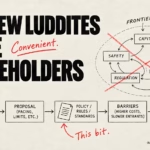
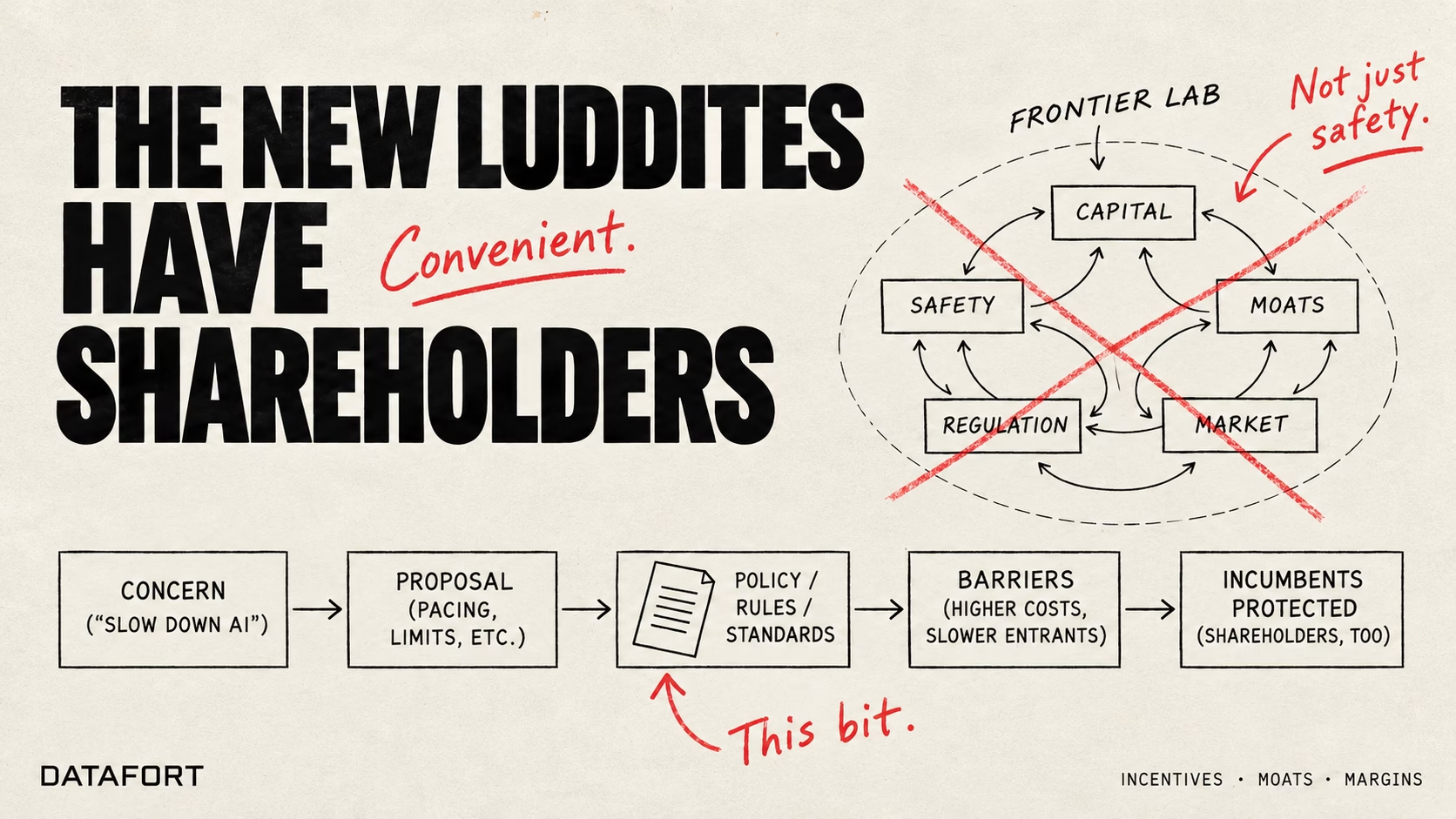
Not the usual suspects, either. In September, Anthropic’s Dario Amodei published an essay called “We Must Pace the Frontier”, arguing the industry should slow the rate at which model capabilities improve. Demis Hassabis and Elon Musk made approving noises. Sam Altman signed up to part of it. Within a fortnight, Bernie Sanders and Greg Casar had introduced a bill to ban artificial superintelligence outright. Add the usual chorus of commentators, a few tech founders and an awful lot of very worried LinkedIn posts, and you’ve got what I’m going to call the New Luddite movement.
Now, I’m sure everyone involved means well. Mostly. But spend a little time on who’s asking, and why, and a pattern emerges. It isn’t altruism. It’s incentives. Let’s go through them.
The frontier labs: please slow down. All of you. At the same time.
Read the small print in any pacing proposal and you’ll find the same clause. It has to apply to everyone. A lab that slows down alone just hands the market to whoever doesn’t. A lab that slows down alongside its rivals gets something far more useful. Two things, in fact.
Capital. Frontier AI is the most capital-hungry business anyone has ever invented. Anthropic’s IPO paperwork, made public last week, shows revenue of $16.3bn for the first half of 2026, up from $1.2bn a year earlier. Impressive. It also shows more than $600bn of compute commitments with cloud providers over the next decade. OpenAI has reportedly forecast $121bn of compute spend in 2028 alone. If every rival agrees to train less aggressively, the arms race gets cheaper for everybody. Smaller training runs. Better cash flow. Calmer investors.
There’s a technical wrinkle here, and it’s an awkward one for the cost-cutting theory. Much of that compute is already contracted, and reportedly payable whether it’s used or not. Inference (running the models for paying customers) reportedly eats more than half of revenue at both firms. Pacing capability gains doesn’t make either of those go away. What it does do is stop each new training run being a bet-the-company event. Less “save money”, more “stop the bill growing faster than the revenue”.
Open source. The second threat is quieter and more dangerous. Open-weight models, many of them from Chinese labs, now trail the frontier by months rather than years, and cost a fraction as much to run. If you’re charging premium prices for a closed model, that’s a problem. To be fair, none of the current proposals bans open weights. But shared safety standards, embedded evaluators and developer liability all share one side effect. They’re expensive to comply with. Fine if you’re worth a trillion dollars. Fatal if you’re twelve people releasing weights on Hugging Face. Regulation as a moat. A classic.
How classic? Try 1833. Britain’s Factory Act of that year limited how long children could work in textile mills, and it was a genuine humanitarian win. Reformers like Richard Oastler and Lord Ashley had campaigned for years to get it. But in 1977 the economist Howard Marvel looked at who actually benefited, and found the Act suited the big steam-powered mill owners rather well. Steam engines ran on a steady schedule. Their smaller rivals ran on water wheels, which stopped in droughts and floods, so they made up lost time by working very long hours, mostly with child labour, whenever the river allowed. Cap the hours and you hobble the water mills. Marvel argued that’s exactly what happened, helped by the political muscle manufacturers gained from the 1832 Reform Act. Historians still argue about how far he’s right. But the shape is familiar. Big incumbent. Noble cause. Rules that cost the competition far more than they cost you.
The software providers: principle, meet business model
Signal makes a useful case study, though not quite in the way it usually gets told. The loud voice there is Meredith Whittaker, Signal’s president, not its founder Moxie Marlinspike. And she isn’t really calling for a slowdown. Her argument is narrower and sharper. To be useful, AI agents need deep, operating-system-level access to your apps, your messages, your browser and your credentials, and that access drives a coach and horses straight through end-to-end encryption. She’s equally scathing about how much power sits with a handful of cloud giants.
On the security point, she’s right. An agent that can read your Signal messages is, functionally, a very helpful man-in-the-middle. But look at whose business model it threatens. Signal’s entire value is that nobody except you and the recipient can read the message. An OS-level assistant makes that promise very hard to keep. So the concern is legitimate. It’s also existential for the product. Both things can be true at once.
Widen the lens and every software company has its own version of this. When one decent developer with a coding agent can rebuild the core of your SaaS product in a fortnight, “AI needs careful oversight” starts to sound suspiciously like “please protect my renewal rate”.
Creatives and developers: the median is in trouble
Two groups with almost nothing in common, except that both are watching their skill base shift under their feet.
There’s a technical reason why some work goes first. A generative model is trained to reproduce the distribution of everything that already exists, and its natural output sits near the middle of that distribution. Competent. Plausible. Average. That’s why AI is brilliant at stock imagery, boilerplate copy, CRUD apps and the forty-third variant of a login page, and noticeably less good at anything new. You can push it away from the mean with good prompting, good taste and a lot of iteration. But someone has to supply the push.
So the work at risk is the work that was already mass-produced. Formulaic content. Template code. The stuff people were quietly embarrassed to invoice for. Meanwhile the truly creative artist and the really good engineer get a force multiplier. One strong developer with decent agents can do what a small team did two years ago. One designer with taste can explore a hundred directions before lunch.
Taste. Judgement. Originality. Those become the scarce inputs, and scarce inputs get paid more. The middle shrinks. The top gets more valuable. That’s uncomfortable if you’re in the middle, and I’m not dismissing it. But “slow down so my average work stays billable” isn’t a moral argument. It’s a pricing one.
The social commentators: “but what about the jobs?”
The biggest and most persistent narrative of the lot. AI takes the jobs, and then what does everyone do?
Will a lot of today’s jobs go? Probably. But we’ve run this experiment before, and the clue is in the name. The original Luddites were skilled textile workers in Nottinghamshire, Yorkshire and Lancashire who smashed machinery between 1811 and 1816. They weren’t anti-technology cranks. They were protesting falling wages and the cheap, shoddy goods the new machines made possible. They lost. And for the handloom weavers who came after them, the following decades were grim, as power looms spread and their wages collapsed.
That’s the honest version, and it matters. Transitions hurt. Some people, often older workers with deep skills in a fading trade, find it far harder to adapt. Pretending otherwise is as daft as pretending the jobs vanish and never come back.
Because they did come back. Different ones. Engineers, clerks, mechanics, teachers, an entire service economy nobody in 1811 could have described. Weaving cotton by hand for fourteen hours a day isn’t a career anyone mourns now. The answer to disruption has never been to stop the machines. It’s been to retrain people, fast, and to share the gains widely enough that the transition doesn’t take a generation. That’s the policy conversation worth having. A pause isn’t it.
And for young people growing up native in this technology? It’s the best opening in decades.
Head, meet sand
Nobody has all the answers. That’s what makes this moment exciting rather than just frightening.
But be sceptical of anyone selling you a slowdown. Ask who pays for it. Ask who profits. Ask whose competitor it hurts. Sometimes the answer really will be safety, and some of the safety concerns are real. More often it’ll be capital, or moats, or margins, wearing a hi-vis jacket.
Don’t let the New Luddites talk you into sticking your head in the sand. It won’t make AI go away. It’ll just mean someone else learns to use it first.
Sources
- Too Big to Pause: Could an AI Slowdown Crash the Economy? (Cointelegraph, 5 Oct 2026): Amodei essay, endorsements, Sanders/Casar bill
- Anthropic’s IPO: a close look at rapid growth, spiralling costs (Reuters, 26 Oct 2026)
- Anthropic’s draft S-1 reveals revenue, losses and compute commitments (Dealroom, 21 Oct 2026)
- An inside look at OpenAI and Anthropic’s finances (OODA Loop, citing WSJ, Apr 2026)
- Howard Marvel, Factory Regulation: A Reinterpretation of Early English Experience (Journal of Law and Economics, 1977)
- Bootleggers, Baptists, and Child Labor (summary of Marvel’s thesis)
- Factory Act (Britannica)
- Signal boss Meredith Whittaker says AI ‘can always be controlled’ (BBC News, Oct 2026)