Hello and welcome back to AI Solutions: The Pathway to Profit! I am so glad you’re joining me today, because we’re about to talk about one of my favorite topics—the one thing that almost every business I see is sitting on, yet completely ignoring.
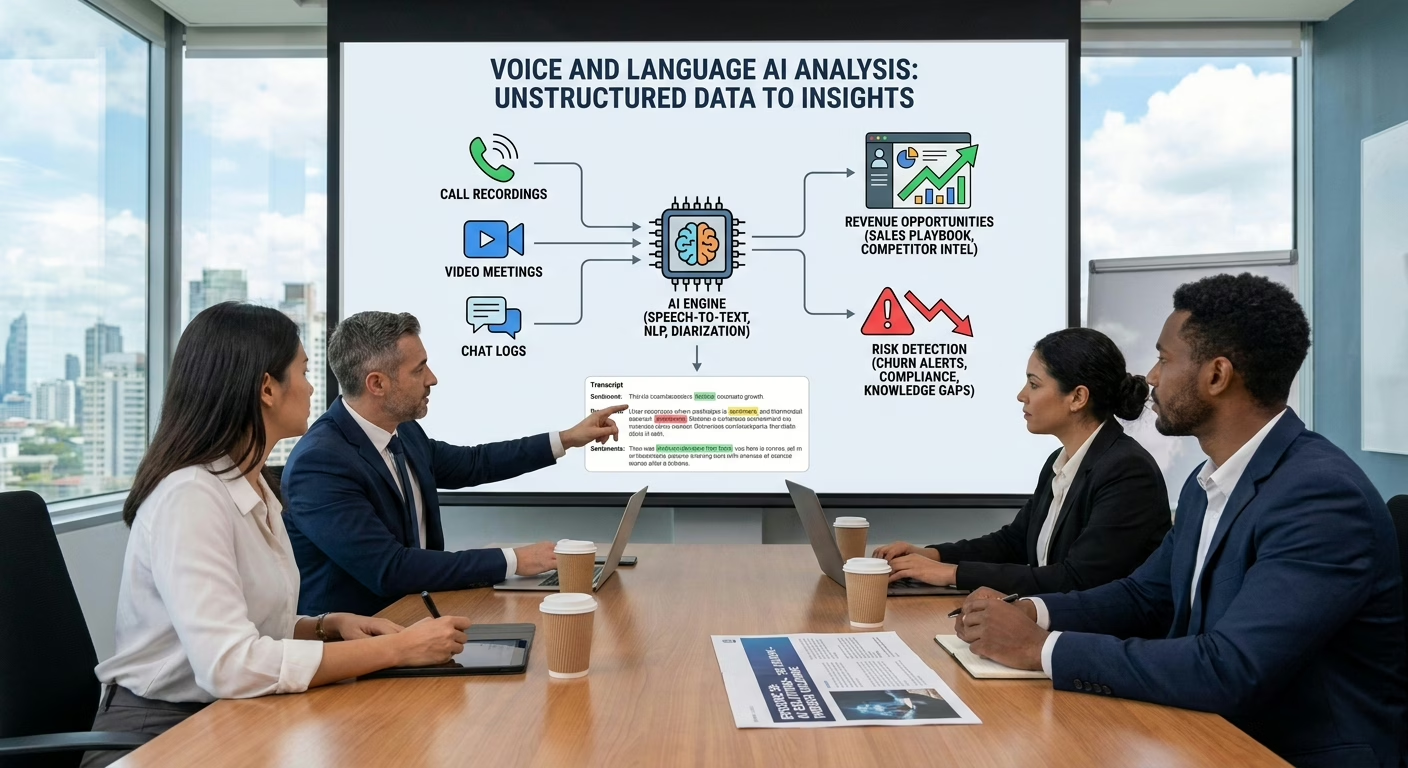
I’m talking about a literal mountain of intelligence. It’s raw, it’s messy, and it’s where the real truth about your business lives. I’m talking about your unstructured conversation data. That means every single call recording from your contact center, every video meeting your sales team has, every internal chat log.
So let’s cut right through the noise with a simple, direct question: What if you could automatically analyze every single one of those conversations to find the hidden revenue opportunities and the risks that are about to cost you a fortune? Today, we’re doing just that. Let’s dive in.
The Hidden Goldmine You’re Ignoring
Frankly, most businesses are getting this wrong. We obsess over structured data—the neat little boxes in our CRM, the post-call surveys, the NPS scores. And look, that data has its place. But it’s the equivalent of a multiple-choice quiz. It tells you what a customer picked from a list of answers you already provided.
It doesn’t capture the deep sigh and the frustration in their voice when they couldn’t find what they really wanted.
The real value, the deep, game-changing insight, is in the candid, messy stuff. It’s the difference between that sterile quiz and a deep, candid interview. Let me paint a vivid picture for you:
- In a sales call recording: You can pinpoint the exact moment a prospect’s tone shifts from curious and interested to skeptical and hesitant.
- In a support call: A customer might casually mention a competitor’s feature they love—that’s unsolicited, priceless product feedback you will never get from a survey.
- In an internal project meeting: A quiet engineer might voice a brilliant solution that gets lost in the shuffle, only to be rediscovered weeks later when it’s too late.
This is where the real story of your business is being told, every single day. My philosophy is simple: you need to be tapping into all of it.
De-mystifying the Tech Stack
Alright, let’s pull back the curtain on the technology. Don’t let consultants or vendors bamboozle you with jargon. At its core, this is a logical, three-step process. Think of it like a translator who not only understands the words but also the emotion and context behind them.
- Speech-to-Text: This is the foundation. It’s the engine that diligently converts all that spoken audio from your calls and meetings into an accurate, written transcript. My unbreakable rule here is that accuracy is non-negotiable. A bad transcript is like a faulty foundation for a house—everything you build on top of it will eventually crumble.
- Natural Language Processing (NLP): This is the brain of the operation, and personally, this is what I find most powerful. NLP doesn’t just read the words; it understands them. It pinpoints customer sentiment—are they frustrated? Delighted? Confused? It automatically tags key topics like “billing issue,” “feature request,” or “competitor mention.” It’s where raw text becomes structured, actionable intelligence.
- Speaker Diarization: This one is critical but often overlooked. It answers the simple, vital question: “Who said what?” Without it, you might know that a pricing objection was raised, but you won’t know if it was the customer asking or your rep proactively bringing it up. It provides the context that separates noise from a meaningful signal.
Text, meaning, and context. That’s the foundation for everything that follows.
Use Case 1: The Proactive Contact Center
Let’s be honest for a second. The way most contact centers handle quality assurance is fundamentally broken. Supervisors randomly sample—what, 2% of calls?—listen in, and check a few boxes. It’s often more security theater than true quality control.
What I love to see is a system that puts AI to work analyzing 100% of interactions. Think about the power of that for a moment.
The AI detects rising frustration in a customer’s voice and automatically flags that call. A manager gets an alert and can intervene that day to save the relationship, not a week later after the customer has already churned and posted a negative review.
Even better, the system notices that fifteen different agents this week struggled to answer questions about your new billing cycle. That’s not an agent performance issue; that’s a knowledge gap. Now you can target that specific issue with a quick, surgical training session for the whole team. This isn’t about creating a “Big Brother” culture; it’s about spotting emerging product issues in real-time and fixing systemic problems before they bleed you dry.
Use Case 2: Sales Intelligence, Redefined
This is where I often see the fastest and most dramatic ROI. For decades, sales coaching has been based on a manager’s gut feeling or a handful of ride-alongs. It’s a complete guessing game, and we just accept it as the way things are.
Now, imagine a system that analyzes every single video sales call to codify what actually works. The AI can show you, with data, that your top performer has a 45/55 talk-to-listen ratio and consistently asks three specific open-ended questions before ever mentioning price. That’s not an anecdote; that’s a playbook.
The system can track prospect engagement, too. You might discover that when your team talks about the new integration feature, positive sentiment spikes by 30%. That’s a data-driven mandate to lead with that feature in every demo. It even flags every time a competitor is mentioned, giving your product marketing team a direct, unfiltered line into the market intel they crave.
This is how you stop coaching based on vague feelings and start building an entire team based on a proven, data-backed recipe for success.
Use Case 3: The Secret Weapon: Your Internal Meetings
Now for an innovative twist—and frankly, this is where the smartest companies are headed. Let’s forget customers for a second and talk about the black hole of your internal meetings. How many hours of valuable discussion, critical decisions, and brilliant ideas just evaporate the second the Zoom call ends?
What I want you to see is a way to turn that liability into your greatest asset.
Imagine your hour-long weekly project sync is automatically processed. Within minutes, you get a five-bullet-point summary delivered to your inbox. Below that is a full, searchable transcript. But here’s the kicker: the AI identifies and lists every single action item—like “David to finalize the Q3 budget numbers by Friday”—and assigns it to the right person.
This isn’t just about saving someone an hour of tedious minute-writing. You’re building an intelligent, searchable knowledge base of your company’s own decisions and expertise, one meeting at a time.
A Few Unbreakable Rules Before You Start
Now, let’s be realistic. This isn’t a magic wand. There are some hurdles to navigate, and my personal rule of thumb is to address them head-on from day one.
- Legal and Compliance First: My first piece of advice, always: get your legal and compliance teams involved from the very beginning. If you’re touching customer data, especially with regulations like GDPR or CCPA, you must have your privacy house in perfect order. It’s a non-starter otherwise.
- Garbage In, Garbage Out: The AI is only as good as the audio it’s fed. You might find that the best investment you can make is upgrading your team’s microphones. This isn’t just a perk; it’s a prerequisite for getting reliable, high-quality data.
- Keep a Human in the Loop: Please, don’t blindly trust the machine, especially at first. What I like to see is a process where your managers and team leads periodically sanity-check the AI’s findings. This not only validates the insights but also helps fine-tune the system over time.
- Transparency is Everything: When you start analyzing internal conversations, you must be transparent with your team. Frame this as a tool for data-driven coaching and knowledge sharing, not surveillance. Be upfront about what you’re analyzing and, more importantly, why. Your goal is to build a smarter, more effective team, not a culture of fear.
Let’s Land the Plane
If you walk away with just one thing today, I want it to be this: the thousands of hours of conversation happening in your business every week are not just noise. They are your single greatest untapped asset.
We’ve talked about how Voice and Language AI is the key to finally unlocking that asset at scale. It can transform your contact center from a reactive cost center into a proactive intelligence hub. It can give your sales team a playbook built on what actually works. And it can even turn your time-consuming internal meetings into a searchable, permanent brain for your entire organization.
It’s a true game-changer, and it’s more accessible than ever before.
Thanks for tuning in! In our next episode, we’re going to shift from analyzing language to creating it. Join me for episode 31, “The Art of the Prompt: A Masterclass for Business Leaders,” where we’ll dive into how you can communicate more effectively with AI to get precisely the results you need.
Until then, keep building. And if you have any questions or “aha!” moments from today’s episode, drop them in the comments below—I read every single one.