
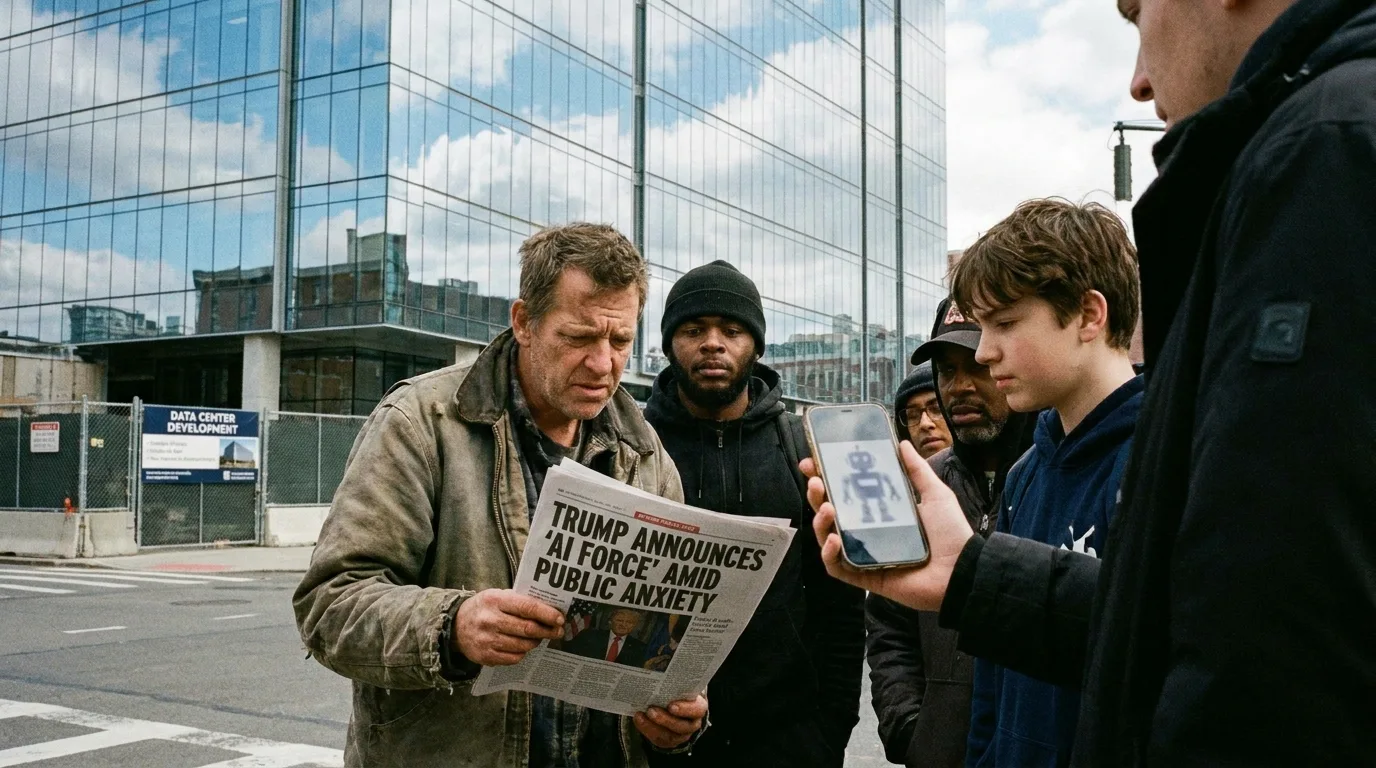
When Donald Trump announced plans for an “AI Force” and a new “AI czar,” the internet collectively raised one eyebrow, the way you do when someone claims they have solved traffic with a magic sandwich. He framed artificial intelligence as the next Industrial Revolution, promising to cherish it, help it, and watch over it, as if tech innovation were a beloved grandchild or a very expensive golden retriever. The details were thin, but the vibes were enormous, complete with comparisons to the Space Force, the branch of the military many of us first encountered through memes and NASA dreams.
I once heard a retired postal worker say that every new technology arrives with two crowds: people who think it will bring abundance, and people who think it will eat the dog. That anecdote felt relevant on Saturday, because while the White House projected confidence, the public projected something closer to a polite scream. Across the United States, concerns about AI are not just dinner-table complaints. They include fears about jobs, deepfakes, autonomous weapons, and the unsettling feeling that the future has arrived without instructions.
My own experience is less heroic: last week, I asked a voice assistant for a family friend’s phone number, and it confidently suggested a sandwich shop instead. Relatable, right? If we cannot reliably summon a pizza place, why is it so shocking that people worry about machines making medical, military, or legal decisions? The humor helps, but the anxiety is real. Trump’s announcement lands as tech executives debate slowing development, Anthropic researchers discuss catastrophic risks, and communities grumble about data centers drinking electricity like a marathon runner after a desert hike.
The president dismissed robot takeover fears as a hoax, declaring the robots are not taking over. He also praised data centers as prestigious places that could bring higher salaries, lower taxes, and safer streets. That is one way to sell a building full of humming servers in a neighborhood worried about noise, power bills, and water. Some conservatives who backed Trump in 2024 are pushing back anyway, which is political shorthand for “I love this country and hate this transformer.” Congress even passed a bill to shield utility bills from AI data center electricity costs, suggesting that even politicians know voters care about bills before they care about breakthroughs.
Still, Trump remains firmly anti-regulatory and pro-growth, viewing AI as a race against China. The new adviser and force are meant to oversee and cheerlead an industry that feels too large for any single committee. Perhaps that is the central irony: the government wants to protect AI by not hindering it, while everyday people want protection from a technology they did not vote into existence.
So we stand at a familiar crossroads, with leaders offering grand metaphors and citizens asking small questions. Will the AI Force be a guardian, a booster club, or a bumper sticker on a runaway truck? Nobody knows. But until the robots stop recommending sandwich shops, I remain cautiously optimistic and terrified.
The AI Force, a Magic Sandwich, and Some Very Nervous Transformers
 Newsletter – Where Does Your Data Go?
 Episode 40: Supercharge Your Sales with AI Lead Scoring
 Build Versus Buy: How AI Is Upending Business Software
 Accountancy Newsletter: So, how did August 7, the first MTD …
 Accountancy Newsletter: So, how did August 7, the first MTD …
 Inside the AI Research Kitchen When Coding Agents Start Doin…
 Episode 39: Knowledge Management Reimagined: Cure Corporate …
 Episode 38: The AI Product Manager: Your Most Important Hire
 Accountancy Newsletter: So, how did August 7, the first MTD …
 Episode 37: AI Personalized Pricing: Power, Peril, and Profi…