AI Efficiency for Accounting | Volume 1 | Edition 12 | by Marcie D Terman
Every tech vendor is pitching accountancy leaders on “AI transformation.” Yet behind the buzzwords, most practices make the single most expensive strategic mistake in technology adoption: starting with the solution instead of the problem. They ask, “Where can we add AI to our practice?” instead of asking, “Where is our firm leaking billable hours, missing deadlines, or taking on compliance risk?”
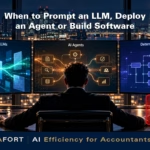
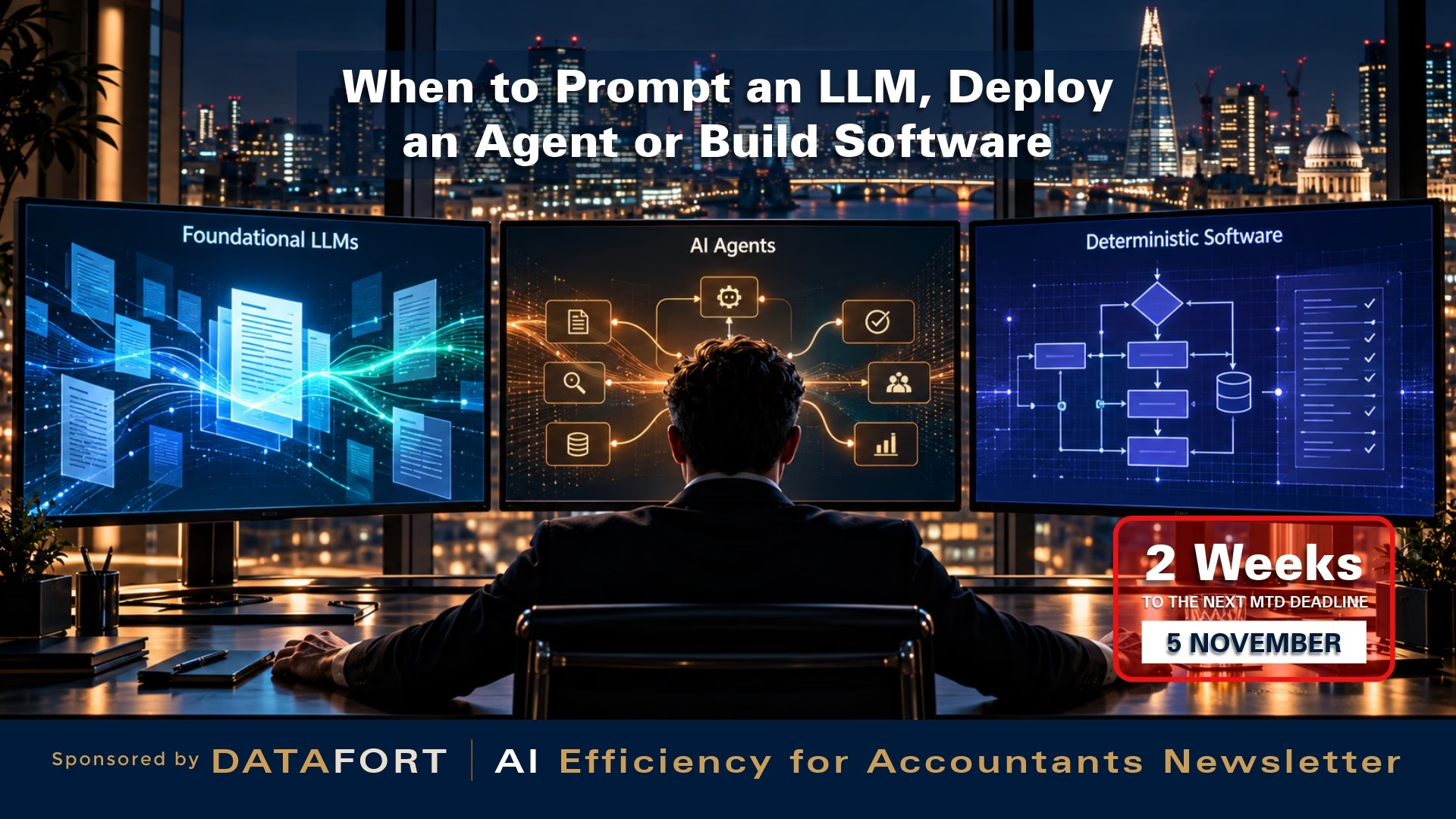
Deploying AI for the sake of AI is a shortcut to wasted budgets and frustrated teams. Real efficiency starts from the opposite direction: ruthlessly diagnosing an operational bottleneck, understanding its exact risk profile, and only then selecting the right technical architecture. Once you have identified the real problem, modern solutions fall into three distinct tiers: Foundational LLMs, Autonomous AI Agents, and Deterministic Software. Here is how to match your firm’s bottlenecks to the right technology without falling for the hype.
The Golden Rule: Start with the Problem, Not the Tech
Before touching any AI tool, practice leaders must run their friction points through three baseline questions:
- What specific problem are we trying to solve? Is it administrative drag, capacity bottlenecks, review latency, or client communication delays?
- What does success actually look like? Can you quantify it in hours saved, turnaround speed, or lower error rates?
- What is our tolerance for error? If a mistake carries regulatory liability or financial penalties, probabilistic guessing cannot be part of the core output.
Only after answering these questions do you select your tool from the three technical tiers below.
The Trade-Off: Reliability vs. Flexibility
Every technology forces a compromise between flexibility and deterministic accuracy:
- High Flexibility / Probabilistic (LLMs): Exceptional with natural language, brainstorming, and synthesizing complex text. Inherently prone to hallucinations with math, citations, and strict logic.
- Goal-Oriented / Orchestrated (AI Agents): Capable of multi-step problem solving and interacting with external tools, but requires guardrails and human oversight.
- 100% Deterministic / Rule-Bound (Traditional Software): Zero creativity, zero hallucination. If you run code a million times with the same inputs, you get the exact same result every time.
Tier 1: Foundational LLMs (The “Colleague in a Box”)
Examples: Claude, ChatGPT, Google Gemini, xAI’s Grok or self-hosted open-source models (e.g., Llama, Mistral, DeepSeek)
The Problem It Solves
Your team spends hours drafting routine correspondence, summarizing dense commentary, or struggling to synthesize hundreds of pages of technical regulatory guidance.
Deployment Routes: Public Enterprise vs. Private Walled Garden
Accountancy firms generally take one of two deployment paths:
- Enterprise Cloud LLMs: Using commercial vendors (Microsoft Copilot, OpenAI Enterprise) with explicit Data Processing Agreements (DPAs) ensuring zero data retention and no model retraining.
- Self-Hosted Open-Source Models in a Walled Environment: Deploying open-weight models inside your firm’s own private cloud (AWS, Azure, private VPC) or dedicated on-premises hardware.
The Compliance Advantage of the Walled Environment
For firms handling sensitive tax files, non-public commercial financials, or unredacted client records, a walled open-source deployment offers compelling governance benefits:
- Zero Data Exfiltration: Client data never leaves your firm’s encrypted perimeter. There is no call to a third-party vendor’s API, eliminating external data leakage risks.
- Strict Regulatory Compliance: Simplifies GDPR, professional conduct standards (e.g., ICAEW, ACCA), and non-disclosure obligations, as no client data is transmitted to or processed by third-party AI providers.
- Total Audit & Retention Control: Your IT team retains complete custody of logging, access permissions, and data deletion schedules without being subject to external vendor terms of service changes.
Where It Fits in a Practice
- Technical Research & Sparring: Uploading 60 pages of technical tax guidance and prompting: “Identify the relevant qualifying criteria under this scheme for our client scenario. Cite the specific sections.”
- Drafting Advisory Communications: Translating dense audit findings or management accounts into clear, plain-English client summaries.
- Challenging Assumptions: Instructing the model to act as a skeptical commercial auditor to challenge cash-flow projections and spot blind spots before a client presentation.
The Risks
- Mathematical Inaccuracy: Pure LLMs should never calculate a tax liability or perform financial reconciliations. Regardless of whether the model is proprietary or open-source, LLMs produce confident, plausible numbers that can be entirely incorrect.
- Infrastructure Overhead (for Open Source): Hosting your own model requires dedicated GPU infrastructure and active technical maintenance, which carries a higher setup cost than off-the-shelf SaaS subscriptions.
- Public Consumer Tiers: Free consumer accounts should be strictly prohibited firm-wide, as default settings often permit provider retraining on submitted client data.
Tier 2: Autonomous AI Agents (The “Digital Junior Associate”)
Examples: Tool-calling systems, custom API agents, multi-agent frameworks
The Problem It Solves
Your staff wastes hours moving between email, shared drives, and practice management software to manually track down missing files, triage incoming client records, or chase outstanding approvals.
How to Apply It
- Intelligent Information Chasing: An agent monitors filing deadlines in practice software, checks client folders for missing documentation, drafts targeted follow-ups requesting the specific missing files, and alerts the manager only when the records arrive.
- Onboarding & Document Triage: Ingesting varied onboarding packs—extracting corporate registration details, IDs, and proof of address across multiple formats—and populating the practice management platform while flagging discrepancies.
- Continuous Advisory Sweeps: Monitoring transaction feeds for unusual supplier changes, margin compression, or burn-rate anomalies, then generating an internal briefing draft for partner review.
The Risks
- Literal Execution & Edge-Case Drift: Agents follow instructions literally. A vaguely worded prompt or an unexpected edge case can trigger endless execution loops, inappropriate client messages, or unintended downstream actions.
- Human-in-the-Loop Requirement: Agents should triage, draft, and assemble, but critical checkpoints must require human authorization before client-facing delivery.
Tier 3: Deterministic Software (The “Rock-Solid Ledger”)
Examples: Relational databases, custom Python/SQL pipelines, practice APIs, native Xero/QuickBooks logic
The Problem It Solves
You need zero-tolerance accuracy for repetitive calculations, strict deadline tracking, statutory filings, and structured data transfers between your core accounting systems.
How to Apply It
- Core Calculations & Compliance: Statutory payroll, VAT thresholds, corporation tax calculations, and double-entry book balancing.
- System Synchronisation: Moving client records reliably between practice management and invoicing engines.
- Strict Rule Automation: Triggers such as: When an engagement letter is digitally signed, generate a secure client folder and dispatch the standard onboarding pack.
The Risks
- The AI Hype Bias: Forcing generative models into tasks where a basic automated workflow or native software integration delivers the outcome faster, cheaper, and with complete mathematical certainty.
Summary Matrix: Selecting the Right Technology
| Feature | Tier 1: Foundational LLMs (SaaS or Self-Hosted) | Tier 2: AI Agents | Tier 3: Deterministic Software |
| Problem Solved | Unstructured language, research, drafting | Multi-system manual triage & chasing | Rule-based data flows & exact calculations |
| Core Strength | Synthesis & communication; walled privacy option | Multi-step execution & tool use | 100% predictable, auditable logic |
| Risk Profile | Factual & numerical hallucinations | Edge-case drift & unexpected paths | Inflexible; halts on unprogrammed edge cases |
| Compliance Posture | Requires enterprise DPA or walled private instance | Strict API permissions & audit logs required | Native compliance; fully deterministic |
| Human Review | High (Inspect every draft) | Medium (Approve actions) | Low (Once verified and tested) |
The Practical Decision Framework
Before writing a line of code or signing a software contract, start with your operational problem and let the requirements dictate the solution:
- Is the bottleneck strictly numerical or rule-bound?
- ➡️ Use Deterministic Software. Keep generative AI away from the calculations.
- Is the bottleneck reading, synthesizing, or drafting unstructured text?
- ➡️ Use an enterprise Foundational LLM (or private walled open-source instance) with structured prompts and strict review.
- Is the bottleneck coordinating steps across multiple platforms and interpreting context?
- ➡️ Deploy a supervised AI Agent with explicit review checkpoints.
The goal of your firm is not to become an “AI company.” The goal is to run a more profitable, accurate, and scalable accounting practice. Don’t adopt technology to check a box—adopt it only when it solves a measurable problem at a level of risk your practice can comfortably justify.
Where is the biggest operational bottleneck in your firm right now—intake, drafting, or client data collection? Let us know in the comments below.
The Practical Decision Framework
Before writing a line of code or signing a software contract, start with your operational problem and let the requirements dictate the solution:
- Is the bottleneck strictly numerical or rule-bound?
- ➡️ Use Deterministic Software. Keep generative AI away from the calculations.
- Is the bottleneck reading, synthesizing, or drafting unstructured text?
- ➡️ Use an enterprise Foundational LLM with structured prompts and strict review.
- Is the bottleneck coordinating steps across multiple platforms and interpreting context?
- ➡️ Deploy a supervised AI Agent with explicit review checkpoints.
The goal of your firm is not to become an “AI company.” The goal is to run a more profitable, accurate, and scalable accounting practice. Don’t adopt technology to check a box—adopt it only when it solves a measurable problem at a level of risk your practice can comfortably justify.
You don’t need an elaborate AI strategy to begin. You need a business problem worth solving and a sensible way to determine whether the investment will pay for itself.
The right technology for the right job. Developed faster, without compromising the engineering standards your business depends on.
If there’s a recurring problem in your practice that’s costing time, creating unnecessary risk or limiting the services you can offer, let’s talk.
Book a 15-minute conversation with DATAFORT. Bring one problem. We’ll help you determine the most practical way to solve it. – https://calendly.com/d/dv5j-f2c-4zx/datafort-ai-development.