Hello and welcome back to AI Solutions: The Pathway to Profit! I am so glad you’re here. Today, we’re diving into a topic that I believe is one of the most important—and most frequently overlooked—foundations for building successful, profitable AI systems. We’re going beyond the leaderboard numbers and the flashy demos to ask a critical question.
When I talk to teams building new AI models, the number they almost always lead with, the one they are most proud of, is accuracy. You’ve seen it: “Our model is 99% accurate!” And on the surface, that sounds incredible. It sounds like perfection. But let’s pause for a moment and think this through together.
Imagine that 99% accurate model. Now, what if I told you that to get a single answer from it, it costs your company a small fortune in computing power? And what if it takes five long seconds to respond, while your customer is tapping their fingers waiting? Is that 99% accurate model still a winner? Is it truly a valuable business asset? I think you know the answer.
In this episode, we’re going to walk through the critical metrics that live in the shadow of accuracy but ultimately determine an AI’s real-world business success. You’ll discover that it’s not just about being right; it’s about being right in a way that is fast enough, cheap enough, and trustworthy enough to actually work. Let’s get into it.
The Tyranny of a Single Number
So, how did accuracy—and its cousins, precision and recall—become the gold standard we all chase? The truth is, it’s simple. In the clean, predictable, sterile world of a research lab, it’s an easy, tangible number to measure. It gives us a single score that feels like a report card, a clear sign of progress. But I’ve come to see this singular focus as a kind of tyranny. It can be incredibly misleading.
I often suggest thinking of it like choosing a new car. If your only metric for a good car was its top speed, you’d ignore everything else that actually makes a car useful and enjoyable. You’d overlook its fuel efficiency, its safety ratings, its cargo space, its comfort. You’d end up with a drag racer for your daily school run—impressive for ten seconds, but utterly useless and wildly expensive the rest of the time. You’d be miserable!
In business AI, the same thing happens all the time. A painfully common example is in fraud detection. A team can build a wonderfully accurate model that spots fraudulent transactions with near-perfect precision. But if that model takes too long to run for a real-time credit card swipe, it’s a complete failure. The transaction has already gone through. The model is technically perfect, but its business value is zero. It has to work in context.
The Need for Speed (and Scale)
If accuracy isn’t the whole story, where do we look next? The first place I always guide teams is toward performance. Let’s talk about two concepts you absolutely must have in your toolkit: latency and throughput.
- Latency: Latency is simply the response time. It’s the delay between a user’s request and the AI’s answer. When we’re building something like a customer service chatbot or a conversational AI, this is absolutely fundamental. A delay of even a second or two makes the interaction feel clunky, unnatural, and broken. You have to remember that your user’s patience is measured in milliseconds, not seconds.
- Throughput: Throughput is the other side of that coin. Think of this as capacity. It’s not just about how fast one answer comes back, but how many requests the system can handle at once. I love seeing teams plan for their peak moment. Imagine a recommendation engine on an e-commerce site during a Black Friday sale. It must serve thousands of users simultaneously, all without slowing down. If it can’t, the system has failed at the most crucial possible time. High latency and low throughput aren’t just technical problems; they lead directly to customer abandonment and lost revenue.
My personal rule of thumb: Test for your “oh no” moment. Don’t just plan for an average Tuesday afternoon. Stress-test your system for your biggest sales day, your most viral moment, the Super Bowl commercial you dream of running. If your AI can’t handle success, that’s a special kind of failure.
The Bottom Line: Does This Actually Make Financial Sense?
This leads us directly to the economics of your system, a topic that teams often ignore until the first terrifyingly large cloud bill arrives. Let’s talk about two more critical metrics: computational cost and scalability.
First is the computational cost, or the cost-per-inference. This is the amount of raw processing power—the CPU or GPU resources—your model consumes to produce a single answer. Every single time your AI thinks, it has a price tag attached. Is it a fraction of a penny, or is it several cents? When you multiply that by millions of user queries, the difference is staggering.
Then, we have to consider scalability. I always want to see teams asking themselves the hard question: If our user base grows by 100x, will our costs also grow by 100x? If the answer is yes, you may have just built a financial trap for yourself. Your success will literally bankrupt you. This is the hidden danger of choosing a massive, resource-heavy model for a simple task. It’s like using a sledgehammer to crack a nut—it works, but the cost and effort are completely out of proportion. It’s a quiet path to unprofitability.
The Human Element: Can We Trust This Thing?
Beyond the raw numbers of speed and cost, there is a deeper, more human layer we absolutely must consider. It’s all about trust. If you can’t understand why your model made a certain decision, you have a fundamental business problem.
This is where we talk about interpretability, or what the industry calls Explainable AI (XAI). Think about it from a human perspective. If your AI model denies someone a loan application, you need to be able to tell them why. Not just for good customer service, but for regulators. In sensitive sectors like finance and healthcare, this isn’t a nice-to-have; it’s often a legal requirement. An unexplainable system is a hidden risk. It’s impossible to debug, stakeholders can’t trust it, and it can expose your business to enormous compliance headaches.
My unbreakable rule is this: If you can’t explain it, you can’t trust it. And if you can’t trust it, you shouldn’t be betting your business on it.
This concept of risk brings us to two final, crucial areas:
- Robustness: How does your model behave not in the lab, but in the chaos of the real world? How does it handle messy, unexpected, or even malicious data? A model that is 99% accurate on clean, perfect data can fall apart completely when faced with a real user’s typos or strange formatting. It must be resilient.
- Fairness: This is a profoundly important question. Does our model perform consistently well for everyone, regardless of their background, gender, or ethnicity? A model that works for one group but fails another isn’t just poor engineering; it’s a significant ethical failure and a massive business liability. A biased model can cause severe reputational damage and lead to serious legal challenges.
Putting It All Together: The Business Value Scorecard
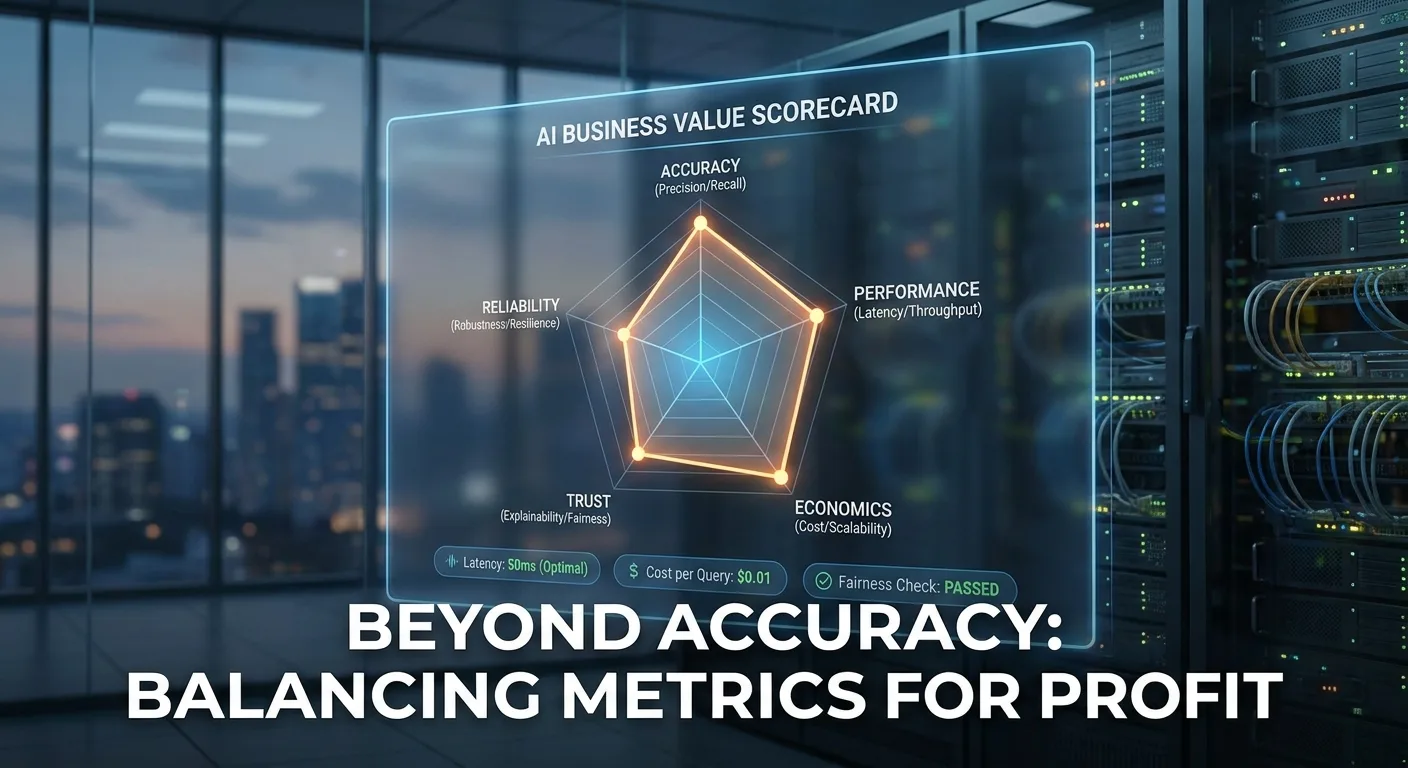
Okay, so we have all these competing metrics—speed, cost, explainability, fairness, accuracy. How in the world do we decide what actually matters? You might find that the pursuit of a single “best” metric is a fool’s errand. Instead, I push for a more holistic approach, something I call a Business Value Scorecard.
Instead of one number, we create a profile that balances these factors based entirely on the specific problem you are trying to solve. The context is everything.
Let me paint a vivid picture with two examples:
- Scenario A: An internal tool that summarizes long reports for your team. What matters here? Your scorecard would heavily prioritize low cost and high accuracy. A delay of a few seconds is perfectly acceptable because no one is waiting in real-time. Interpretability is less critical.
- Scenario B: A customer-facing chatbot on your website. The priorities here completely flip. The most important things are low latency for a natural, flowing conversation and robustness to handle all the weird things customers will type. Accuracy can even be a bit lower if the bot is good at saying, “I’m not sure, let me get a human for you.”
The scorecard looks entirely different because the business context dictates what “good” truly means.
Your Journey to Real Value
As we bring our discussion to a close, the most important takeaway I want you to have is this: the search for the single “best” AI model is a distraction. The truly valuable, profitable, and successful model isn’t the one with the highest accuracy score. It’s the one that strikes the right balance of performance, cost, trust, and reliability for your unique business context.
Now that we have a framework for measuring success, a new question naturally emerges: Which underlying engine or platform should we build on? This is the next logical step in our journey.
And that’s exactly what we’ll cover next time. Please join me for Episode 44: “The Platform Shift: How to Choose a Foundational AI Vendor (OpenAI, Google, Anthropic).” We’ll walk through how to navigate that crucial, high-stakes decision together.
Thank you so much for your time and attention today. I’d love to hear from you in the comments below—what metrics matter most for the projects you’re working on?