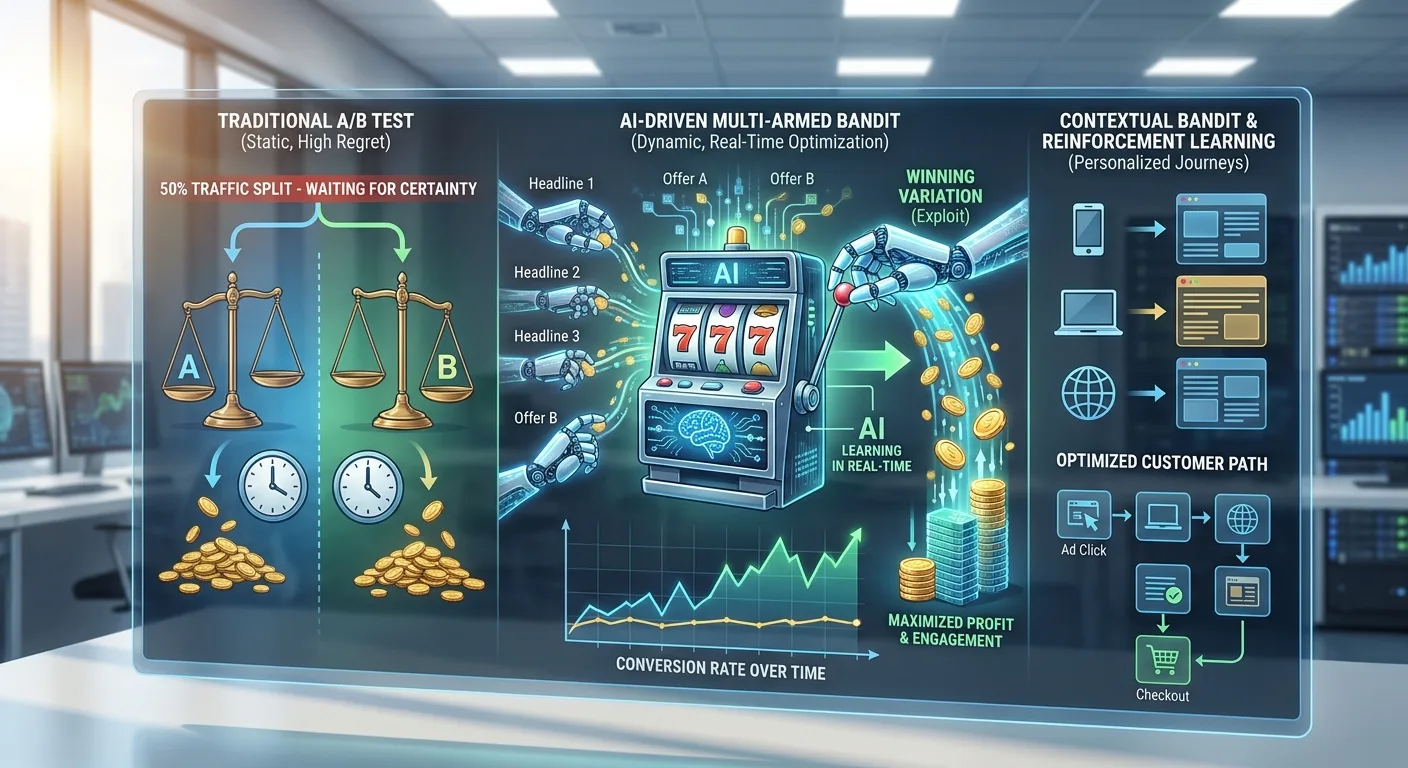
Hello and welcome back! You’re tuned in to AI Solutions: The Pathway to Profit, and I am so glad to have you with us today. We’re about to dive into a topic that I find genuinely elegant, one that transforms a common marketing practice from a slow, clunky process into a dynamic, profit-driving engine. We’re talking about A/B testing on steroids, using what we call Multi-Armed Bandits and AI-driven experimentation.
If you’ve ever run a traditional A/B test, you might know the frustration I’m talking about. What I so often see is a process that feels… well, a bit painful. It’s slow. It forces you to send half of your precious traffic to a version of your page that you suspect is weaker, all in the name of learning. For weeks, you wait for that magical phrase, “statistical significance,” and all the while, you’re knowingly leaving money on the table. It feels like driving with one foot on the brake.
Today, we’re taking our foot off the brake. We’re going to walk through a smarter path—a faster, more profitable way to experiment using an AI that learns and adapts in real-time. This is about ensuring you’re not just learning from your tests, but earning while you do.
The Painful Cost of Traditional A/B Testing
Let’s first paint a vivid picture of the classic A/B test. The structure is incredibly rigid. You split your audience precisely down the middle: fifty percent see Version A, fifty percent see Version B. Then, the waiting game begins.
This long, mandatory “exploration” phase is all about gathering enough data to be certain. But this certainty comes at a cost—a very real, quantifiable cost that data scientists have a precise term for: regret. In this context, regret is the value you lose, the conversions you miss, while you’re stuck sending traffic to the underperforming option. It’s the opportunity cost of learning slowly.
Let’s make this tangible. Imagine you’re testing two call-to-action buttons for a new service, and you have 100,000 visitors coming to your site this month:
- Button A (the original): Converts at 2%.
- Button B (the challenger): Is a superstar, converting at 5%.
In a classic 50/50 test, 50,000 people see the weaker button, which gives you 1,000 conversions. The other 50,000 see the better one, giving you 2,500 conversions. Your grand total is 3,500 conversions.
But what if you could have magically known Button B was the winner from the start? You would have sent all 100,000 visitors to it and gotten 5,000 conversions. That difference—the 1,500 lost conversions—that’s your regret. That’s the high price you paid for information. What if we could dramatically reduce that price?
Enter the Multi-Armed Bandit: A Smarter Gamble
This is where we introduce a concept with a wonderfully memorable name: the Multi-Armed Bandit. To understand it, I want you to picture yourself in a classic Las Vegas casino. You’re standing in front of a row of slot machines—the old-school “one-armed bandits.” Each machine has a different, hidden payout rate. Your goal is simple: walk away with the most money possible.
What would you do? You certainly wouldn’t just pull each lever an equal number of times and diligently record the results before choosing. That’s the A/B test approach! Instead, your human intuition would take over. You’d probably pull each lever a few times to get a feel for it. As soon as one machine starts showing promise—paying out more consistently—you’d naturally start focusing your money and your efforts on that machine. You’d exploit what you’ve learned, while maybe still occasionally trying the others just in case.
A Multi-Armed Bandit algorithm does exactly this for your website, your app, or your ad campaigns. It doesn’t commit to a rigid 50/50 split. It intelligently and automatically sends more traffic to the winning variation as it learns, dynamically reducing regret and maximizing your returns, right from day one.
The Explore-Exploit Tradeoff: AI’s Beautiful Balancing Act
So, how does the system decide when to try something new versus when to stick with the current winner? This brings us to a beautiful tension at the heart of machine learning: the explore-exploit tradeoff.
- Exploration: Gathering new information. It’s pulling the lever on a machine you know little about.
- Exploitation: Using the information you already have to get the best possible result. It’s pulling the lever on the machine you believe pays out the most.
My favorite way to think about this is to imagine the algorithm developing “beliefs.” It doesn’t just see a single conversion rate; it maintains a range of possibilities for each option’s performance. Early on, with very little data, its beliefs are wide and uncertain, so it explores all options fairly equally. But as one variation consistently performs better, its belief in that option’s superiority strengthens. Its confidence grows.
What you see then is a graceful shift from exploration to exploitation. The algorithm intelligently routes more and more traffic to the perceived winner. Yet—and this is the clever part—it never becomes 100% certain. It always sends a tiny fraction of traffic to the underdogs, just in case it was wrong or in case customer behavior changes over time. It is always, always ready to learn.
Bringing Bandits to Life: Real-World Examples
This balance moves from a beautiful idea to a powerful business tool when you see it in the real world. Here are a few places where this approach absolutely shines:
- News Media: Picture a major publication testing five different headlines for the same breaking news story. A bandit algorithm watches in real-time to see which headline readers are clicking on. Within minutes, it automatically identifies the winner and promotes it to the entire audience, maximizing engagement when it matters most.
- E-commerce: Consider testing promotional banners on your homepage. Instead of running a two-week test to decide between “Free Shipping” and “20% Off,” a bandit system can test several offers at once. It will quickly learn which one is driving sales and prioritize showing that most profitable message to the most people.
- Digital Advertising: Here, speed is everything. An AI-driven system can rapidly test different ad creatives, copy, and audience combinations. It learns which ones perform best and dynamically allocates your budget toward the winners, minimizing waste and maximizing your return on ad spend.
The Next Frontier: Contextual Bandits and Beyond
What I find truly fascinating is where this technology is headed. We can elevate the question we ask the system. Instead of simply asking, “Which headline performs best overall?” we can start asking, “Which headline is best for this specific user, right now?”
This is the realm of the Contextual Bandit. This AI becomes aware of the user’s context—their device, their location, their past browsing history—and uses that information to personalize the choice in real-time. A user on a mobile device in New York might see a different offer than a desktop user in California, because the system has learned that’s what works best.
And we can go even further. My personal passion is seeing an AI that optimizes not just one decision, but an entire sequence of them. This brings us to Reinforcement Learning, where the system learns the optimal path for a customer—from the first ad they click, through their journey on your site, all the way to the final checkout. It’s about optimizing the entire conversation, not just a single word.
Your First Steps: How to Get Started
Now, this might feel complex, but I want you to hear this loud and clear: this power is not reserved for the tech giants. Tools you might already be familiar with, like Google Optimize alternatives or leading platforms such as Optimizely and VWO, have multi-armed bandit capabilities built right in, making it incredibly accessible.
So, where do you begin? My unbreakable rule for starting with any new technology is to start simple and aim for a clear win:
- Pick One High-Impact Element: Choose a single component on a high-traffic page with a very clear conversion goal. Think the main headline on your landing page, the call-to-action button on a sign-up form, or the hero image on your homepage.
- Ensure You Have a Clear Goal: The system needs to know what “winning” looks like. Is it a click? A form submission? A purchase? Be specific.
- Start with a Simple Bandit Test: Don’t jump straight to contextual models. Run a standard multi-armed bandit test with 3–4 variations of your chosen element. Prove the value to yourself and your team.
Once you’ve seen the lift from this first test, you’ll find it’s much more natural to evolve toward the more powerful, personalized models. You’ll have built the foundation and the confidence to take the next step.
The Shift in Mindset
What I hope you can see now is the sheer elegance of this approach. By beautifully balancing the tension between exploring new options and exploiting what’s known to work, these systems achieve something remarkable. They fundamentally minimize regret and dramatically accelerate the learning process, turning experimentation from a cost center into a profit center.
The key takeaway today isn’t just about a new testing method. It’s about a shift in thinking—from running static, slow-moving tests to implementing dynamic, self-optimizing systems that are always learning and always working to deliver the best possible outcome.
Thank you for your focus and for joining me on this journey today. I hope you’ll join us next time for Episode 36, where we’ll be tackling a completely different but equally critical topic: “AI and the Law: Navigating Copyright, IP, and Liability.” It’s a look into the crucial legal frameworks every business leader needs to understand in this new era.
Until then, keep experimenting! If you have any questions or want to share your own experiences with A/B testing, please leave a comment below. I’d love to hear from you.