
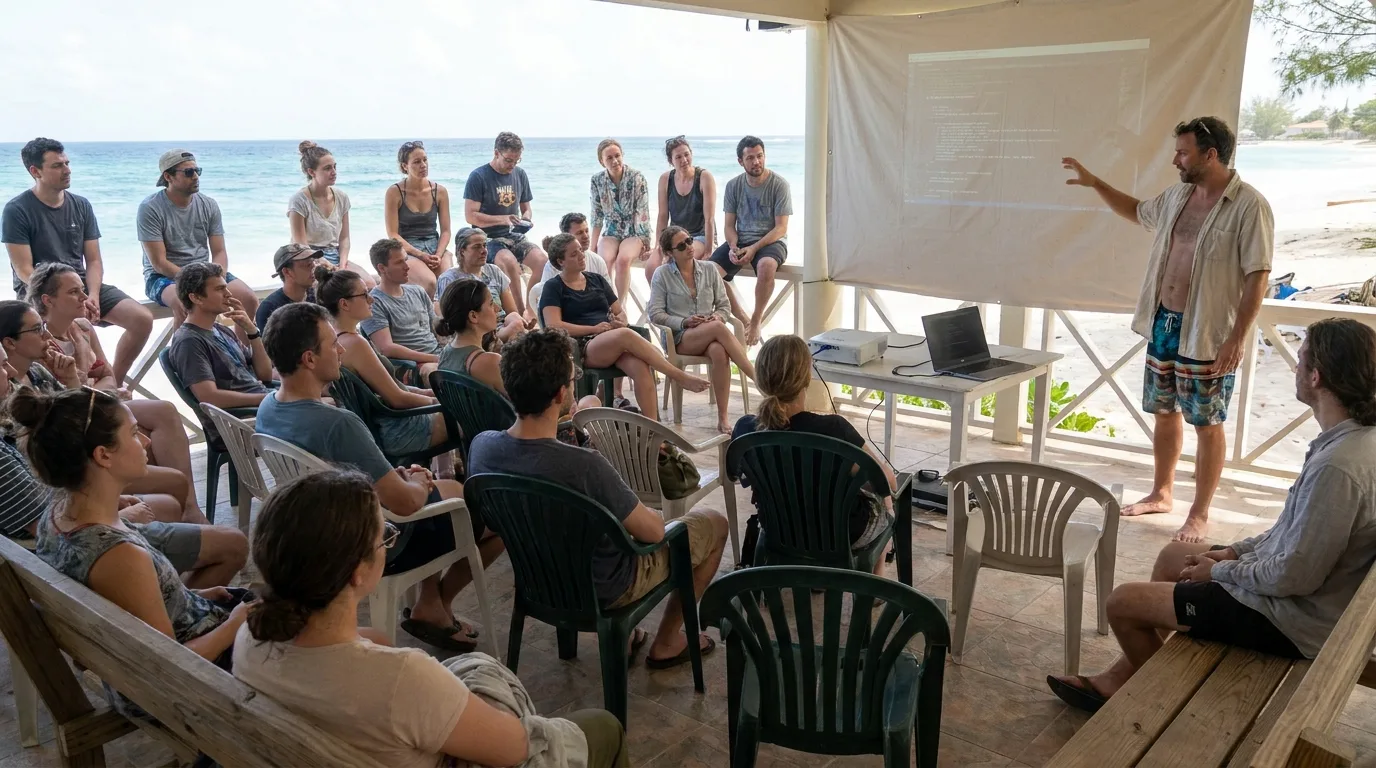
When I picture the future of neuroscience, I imagine calm labs, tidy datasets, and serious Bayesian-priors debates. What I did not expect was a man in swimming trunks, before thirty scientists in Barbados, saying, “Watch this,” while a projector fought the sun like a tiny candle.
Konrad Kording, trunks on, confidence maxed out, asked Claude Code to build a web app. Minutes later, it was testable. The room went quiet in the way rooms do when someone hands the future a business card. It was not just “AI is fast.” It was “AI is fast enough to ruin your favorite excuses.”
My brain did the usual scientist spin: wow, scary, useful, please stop talking and let me stare at the ocean. But the feeling stuck. Back home, I have the relatable personal experience of every researcher: I open a code file, remember I wrote it six months ago, and suspect it has been living with another family. When my lab prototyped a decoding pipeline in a day at a retreat, the shock was real. It felt less like productivity than one new, surprisingly good magic trick. Lunch conversations shifted from grants and coffee to a dangerous question: what do we do when the machine can draft, code, and almost make us obsolete?
We needed a policy, but not a boring one. We started with a simple idea: let AI help us, but keep our brains in the loop. The machines are fine; I am worried about us. If AI carries us through every hard step, what happens to the slow, unglamorous work that builds real skill? Writing was the slippery slope. It can help wordsmiths and non-native writers, yes, but it can also nudge arguments toward a smoother, shaggier idea. So the rule became: draft it yourself first, let AI polish, then check that your argument did not quietly change shoes.
We also agreed that AI confidence is not evidence. It can sound like a self-assured librarian who still returns the wrong book. So we test outputs, verify results, and never trust “the model said so.” Data privacy mattered, too: participant data stays home, and agents get only keys to the rooms they actually need.
The biggest outcome was not a rule, but a culture. We now ask, openly, what AI did and what it did not do. That transparency helps me judge not just results, but my confidence in those results. It is a small, strange superpower: meta-confidence, or trust in the trust.
What worries me is that if we quietly slide into whatever feels easy, the easy thing becomes normal. We need field-wide norms, not just lab-group folk rules. The future of science will be written by people who understand the tools, but it should still be argued, checked, and owned by humans.
So here is my hope: may our labs move fast, may our AI helpers stay useful, and may we never forget that the most important code in the lab is still the one we understand.
Swim-Trunk Code: How a Sunny Demo Shifted My Lab’s AI Brain
 DATAFORT completes AI automation project to help BHUK Group …
 Investors are checking to see if business plans include an A…
 Episode 43: Beyond Accuracy: What Other Metrics Matter for B…
 Accountancy Newsletter – Your client’s numbers j…
 The AI didn’t escape
 Accountancy Newsletter – AI REVEALS THE ADVANTAGE HIDD…
 Episode 42: Build Your AI-Powered MVP This Weekend
 FIRST RULE OF INTELLIGENT AUTOMATION: DON’T AUTOMATE A BROKE…
 Accountancy Newsletter – Where Does Your Data Go? AI S…
 Episode 40: Supercharge Your Sales with AI Lead Scoring