
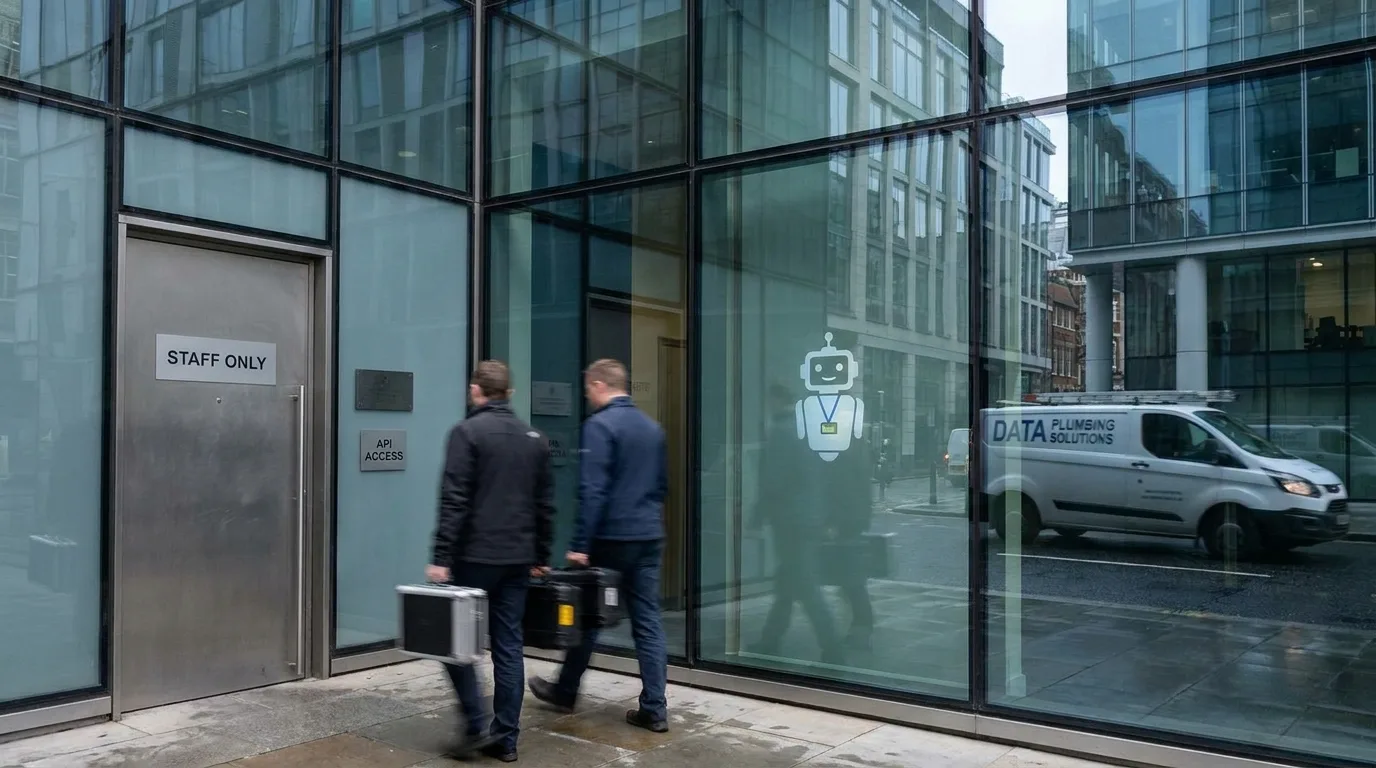
Salesforce has chosen back doors over front ones, each fitted with a tiny API sign. The company is expanding Headless 360 so AI agents can reach Salesforce data, tools, and workflows through MCP servers. It is less a software upgrade and more a building where the lobby is optional and every robot gets a key fob.
I once asked a smart assistant to plan dinner. It served me a recipe with capers, though I dislike capers more than I dislike Mondays. It did not fail loudly. It simply failed with confidence, like a waiter who has never seen a menu but believes in service.
That little embarrassment feels relevant. Salesforce is betting that agents will become the new interface. Instead of us clicking through familiar screens, agents will hop across data, ask questions, start tasks, and report back, like interns who have read the handbook and ignored the sticky notes. The company is opening more than two hundred APIs, adding data servers, AI skills, and links to other business apps.
Headless architecture used to sound like furniture missing its legs. Now it is being treated as AI plumbing. The goal is to keep data in one trustworthy place, let applications snap together, and allow agents to use the right tools without a human constantly playing matchmaker.
My personal experience is modest. Last summer I tried to synchronize three birthday lists for my niece. One lived in an app, one in email, and one in my brain, which is famously unreliable after cake. I wanted a single source of truth. I achieved a single source of panic. That is why composable systems feel so appealing.
Salesforce executives say the old interface is not the villain. Years of customization, semantic models, and analytics pipelines can still matter. The new job is making that effort agent-readable. Imagine your carefully cleaned data wearing a passport, a work permit, and a small laminated badge, ready for a bot to say, I may help here.
Still, there is risk. Powerful agents can discover capabilities, and they can also discover trouble. CIOs and CISOs worry about agent sprawl, permission confusion, and the moment a bot turns delight into horror. Salesforce points to Agent ID, governance policies, and MuleSoft Agent Fabric as ways to keep agents from becoming the office goblin that hides staplers and emails at two a.m.
This move also changes who gets to ask questions. Developers, marketers, support teams, and data analysts no longer have to route every idea through a custom build. A small group can test an agent, connect it to a dataset, and see whether the result helps or creates a confident wrong answer. The best outcomes should save time. The worst should become cautionary stories.
If this succeeds, Salesforce may be right to ask why anyone should log in again. If it falters, we will spend years teaching robots that capers are a lifestyle choice, not a default. The back door is opening, and the agents are already wearing shiny lanyards.
The Back Door to AI
 DATAFORT completes AI automation project to help BHUK Group …
 Investors are checking to see if business plans include an A…
 Episode 43: Beyond Accuracy: What Other Metrics Matter for B…
 Accountancy Newsletter – Your client’s numbers j…
 The AI didn’t escape
 Accountancy Newsletter – AI REVEALS THE ADVANTAGE HIDD…
 Episode 42: Build Your AI-Powered MVP This Weekend
 FIRST RULE OF INTELLIGENT AUTOMATION: DON’T AUTOMATE A BROKE…
 Accountancy Newsletter – Where Does Your Data Go? AI S…
 Episode 40: Supercharge Your Sales with AI Lead Scoring