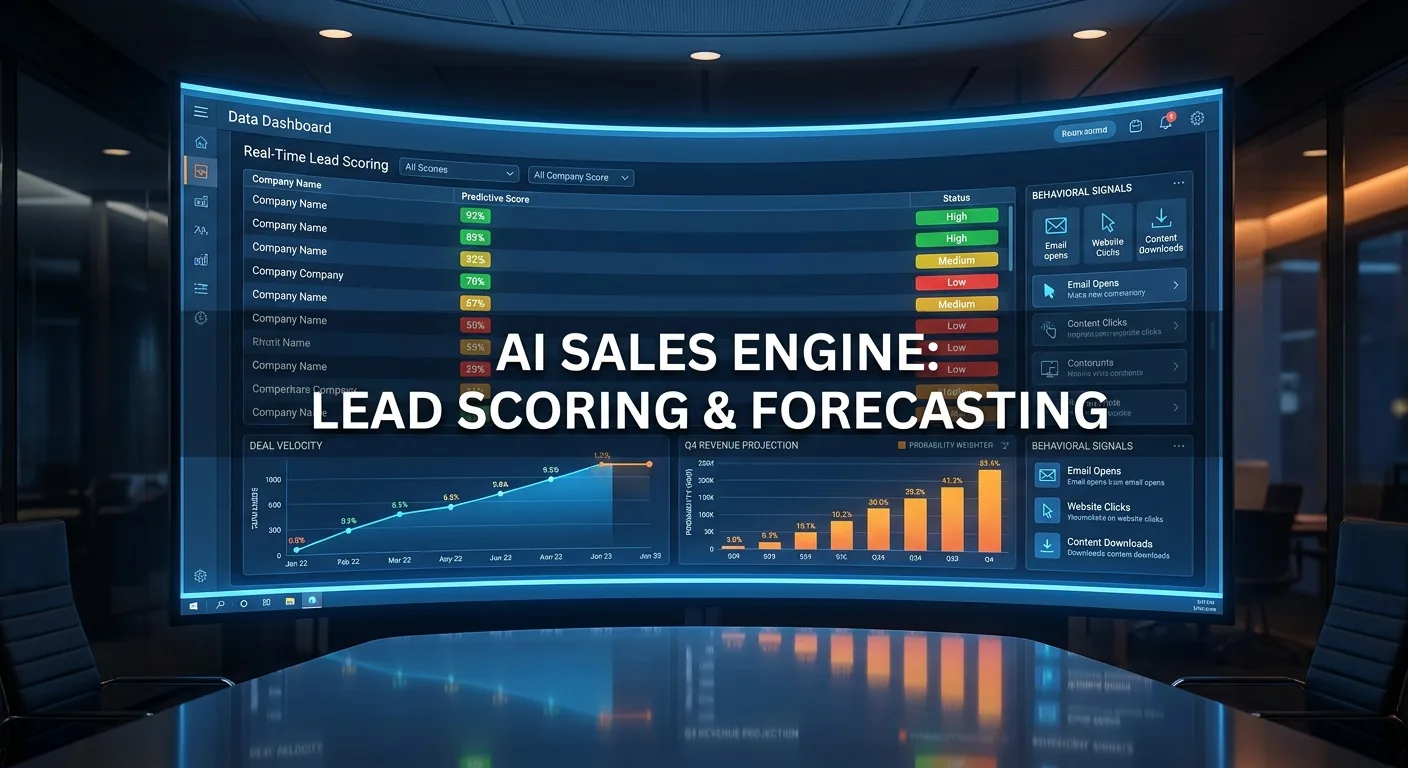
Hello and welcome back to the blog! I’m so glad you’re here. Today, we’re diving into one of the most critical functions for any business looking to grow: supercharging your sales team. We’re going to talk about how to use AI for intelligent lead scoring and forecasting, moving your team from guesswork to a predictable, high-performance engine.
Think about the fundamental challenge every single sales professional faces. It’s that constant, nagging question: where do I invest my most valuable, non-renewable resource—my time? You’ve got a long list of potential leads, but let’s be honest, they aren’t all created equal. How do you separate the truly “hot” prospects who are ready to talk from the time-wasters who are just kicking tires? For years, the answer has been a mix of experience and pure gut feeling. But we can do better. This episode is our guide for that journey, showing you how to build a sales engine that scientifically tells your team exactly where to focus their efforts, right now.
The Old Playbook: Why Static Rules Fail Us
To understand where we’re going, we first have to be really honest about where we’ve been. For decades, the standard approach to lead scoring was based on simple, rigid rules. You’ve probably heard of frameworks like BANT—that’s Budget, Authority, Need, and Timeline. On the surface, it seems perfectly logical. You ask a few questions, check a few boxes, and assign a score.
But here’s the problem I see time and time again: these methods are fundamentally static. They capture a single, blurry snapshot in time, often based on subjective answers from an initial discovery call. Let me paint a vivid picture. A lead fills out a form and says their timeline is 6–12 months, so they get a low score. The BANT system files them away as “cold.” But what that static system can’t see is that two days later, that same lead spent thirty minutes on your pricing page, downloaded three technical case studies, and watched your product demo. Their “digital body language” is screaming buying intent, but your system is completely blind to it.
The result is a tragically common one: sales reps waste enormous amounts of energy chasing leads that simply aren’t ready, all while the real, hidden-gem opportunities are being overlooked and going cold. It’s inefficient, frustrating, and a massive drain on morale.
The AI Revolution: Learning the ‘Digital Body Language’ of Your Best Customers
This is where we introduce a fundamentally different, and far more powerful, approach. Welcome to the world of predictive lead scoring, where AI models completely revolutionize the process. An AI doesn’t just look at the four or five data points from a form fill. It synthesizes thousands of them in real-time.
We’re talking about a rich tapestry of information:
- Demographic data: Job title, location, and role.
- Firmographic data: Company size, industry, and revenue.
- Behavioral data: Every website click, content download, email opened, and webinar attended.
What the model is doing, essentially, is becoming an expert on what your ideal customer looks like in action. It studies the specific journey your past successful customers took—all the subtle patterns and digital breadcrumbs they left behind before they signed a contract. Then, it uses that intelligence to watch your new leads and predict which ones are behaving in the exact same way. It’s not just scoring a lead; it’s identifying a pattern of success.
From Insight to Action: Making the Score Matter
But listen, a score by itself is just a number on a screen. It’s potential energy. The real breakthrough—the part that gets me truly excited—is turning that insight into intelligent action and kinetic energy. It’s about building momentum.
Imagine your sales team starting their day. Instead of an overwhelming, alphabetical list of leads, they open their CRM to a dynamic, prioritized queue. At the very top isn’t “Aaron from Acme Corp.” It’s “Sarah from Summit Inc.,” who just spent the last five minutes on your pricing page. That’s the first call you make. The AI has served up the warmest opportunity on a silver platter.
And it goes deeper. What I find truly elegant is how AI can orchestrate the entire nurture sequence. If a lead with a high score downloads a whitepaper on a specific feature, the system doesn’t just bump their score by five points. It can instantly trigger a personalized email from their assigned rep with a relevant case study on that exact topic. This isn’t generic marketing; it’s a perfectly timed, hyper-relevant conversation. It’s about delivering the perfect message at the precise moment of interest, gently guiding that prospect along their journey.
Beyond Leads: Forecasting with Scientific Confidence
Now, we can apply this same intelligence to an even bigger strategic question: forecasting. For years, sales forecasting has been a shaky blend of art and educated guesswork. It usually involves a sales manager asking reps how they “feel” about their deals, combining that optimism with some simple historical averages, and crossing their fingers.
This is where AI provides incredible clarity. An AI model doesn’t care about a rep’s feelings. It analyzes the cold, hard, empirical data. It looks at factors like:
- Stage & Velocity: The current deal stage and how long it’s been there compared to thousands of similar won deals from the past.
- Sentiment Analysis: The tone in email communications. Is the language from the prospect positive and committal (“we are excited to proceed”) or vague and evasive (“we’ll circle back next quarter”)?
- Historical Rep Performance: The individual rep’s historical close rate for this specific type of deal.
By analyzing all of this, the AI generates a probability-weighted forecast. Suddenly, you move from a hopeful guess to a data-backed prediction of revenue. This allows for genuinely strategic planning around hiring, spending, and growth. It’s a game-changer for the entire business.
Getting Started: Your AI Implementation Playbook
Okay, this all sounds great in theory, but where do you actually begin? The technology is more accessible than ever, but success hinges on getting the foundation right.
My unbreakable rule is this: start with your data. An AI model is only as intelligent as the information it learns from. If your CRM is a mess of duplicate contacts, incomplete records, and inconsistent data entry, your results will be mediocre at best. Garbage in, garbage out. So, your absolute first step is a data-hygiene initiative. It’s not glamorous, but it is non-negotiable.
From there, the biggest hurdle often isn’t the tech, but the people. Getting your sales team to trust and adopt a new system is crucial. This is why I always stress choosing tools that offer explainable AI. You want to avoid the “black box” problem where no one understands why a lead gets a score of 92. The best systems can show you the “why”—“this lead gets a high score because their company fits our ideal customer profile and they just engaged with three key pieces of content.” When reps see the logic, they start to trust the tool.
Ultimately, my process is to frame this correctly from day one. This technology is not here to replace a salesperson’s intuition or relationship-building skills. It’s here to augment them. The AI is a co-pilot, handling the mind-numbing data analysis so your team can focus on what humans do best: connecting, solving problems, and closing deals.
From Guesswork to Growth Engine
As we draw this to a close, you can see the complete picture that forms. We aren’t just talking about a couple of new software tools. We’re talking about transforming your entire sales process from a reactive, gut-feel operation into a proactive, predictable, and incredibly efficient growth engine. We’ve moved from static rules to dynamic prioritization, and from hopeful guesswork to data-driven clarity.
But as we’ve discussed, this entire structure rests on one critical foundation: the data itself. Everything we’ve built depends on the model having access to rich, high-quality information. This brings us to a fundamental—and very important—question. What if that data is too sensitive to move to the cloud for training? What if it’s locked away due to privacy regulations or company policy?
Don’t worry, we have an answer for that. Join us next time for Episode 41: “Federated Learning: Training Models Without Moving Sensitive Data,” where we explore the fascinating, privacy-preserving future of AI.
Until then, thanks for reading! I’d love to hear your thoughts or questions in the comments below. Have you started experimenting with AI in your sales process? What have you learned?