Hello and welcome back! It’s great to have you here for another episode of AI Solutions: The Pathway to Profit. Today, we’re tackling a topic that’s incredibly close to my heart, one that I believe is fundamentally changing the game for aspiring entrepreneurs everywhere: using AI to build your Minimum Viable Product, or MVP.
For a long time, I’ve seen startups, especially those led by ambitious, non-technical founders, view AI as this monolithic mountain they have to climb. They treat it as the final destination, a core feature to be painstakingly built after everything else is in place. But I’m here today to propose a radical shift in perspective.
What if AI wasn’t the product, but the master tool you use to build the product? What if you could validate your complex, intelligent software idea with a functional prototype that you, yourself, built in a single weekend?
This isn’t a fantasy. This is the new reality of product development, and it changes the entire dynamic of validating your big idea. It’s a pathway that’s faster, cheaper, and frankly, smarter than anything we’ve had before. So, grab your coffee, and let’s explore how you can build the future, starting now.
From Minimum Viable Product to Minimum Viable Intelligence
For years, the gospel of the startup world has been the MVP. The core idea, pioneered by Eric Ries, was to strip your product down to its barest, most essential features to get it into the hands of real users as quickly as possible. It’s a brilliant and useful concept, but I believe it’s time for an evolution.
I’m seeing a powerful shift away from “minimal features” and towards what I call “Minimum Viable Intelligence.”
The guiding question is no longer, “What is the simplest version of the interface we can build?”
Instead, we now ask, “What is the simplest form of intelligence we can deliver that provides real value?”
Let me paint a vivid picture. Imagine you’re building a platform with a recommendation engine. The old MVP approach might involve you hard-coding five generic recommendations that every single user sees. It works, technically. The button is there, the list appears. But is it testing your core hypothesis? Not really. It’s static, lifeless, and tells you very little about whether users actually want smart recommendations.
Now, let’s look at it through the lens of Minimum Viable Intelligence. Instead of a hard-coded list, you use a simple, off-the-shelf AI model. From the very first user who signs up, your product begins to learn and adapt. The recommendations it makes tomorrow are smarter than the ones it made today. It’s a living, breathing system. You’re no longer just testing a feature list; you are testing the very soul of your product—its intelligence—from the moment you launch.
Your AI-Powered Toolkit: No PhD Required
This is the part where theory becomes wonderfully, thrillingly practical. For many founders I talk to, especially those without a deep technical background, the idea of “building AI” sounds terrifyingly complex. But the barrier to entry hasn’t just been lowered; it’s been completely dynamited.
My personal rule of thumb is to think of these tools like LEGO bricks. You don’t need to know how to manufacture the plastic; you just need to know how to snap the pieces together to build something amazing.
Here’s a look at my go-to starter kit:
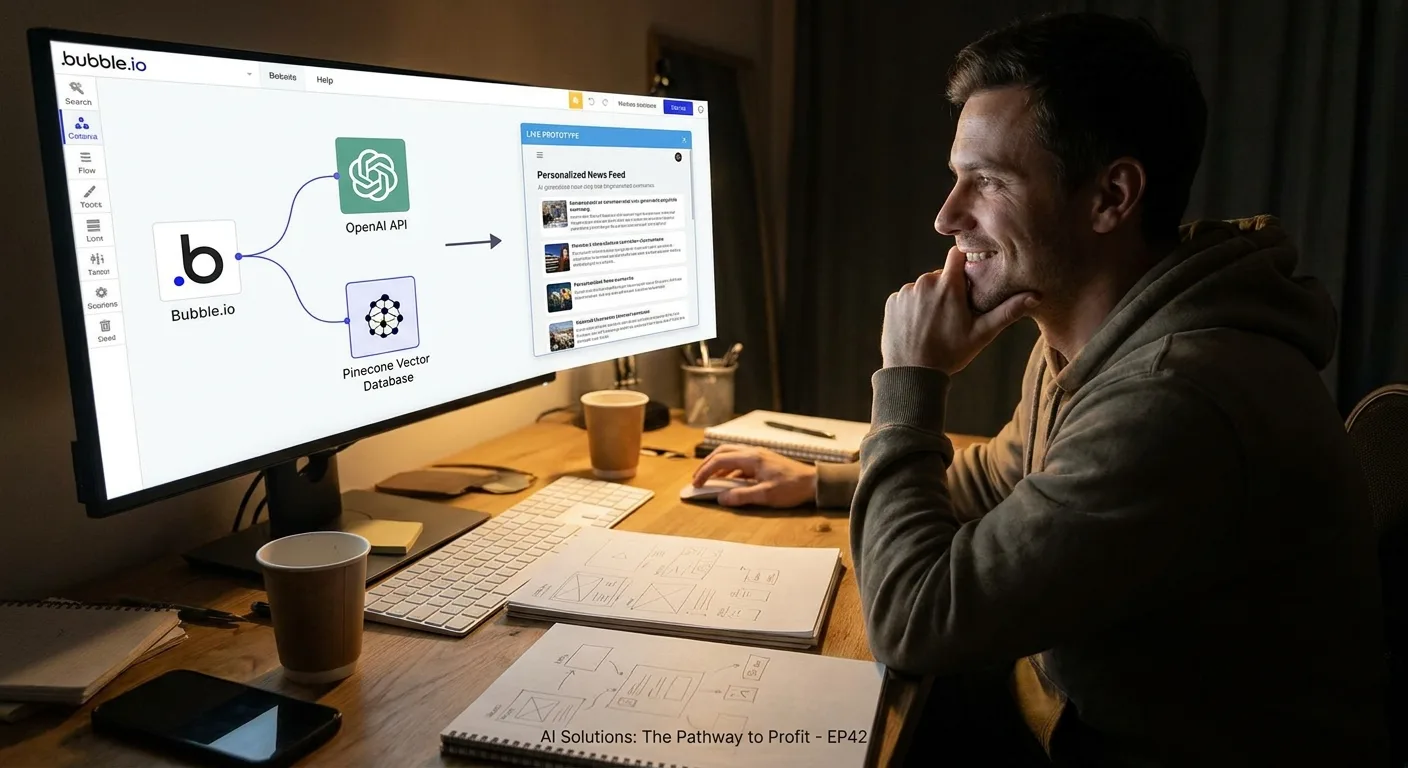
- For Web Applications: Platforms like Bubble.io are an absolute game-changer. They allow you to visually design your entire user interface with drag-and-drop tools. But here’s the magic: you can then connect that beautiful “body” directly to a powerful “brain,” like an OpenAI API. Suddenly, your app isn’t just a collection of buttons and forms; it can generate human-like text, analyze complex data, or power a chatbot.
- For Mobile Apps: You might find that a tool like Glide is a perfect fit. It lets you build a functional, beautiful mobile app directly from something as simple as a Google Sheet. And now, you can embed AI logic right into that workflow. It’s astonishingly powerful.
- For Custom Intelligence: But what if you need your AI to do something very specific, like recognize your company’s products in a photo? In the past, this was the domain of highly paid data scientists. Today, you can use tools like Lobe.ai or Google’s Teachable Machine. You provide the examples—pictures of your products, in this case—and you train the model with clicks, not with code. This is true democratization in action.
Let’s Get Real: Two Blueprints for Your Intelligent MVP
Alright, let’s make this tangible. I want to walk you through two examples of how this approach can transform an idea into a reality.
Blueprint #1: The Personalized News Curator
Imagine you want to build a platform that cuts through the noise and delivers a perfectly personalized news feed to each user. The traditional path is a test of sheer endurance. It involves you, the founder, waking up at 4 AM to manually find, read, and categorize hundreds of articles to create a daily digest. You’re testing your stamina, not your business model.
Let’s build a smarter MVP. Using a no-code tool, you can set up a simple scraper to automatically pull in articles from dozens of sources. Then, here’s the crucial step: you connect it to an AI API. This AI doesn’t just fetch text; it reads and understands it. For each article, it can generate a perfect, concise summary and, based on a user’s stated interests, assign a relevance score.
In a matter of hours, you’ve built a dynamic, intelligent news feed that is unique to every single user. You are now testing the actual core of your business—the smart curation—from day one. You’re validating the intelligence, not just the interface.
Blueprint #2: The Visual Shopping Assistant
Let’s take on something that feels even more complex: e-commerce. You have an idea for a site where the search bar isn’t for text, but for images. A user sees a jacket they love on Instagram, takes a screenshot, and uploads it to your app to find similar items in your store. This sounds like a feature that would require a dedicated machine learning team and months of work, right? Not anymore.
Here’s how we’d build the MVP. We start with a simple no-code front-end for the user interface. The intelligence comes from connecting a few brilliant services. You could use an off-the-shelf API that can analyze an image and translate its visual essence into a series of numbers, known as a “vector.” You then store the vectors for all of your products in a specialized vector database—services like Pinecone or Supabase’s pgvector make this incredibly easy.
When a user uploads their image, your system converts it into a vector and simply asks the database to find the closest mathematical matches. Voilà! You’ve just built a deeply complex, AI-native feature and can begin validating its appeal immediately, all without a single data scientist on staff.
A Word of Warning: Navigating the AI Frontier
Now, this new path is incredibly powerful, but it’s a frontier. And like any frontier, it has its own unique challenges you need to navigate carefully. Think of me as your friendly guide pointing out the river crossings and the poison ivy.
- Hallucinations: These large language models, in their eagerness to be helpful, can sometimes just… invent information. We call this “hallucination,” and it can instantly damage trust with your first, most important users. My unbreakable rule here is to have a human in the loop for any critical outputs, especially early on. Have the AI draft the response, but have a person approve it before it goes out.
- Inherited Bias: AI models learn from vast amounts of human-generated text from the internet, and unfortunately, they can inherit our biases. You must be the conscious check for fairness in your AI’s output.
- Data Privacy: This is paramount. When you send user data to a third-party API, you are still responsible for it. My process for this is simple: be radically transparent with your early users. Tell them exactly how you’re using their data and why. You’ll find that building on a foundation of trust is the only way to scale.
Your MVP is a Compass, Not a Car
It’s tempting to see your shiny new AI-powered MVP as the first version of your final product. I want you to resist that temptation. Its true role is much more fundamental.
Your MVP is not a car; it’s a compass.
Its sole function is to gather data, point you in the right direction, and help you prove your core hypothesis. As real users interact with it, you’ll start to see where the magic is, but also where the weak points are. You’ll notice where the API costs begin to add up or where the response time—the latency—creates a poor user experience.
These aren’t failures; they are priceless data points. They are a bright, flashing arrow pointing to precisely what you need to engineer for scale. From here, you can build a clear roadmap, systematically replacing the no-code components and third-party APIs with your own optimized code and, eventually, proprietary models as you grow. The MVP proves what to build. The next step is building it right.
The Journey Ahead
What we’ve walked through today is a fundamental shift in how we approach building new ventures. AI is no longer just a feature you build towards; it is the very tool you use for building. This approach empowers you to test more ambitious, more intelligent ideas with a speed and efficiency that was simply out of reach just a few years ago.
The focus moves from the long, arduous journey of building a product to the fast, exciting sprint of achieving validation. The question is no longer if you can build your intelligent idea, but what you will build first.
Thank you for joining me on this journey. Our exploration continues in the next episode, “Beyond Accuracy: What Other Metrics Matter for Business AI?” I often find that technical accuracy is just the beginning of the story. To truly succeed, we must measure what matters to the business and to the user. We’ll explore the critical, real-world metrics of cost, latency, and that vital foundation of user trust.
Until then, keep building smarter.
I’d love to hear your thoughts or questions. What intelligent MVP are you dreaming of building? Drop a comment below!