
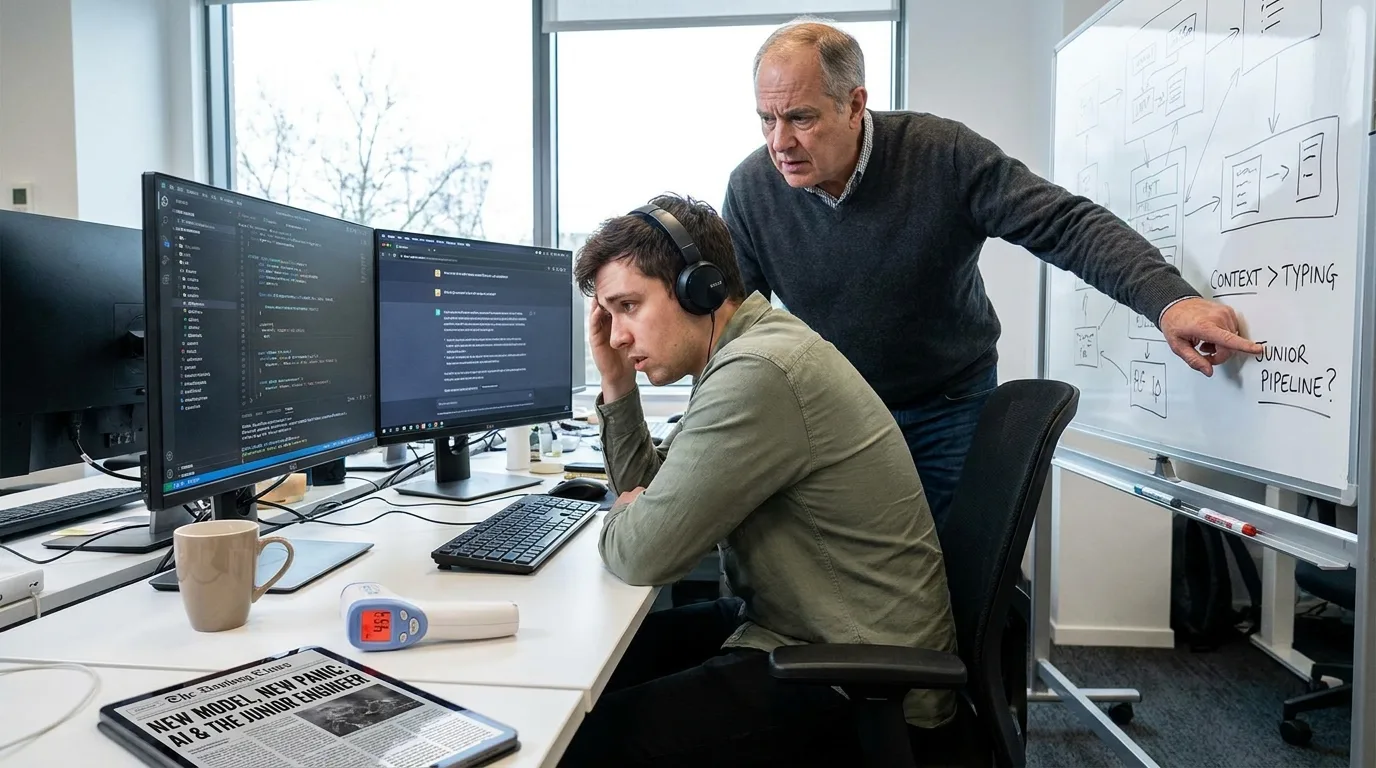
New model, new number, new panic. Every time a coding score climbs, I hear juniors are toast. It feels like watching a thermometer rise and scheduling a funeral for summer. The number goes up, then the labor-market conclusion leaps over every step in between, like a frog who skipped breakfast and landed in the wrong pond.
I once joined a team where our senior developer spent four hours arguing with a ticket that should have taken twenty minutes. Not because the code was hard, but because he did not know which service owned the bug, why an old abstraction existed, or whose elbow to tap. That is the relatable part: engineering is mostly context, not typing.
So I stopped asking whether agents will replace junior engineers. I asked what would have to be true. Four conditions. Three fail. The fourth is the quiet ghost in the machine, and it does not need the other three to knock.
First, agents must be reliable for real junior work. METR’s time-horizon studies show models improving, but the tasks are neat, self-contained, and stripped of prior context. A junior engineer’s first six months are mostly learning which door to open, not solving a puzzle in a vacuum. If the benchmark is a goldfish in a glass bowl, the job is a river.
Second, the benchmark has to measure the job. OpenAI stopped recommending SWE-bench Verified after finding flawed tests and contamination. That is like retiring a quiz because half the answers were photocopied. When easier, leakier sets are swapped for harder, cleaner ones, scores tumble. The specific number used to scream juniors are obsolete just became less respectable.
Third, checking agent output has to become cheaper than delegating to a person. METR randomized developers into AI-allowed and AI-disallowed tasks. They thought they were faster. They were slower. Generation became cheap; verification did not. Review capacity became the bottleneck, and review capacity is senior engineer time, which is as renewable as willpower on a Monday.
Fourth, firms must be willing to break their own senior pipeline. Stanford’s payroll data shows young workers in AI-exposed jobs, including software, getting squeezed by reduced hiring, not mass firings. Nobody is being thrown out the window; the door is just closing one degree at a time. The scary implication: we may be automating the apprenticeship while still demanding the judgment that apprenticeship used to produce.
Here is the quirky turn of phrase I keep coming back to: we are not replacing the engineer; we are replacing the practice run. A practice run is not a luxury. It is how judgment is cooked.
I do not think agentic coding is replacing junior engineers. I think it is replacing the tasks we used to give them while they grew up. The firms that will look smart in three years will run the boring experiment: hire juniors, give them agents on day one, and measure whether they reach senior judgment faster.
My guess? They will, substantially. Nobody funds that study at all.
The Junior Engineer Panic Is a Thermometer Problem
 Episode 45: From Bottleneck to Breakthrough with AI QA
 Newsletter – Beyond Standard Accounting Software | The…
 Accounting Newsletter | What is Vibe Coding and how to use i…
 Episode 44: The Platform Shift: Choosing Your AI Vendor
 DATAFORT completes AI automation project to help BHUK Group …
 Investors are checking to see if business plans include an A…
 Episode 43: Beyond Accuracy: What Other Metrics Matter for B…
 Accountancy Newsletter – Your client’s numbers j…
 The AI didn’t escape
 Accountancy Newsletter – AI REVEALS THE ADVANTAGE HIDD…