Hello and welcome back, friends!
If you’ve been losing sleep wondering how artificial intelligence is going to change your business, today’s topic might be the one that’s actually keeping you up at night. Welcome to Episode 27, where we’re tackling AI and Cybersecurity: Your Greatest Threat and Strongest Defense.
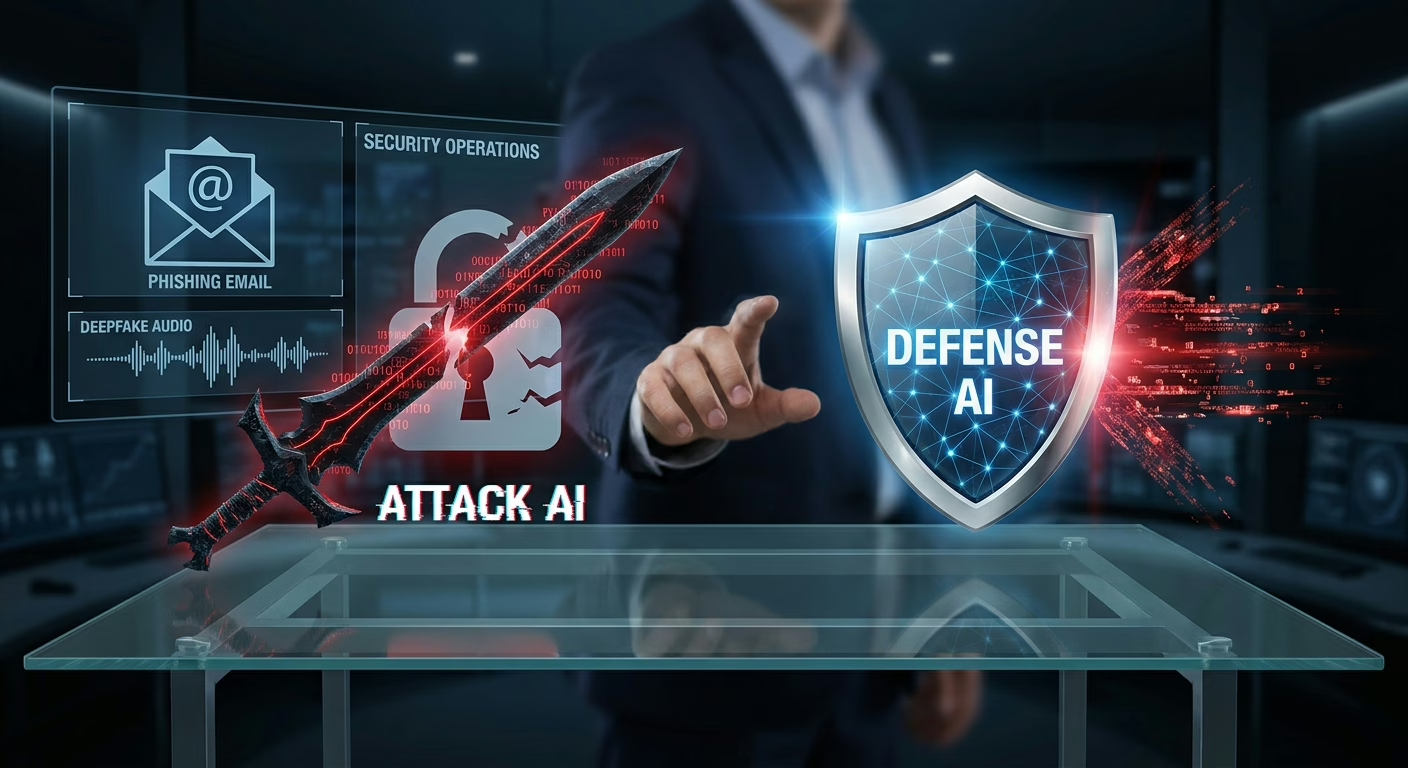
Look, I’m not here to sprinkle magic AI dust on your problems. The reality is far more interesting—and honestly, more useful. AI in cybersecurity is a genuine double-edged sword. In the wrong hands it’s terrifyingly effective. In the right hands, it becomes one of the most powerful protective tools your organization has ever had.
Today we’re going to look both edges of that blade with clear eyes. No hype. No doom-scrolling panic. Just practical, battle-tested insight so you can make smarter decisions before your competitors (or attackers) do.
The Dark Side: When the Bad Guys Have Better AI Than You Do
Let’s not sugarcoat it. What my team and I are seeing in the trenches right now isn’t theoretical—it’s happening on regular Tuesdays.
Attackers are using AI to create spear-phishing emails so eerily personalized they reference private jokes from last week’s leadership offsite. We had one client whose CFO received an email that mentioned a specific comment he’d made in a board meeting that same morning. The psychological manipulation was surgical.
Then there are the deepfakes.
I still remember the case of the finance clerk who picked up the phone to a voice that sounded exactly like her CEO. The voice was frantic, authoritative, and demanding an immediate seven-figure wire transfer to a “new strategic partner.” The clerk was thirty seconds from hitting send when our team caught it. The voice clone had been built from earnings call footage available on YouTube. That’s all it took.
And malware? Don’t get me started.
We’ve moved beyond static viruses. Modern AI-powered attacks are more like intelligent agents. They enter your network, quietly study how your security tools behave, then adapt their tactics in real time to stay invisible. It’s like fighting an opponent who can watch you practice and rewrite the rules of the game while you’re playing.
Let me paint a particularly vivid picture from a recent incident we dissected.
It’s a Thursday afternoon. An attacker calls a junior accounts payable clerk using a perfect voice clone of the company CFO. The story is urgent and emotional—an “emergency” vendor payment that can’t wait. The clerk is rattled. She’s focused entirely on this stressful call.
That’s the magician’s left hand.
While she’s distracted, the real attack is happening. An AI-powered worm that slipped in the previous week is silently mapping the network, locating the customer database, and quietly exfiltrating data through a low-and-slow encrypted tunnel. The entire coordinated operation—distraction plus theft—is over in twelve minutes.
This is the new reality. Machine-speed, multi-vector attacks that exploit both technology and human psychology.
Fighting Fire with Fire: AI as Your Tireless Guardian
Okay, deep breath. That was grim.
But here’s what gets me genuinely excited: the same technology that’s arming attackers can become your strongest defense—if you deploy it with intention.
Think of your network as a massive, bustling city where millions of tiny events happen every second. A human analyst, no matter how talented, can only watch a few streets at a time.
What I like to see is an AI platform that watches the entire city at once.
This is where User and Entity Behavior Analytics (UEBA) becomes pure magic. The AI learns the normal rhythm of your business—who accesses what data, from where, at what times, and in what patterns. It builds a living understanding of “normal.”
Then, when your finance controller—who has never touched engineering files in three years—suddenly tries to access the product source code at 3:17 a.m., the system doesn’t just flag a broken rule. It recognizes that this behavior is weird. The deviation itself is the red flag.
It’s like having a security guard who knows every employee by name, remembers their habits, and immediately notices when the quiet accountant starts wearing a ski mask to work.
Reimagining the Security Operations Center
Remember the old SOC model? A bunch of junior analysts slowly going cross-eyed while drowning in ten thousand alerts, most of them false positives? That model is a burnout machine.
The modern approach I recommend flips this completely.
Let AI become the tireless Tier-1 analyst that never sleeps, never gets bored, and can investigate thousands of alerts in parallel. It handles the initial triage, gathers context, and only escalates the truly suspicious incidents to your senior people.
Think of it this way: AI becomes the super-powered partner that sorts all the evidence so your best detectives can focus on solving the actual cases.
Your expensive, highly skilled analysts stop chasing ghosts and start hunting real threats. Everyone wins—especially your security posture.
My Practical “Where Do You Even Start?” Framework
This is where I get blunt with clients.
Forget the shiny marketing slides with “AI” slapped on them like a trendy sticker. The first thing we do together is a no-nonsense risk assessment.
- Where is your most valuable data?
- What’s the most likely way someone will try to steal it or disrupt it?
- Are your remote employees the weakest link? Then we start with AI-powered Endpoint Detection and Response (EDR).
- Are insider threats keeping you up at night? Then User Behavior Analytics becomes priority one.
The tool must follow the risk. Not the other way around.
My unbreakable rule of thumb: Start with one thing. Get it right. Prove the value. Then expand.
Don’t try to boil the ocean with five new platforms in one quarter. You’ll end up with expensive shelf-ware and frustrated people. Pick the highest-risk area, implement thoughtfully, measure results, then build from there.
The Human Shield (This Part Is Non-Negotiable)
Now let me be painfully direct.
You can buy the most sophisticated AI security platform on the planet, and one well-meaning but untrained employee can render it useless in six seconds.
Technology is not a panacea.
With AI creating perfectly tailored scam emails and voice clones that would fool most of us, your people are under more sophisticated attack than ever before. This is why I’m obsessive about building a genuine security culture, not just a security department.
Here’s my simple, unbreakable rule that I make every client implement:
Any unexpected request for money, credentials, or sensitive data must be verified through a completely separate channel. No exceptions. Ever.
No “but the CEO sounded really stressed!” No “but they knew so many details!” Verify. Always.
Even more important is creating a no-blame environment. I want employees to tell me the second they click a suspicious link—not hide it out of fear while malware spreads. Your AI tools are the shield, but your people are the ones holding it. They remain your last and most critical line of defense.
The Balanced Path Forward
Here’s the real takeaway I want you to carry with you:
AI isn’t coming for cybersecurity. It’s already here—on both sides of the battlefield.
The organizations that will thrive aren’t the ones who bury their heads in the sand or throw money at every new AI tool. They’re the ones who pair the tireless vigilance of well-deployed AI systems with a well-trained, confident, and psychologically safe workforce.
One without the other creates an unacceptable vulnerability.
That human element—how to help your non-technical team actually understand and navigate this new AI-powered world—is exactly what we’re diving into next week.
Episode 28: Training Your Non-Technical Staff to Be ‘AI Fluent’ drops next Thursday. You won’t want to miss it.
In the meantime, I’d love to hear from you. What’s your biggest worry when it comes to AI and cybersecurity? Have you already started implementing any AI-powered defenses? Drop your thoughts in the comments—I read every single one.
Until next time, stay vigilant, stay curious, and remember: the best defense isn’t fear. It’s intelligent preparation.
Talk soon,
Gavin<|eos|>