The AI Efficiency for Accountants Newsletter V1 E5 by Marcie D Terman | Business Development Director 8 September, 2026
Accountancy practices have used technology to improve productivity for decades.
Spreadsheets, Sage, Xero, cloud accounting, payroll systems and practice-management software have transformed how the profession works. Accountants do not need to be persuaded that software can make a business more efficient.
What is changing now is the type of work software can handle.
Much of the technology practices already use helps people perform individual tasks. Increasingly, AI can help move an entire process forward. Agentic systems can identify which documents are required, check what has arrived, monitor deadlines, organise information, perform routine comparisons, prepare communications and alert the right member of staff when something needs attention.
That raises a more commercially interesting question:
Could a practice increase the amount of work it handles without increasing payroll at the same rate?
If the answer is yes, this is no longer simply a discussion about saving time. It is a discussion about capacity, margin and profit.
MTD COULD BE THE REASON TO INITIATE CHANGE
Making Tax Digital gives practices an immediate reason to examine this opportunity.
More frequent reporting means more information moving between clients, practices, software and HMRC. HMRC advises practices preparing for MTD to consider changes to staff training, responsibilities and software, including how new systems will integrate with existing processes and how much support different clients will require.
ICAEW has been even more explicit about the staffing implications. Its guidance warns that work bunching around quarterly submission periods could create significant workload pressures, and says some practices may need additional flexible or part-time staff to cover peak periods.
For some practices, recruitment will be the right response. But hiring another person involves considerably more than paying another salary. Someone has to find and interview candidates, while experienced members of the team must train and supervise them. That creates additional pressure at precisely the point when MTD may already be stretching the practice.
This is why MTD could be a useful opportunity to draw a line in the sand.
Before solving additional workload by adding more people, ask whether some of it could be removed, redesigned or automated instead.
WHAT PART OF THE WORK ACTUALLY NEEDS AN ACCOUNTANT?
The distinction is not between jobs AI can do and jobs people can do. It is between the parts of a process that require professional judgement and those that do not.
A client with an unusual tax position needs an accountant. A complex commercial decision requires experience and a broad understanding of the circumstances. An unexpected discrepancy needs investigation. A client considering a sale may need years of professional judgement applied to the numbers, the market and the personalities involved.
But an accountant does not necessarily need to spend time monitoring whether April and May’s bank statements have arrived while June’s is still outstanding.
That kind of work has traditionally been left to junior staff because somebody had to do it. The question now is whether people should continue doing it manually when software can monitor the process, identify what is missing and prompt the appropriate person to act.
That is where the economics begin to change.
TWO PRACTICES FACE THE SAME MTD PROBLEM
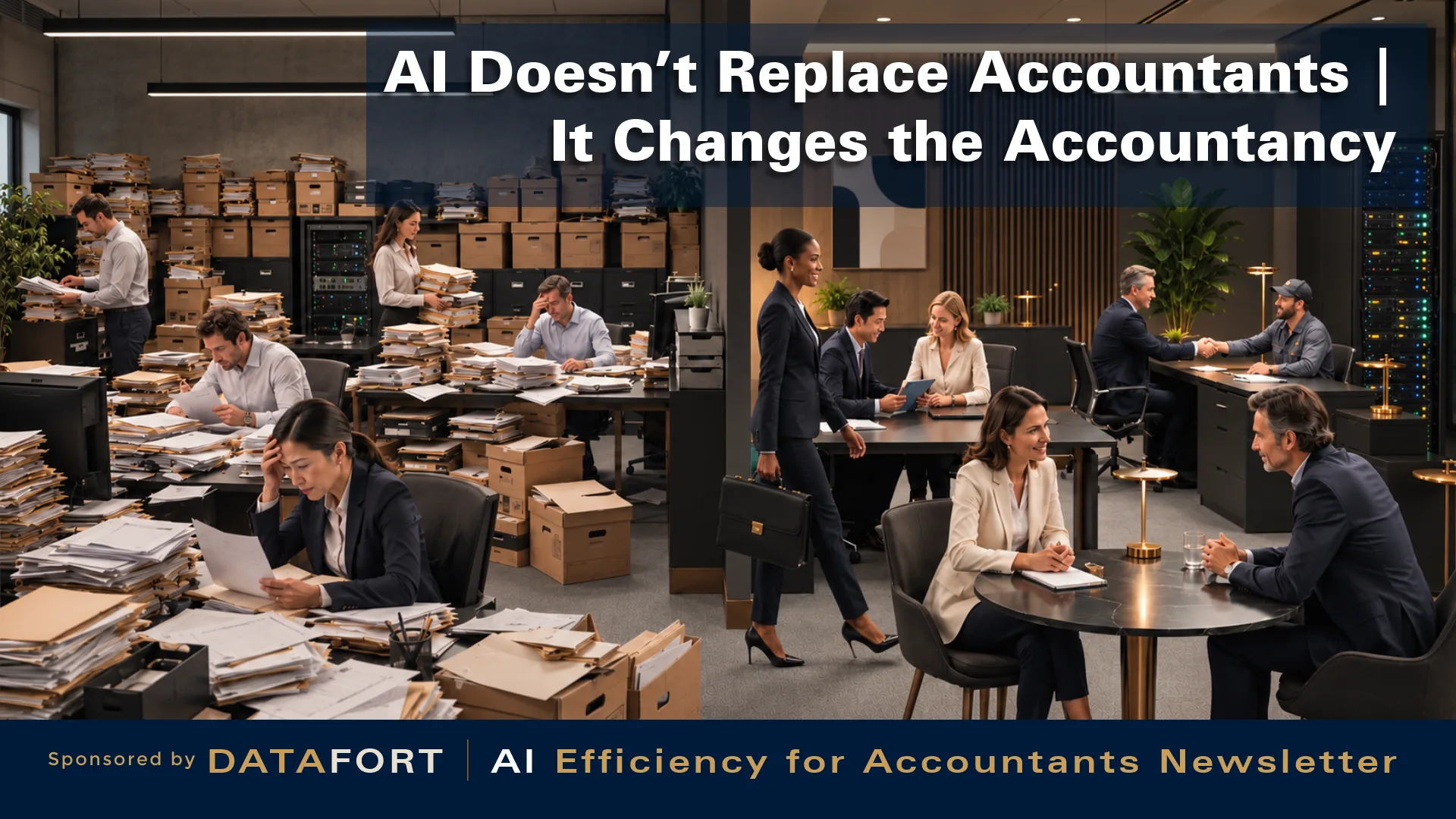
Imagine two similar practices with broadly the same number of clients and staff. Both expect MTD to create additional recurring work, with particularly heavy pressure at certain points in the reporting cycle.
Practice A responds principally by recruiting.
It hires additional staff to absorb the extra workload. That brings salary and recruitment costs, as well as the time required to find, train and supervise new employees. There is also the risk that a new hire may not work out, leaving the practice to repeat the process.
Practice B asks a different question first.
It examines where the additional workload will arise. Some of it requires professional judgement, but much of it involves monitoring information, identifying gaps, sending reminders and managing routine workflow.
The practice redesigns those processes and automates the parts that can be handled reliably by software. It may still recruit, but it needs fewer additional human hours to service each new tranche of work.
Over several years, the difference becomes significant. If Practice A has to increase headcount broadly in line with its workload while Practice B can increase its workload faster than its headcount, the two businesses will develop very different economics.
The difference eventually appears in revenue per employee, margin and profit.
That is an opportunity worth examining.
TECHNOLOGY CAN ALSO CHANGE HOW PEOPLE ARE DEVELOPED
Automation may also change how junior accountants are trained.
Once the fundamentals are understood, less time can be spent repeating routine tasks and more time can be spent alongside experienced practitioners, learning judgement, client handling and the commercial craft of accountancy.
There is already evidence of this shift. Deloitte is redesigning elements of its graduate audit training because AI is changing manual trainee work. Its aim is to move junior accountants further up the learning curve, with greater emphasis on judgement, communication and problem-solving. ACCA similarly notes that automating repetitive tasks such as data entry and reconciliation can allow trainees to develop analytical and advisory capabilities earlier.
The point is not to remove the junior accountant’s role. It is to make that role more developmental and valuable.
HOW THE TEAM MANAGES WORK BECOMES MORE IMPORTANT, NOT LESS
The most useful discussion about AI in accountancy should therefore not revolve around replacing accountants.
The valuable parts of the profession remain human: understanding why two superficially similar businesses need different advice, recognising when a technically possible course of action creates unacceptable commercial risk, challenging the assumptions behind a forecast and understanding the ambitions and temperament of the client.
AI can analyse information, detect patterns and generate possibilities. But someone still has to interpret those possibilities in context, decide what matters and take professional responsibility for the advice that follows.
The opportunity is to spend more human time on that work.
PROFIT IS NOT A DIRTY WORD
Practices are businesses. If technology allows a team to service more clients without employment costs rising at the same rate, profitability can improve. If qualified staff spend less time administering work and more time on client relationships, service may improve and additional revenue may become possible.
The same applies internally. Junior staff can develop useful judgement earlier, while senior staff can spend less time supervising repetitive processing and more time advising clients, mentoring colleagues and developing the practice.
None of this requires accountants to disappear. It requires practices to become more deliberate about where human beings create the most value.
MTD MAY PROVIDE THE REASON TO BEGIN
The immediate pressure may be MTD, but the more important opportunity is what practices learn from responding to it.
If AI or automation can reduce unnecessary workload in one process, the next question is obvious:
Where else are we using people to compensate for processes that could work better?
The objective is not to automate everything. It is to identify the parts of the practice where technology can create enough additional capacity to make a meaningful commercial difference.
Both practices in our example employ accountants. Both value professional judgement. Both may continue recruiting when they genuinely need more people.
The difference is that one uses technology to concentrate its people on the work for which people are most valuable. Over time, that practice may be able to grow faster, serve clients better and produce stronger margins.
So perhaps the most important question surrounding AI in accountancy is not – Will AI replace accountants? It is – Will practices that learn to use their accountants more productively become more profitable and competitive than those that do not?
AI does not have to make the accountant less important. Used well, it can enable practices to spend more of their accountants’ time doing the work that makes them valuable in the first place.
And that could make the practice considerably more valuable too.
Download a copy of MTD: Burden or Business Advantage, our handy e-guide on how AI could streamline the peaks and valleys of work that have resulted from the introduction of the Making Tax Digital initiative, visit https://datafort.com/mtd-guide.
If you have processes in mind you would like to improve in your business, bring that information to a short, no-obligation meeting and we can start there. Use this link to book a brief introductory meeting.
SOURCES
- HMRC — Get ready for MTD: an agent toolkit — Preparing your practice
- ICAEW — Prepare for MTD ITSA: managing workflows
- ICAEW — How Deloitte is reshaping its audit training for the AI age
- ACCA — The future of accountant training: AI and experience