Hello and welcome back to AI Solutions: The Pathway to Profit.
Today we’re diving into one of the most misunderstood topics in the AI world: synthetic data.
Is it a revolutionary accelerator that lets you train models on scenarios you could never safely capture in reality? Or is it a seductive shortcut that quietly trains your expensive AI to be brilliant at make-believe?
The answer, as usual, is both. And that tension is exactly why we need to talk about it.
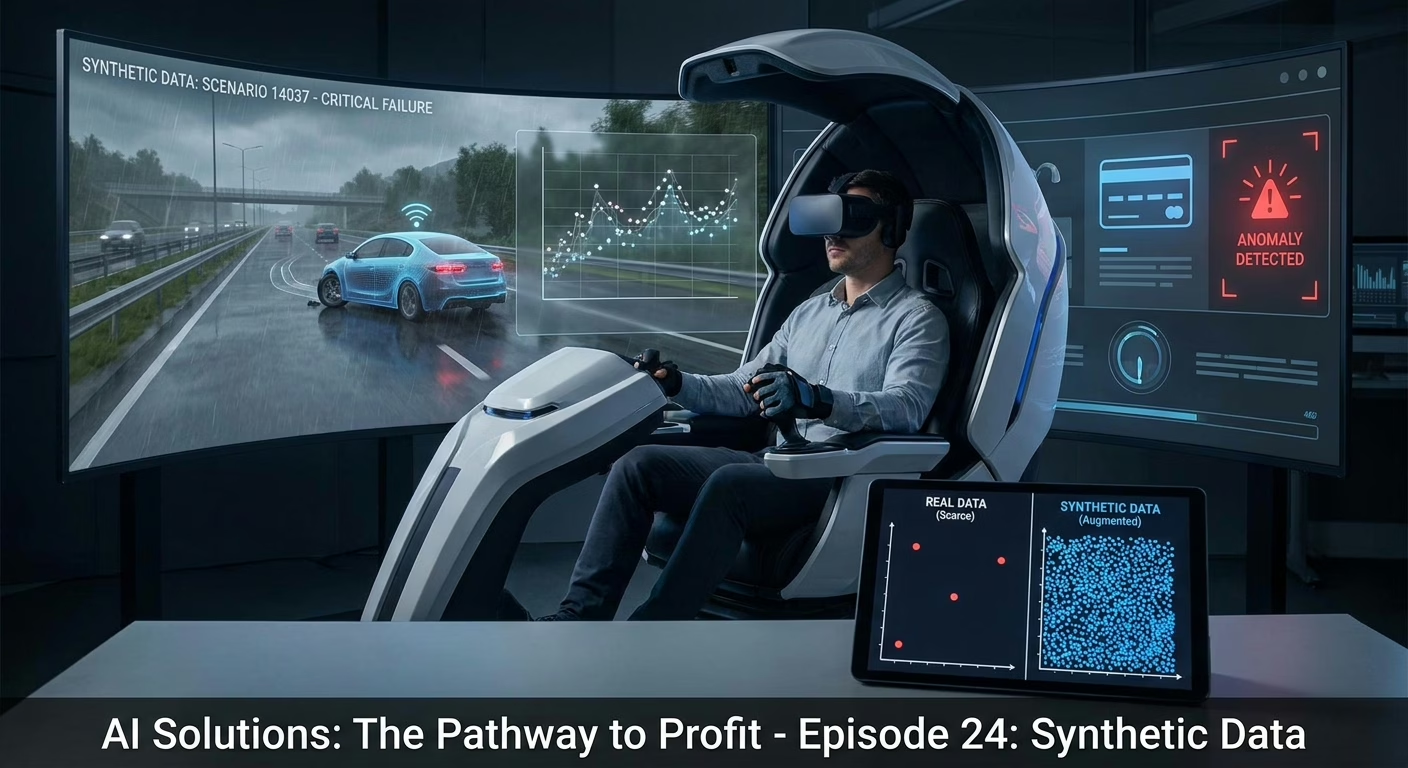
Let me paint a vivid picture. Imagine teaching a self-driving car how to handle a tire blowout on a rain-slicked highway at 75 mph. You could try to stage that scenario hundreds of times in the real world. You’d bankrupt the company, terrify your test drivers, and still not get enough variety.
Or… you could simulate it ten thousand times before breakfast.
That’s the incredible promise of synthetic data. But get it wrong, and you’ve just built an AI that’s an expert in a fantasy world that doesn’t exist. Today I’m going to show you how to stay on the right side of that line.
What Synthetic Data Actually Is (And Isn’t)
Synthetic data is artificially generated information that mimics the statistical properties of real-world data.
We’re not talking about faking a few numbers in Excel. Modern approaches use sophisticated techniques like Generative Adversarial Networks (GANs), where two neural networks go toe-to-toe—one creating fake data while the other tries to spot the forgery. They battle until the generated data becomes nearly indistinguishable from reality.
Think of it as a flight simulator for your AI. The pilot (your model) can crash spectacularly ten thousand times, learning from every possible failure mode, without ever bending real metal or violating privacy laws.
Why Real-World Data Is a Nightmare
I’ve never met a client who had too much clean, perfectly labeled, unbiased real data. It’s almost always expensive, legally treacherous, and frustratingly incomplete.
Take the manufacturing client I worked with a few years ago. They had years of operational data from their pumps, but only three recorded instances of a catastrophic failure mode that cost them millions when it happened.
Three examples.
You can’t build a reliable predictive maintenance model on three examples. It’s like trying to predict the weather after looking out the window three times.
This is where synthetic data becomes pure magic. We generated thousands of realistic variations of that failure mode, grounded in the physics and sensor patterns from the real cases. The model went from glorified coin-toss to genuinely useful early warning system.
The Three Massive Benefits Nobody Talks About Enough
1. Privacy Superpowers
In finance and healthcare, teams are rightly terrified of GDPR, HIPAA, and the next big breach. Synthetic data lets you create a statistically identical twin of your customer dataset that contains zero actual personal information. Your data scientists can go wild building new products while the legal team finally stops having nightmares.
2. Speed and Cost Efficiency
Remember that executive who spent six months and a small fortune physically reconfiguring his flagship store to test new layouts? (Painfully common story.) A synthetic approach could have simulated ten thousand customer flow patterns overnight for a fraction of the cost.
3. Filling Critical Data Gaps
When reality doesn’t give you enough examples of rare but expensive events, synthetic data steps in as the ultimate multiplier. It doesn’t replace reality—it multiplies it.
Where Things Go Spectacularly Wrong
Now let’s talk about the dark side. Because I’ve seen some truly expensive disasters.
The first trap is bias amplification. If your real data contains historical prejudice (fewer loans to a certain demographic, for example), a synthetic data generator doesn’t magically fix it. It can learn that bias and scale it up dramatically. You end up automating discrimination at industrial scale. Not ideal.
Then there’s what I call the reality gap. One retail client built a beautiful demand forecasting model using synthetic data. It was statistically perfect. Except the model had never learned that when it rains, people buy more comfort food. The simulation missed that subtle human behavior. The model was perfect at predicting a world that didn’t quite exist.
My favorite cautionary tale involves a sharp but arrogant e-commerce company. They built a recommendation engine trained entirely on five years of synthetic data that perfectly mirrored their past successes. Then a viral trend made retro jackets the hottest item on earth. Their engine, trained in an echo chamber of its own past, kept pushing fleece vests. Their competitors cleaned up while their sales dashboard looked like a crime scene.
The lesson? Your synthetic data is only as good as the reality it’s modeled on.
The Credit Card Company That Got It Brilliantly Right
Let me share a success story that still makes me smile.
A major credit card issuer had billions of transactions but their fraud models were always playing catch-up. They were great at catching last year’s scams.
Instead of continuing that losing game, they used synthetic data to generate new, never-before-seen types of fraudulent behavior. They created a training ground where their AI could spar against future threats instead of just memorizing past ones.
The result? Their model started spotting the underlying signals of fraud rather than just known fingerprints. That shift from reactive to proactive saved them tens of millions in the first year.
That’s not a shortcut. That’s strategy.
My Rules for Using Synthetic Data Without Becoming the Fool
After watching both spectacular wins and expensive disasters, I’ve developed some pretty firm guidelines:
Rule #1: Never use synthetic data in isolation.
It’s an accelerant, not a replacement. My unbreakable rule is constant “ground-truthing.” Keep a high-quality set of real-world data as your compass and continuously validate against it.
Rule #2: The method must match the mission.
Don’t just grab the shiniest new algorithm. The right technique depends entirely on whether you’re dealing with tabular data, images, time series, or customer behavior.
Rule #3: Put a human in the loop.
Before a single synthetic record touches your production model, a domain expert needs to look at it and ask: “Does this feel right?” If it doesn’t pass the gut check, it’s teaching your AI to be an expert in nonsense.
The Mindset Shift That Changes Everything
Here’s what I want you to take away from this episode:
Stop thinking about synthetic data as a replacement for real-world data. Start thinking about it as augmentation—a way to sharpen your insights and illuminate your blind spots.
The companies winning with synthetic data aren’t using it because they’re lazy about collecting real data. They’re using it because they’re serious about covering every possible scenario their models might face.
They treat it as a high-potential, high-risk tool that requires thoughtfulness, governance, and constant connection to reality.
Your Next Move
If you’re building AI solutions that need to handle rare events, protect privacy, or explore scenarios that don’t exist in your current data, synthetic data might be your competitive advantage.
But only if you wield it with respect.
The difference between the companies that get destroyed by it and the ones that save millions comes down to one thing: strategic discipline.
Thanks for spending time with me today. I genuinely love geeking out about these tools with you.
Next week we’re tackling a decision that keeps leaders up at night: build your AI team from scratch or bring in the experts? We’ll break down when to do each and how to avoid the painfully common traps either way.
I’d love to hear from you. Have you had success (or disaster) with synthetic data in your organization? Drop your thoughts in the comments.
Until next time, keep it real… even when you’re generating the fake stuff.
— Your AI Solutions Guide