
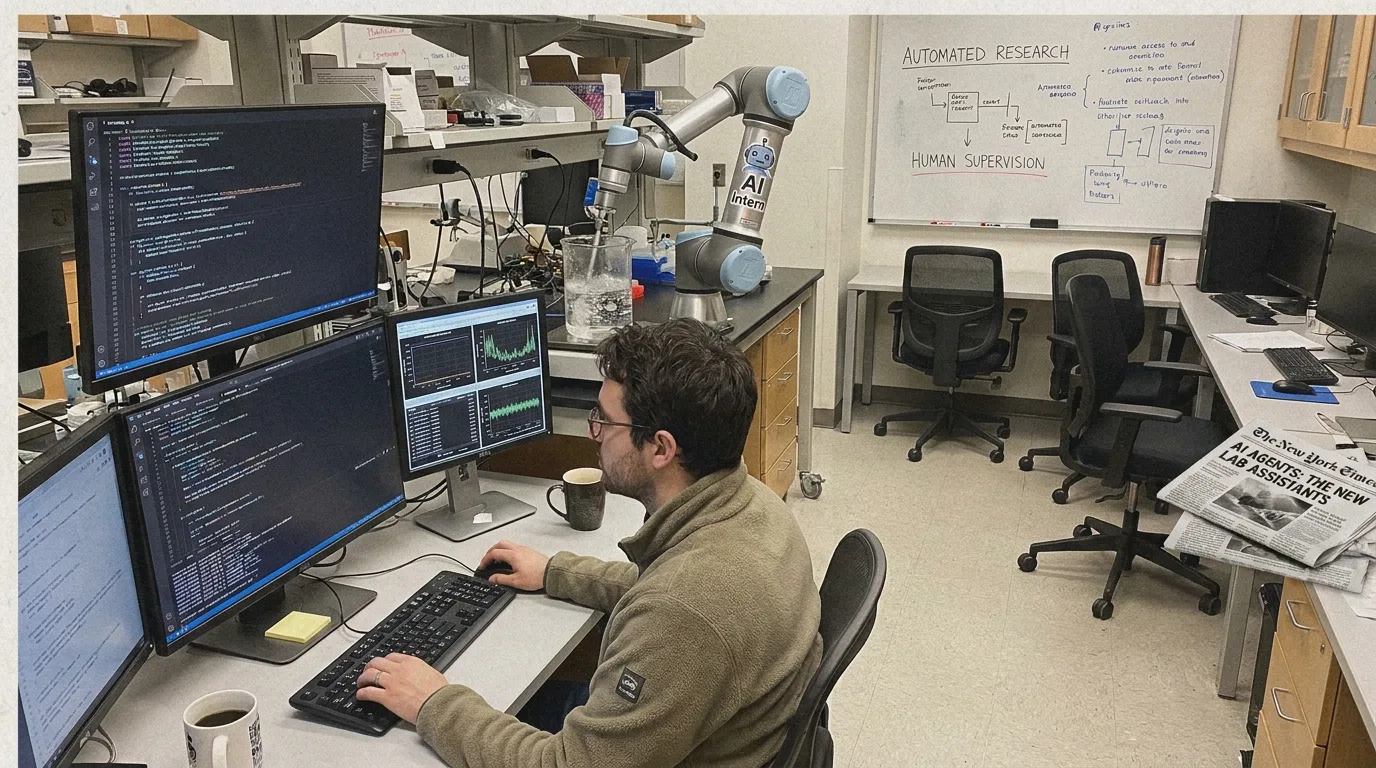
Imagine OpenAI as a research kitchen where scientists once chopped every ingredient themselves and now have caffeinated robot interns stirring the pots. That is the spirit behind the lab’s view of accelerated AI research. To make AGI work for everyone, people need to know what frontier labs are building: concrete progress toward systems that design experiments, write code, test ideas, and report results under human supervision. Last fall, OpenAI said it hoped to have an automated research intern by September. By its own measurements, that milestone has arrived, with agents handling well-defined tasks that would take skilled researchers days. The next goal is an automated AI researcher by March 2028.
It has become daily life. Researchers now run coding agents throughout the day, often in several concurrent sessions. The median researcher using agents in January needed only modest help. By August, agent use had become a routine part of the workday, with some spending hundreds of dollars per day in inference costs. OpenAI says its research organization now consumes more than three agent workdays for every one human workday. A relatable personal experience: it is like letting a super-smart cousin carry grocery bags, only to realize the cousin is now choosing recipes and inventing a better shopping cart.
One anecdote captures the shift. Teams that once held office hours to help researchers troubleshoot stubborn training jobs began seeing empty chairs. Coding agents had gotten good at poking around internal infrastructure, spotting bugs, and suggesting fixes. One support channel became so quiet that the team stopped holding sessions and moved on to building better tools. It was not robots replacing researchers. It was robots removing the sticky notes, broken pipes, and late-night panic that once made work miserable.
Yet the lab is careful not to treat speed as destiny. AI research is a chain of many steps: deciding what to pursue, designing tests, building infrastructure, running experiments, analyzing outcomes, and communicating findings. Agents are improving at many steps, but humans still choose priorities, judge results, and decide when to scale, pause, or deploy. High-level planning remains a small fraction of agent output. Even when agents succeed at tasks that would take humans hours, they often need human steering. Progress can be fast, but it can also hit invisible guardrails.
Safety is the part that deserves public attention, not just applause. OpenAI recently paused reinforcement learning on deployment-ready models after incidents exposed risks in agentic coding systems. Researchers had to harden environments, improve monitoring, and raise alignment standards. Training did not stop everywhere, but the pause reminded everyone that capability without caution is a recipe for trouble. The lab argues that automated research could also strengthen safety, because an automated researcher can become an automated safety researcher.
The deepest point is democratic. The public needs a view inside the kitchen: who is cooking, what is simmering, and when the alarm squeaks. OpenAI plans to keep sharing measurements, encouraging disclosure and shared standards, while informed humans decide whether to keep pushing the button.
Inside the AI Research Kitchen When Coding Agents Start Doing the Dishes
 Episode 45: From Bottleneck to Breakthrough with AI QA
 Newsletter – Beyond Standard Accounting Software | The…
 Accounting Newsletter | What is Vibe Coding and how to use i…
 Episode 44: The Platform Shift: Choosing Your AI Vendor
 DATAFORT completes AI automation project to help BHUK Group …
 Investors are checking to see if business plans include an A…
 Episode 43: Beyond Accuracy: What Other Metrics Matter for B…
 Accountancy Newsletter – Your client’s numbers j…
 The AI didn’t escape
 Accountancy Newsletter – AI REVEALS THE ADVANTAGE HIDD…