The AI Efficiency for Accountants Newsletter V1 E4 by Marcie D Terman | Business Development Director 1 September, 2026
For many, AI still means asking ChatGPT a question, editing an email so it is more fluent, or summarising a document. Company administrators are being asked to decide what staff should be permitted to do with these tools. They are also unsure about whether using AI exposes customer information or whether that information is used as training data by a model. Many suspect there are substantial efficiency gains within reach, but lack the information they need to put sensible company policies in place.
Is AI potentially useful for increasing efficiency? Undoubtedly. But adoption in many firms remains piecemeal — without an overall strategy or clear oversight.
Now there is the added question of what to do about Agentic AI.
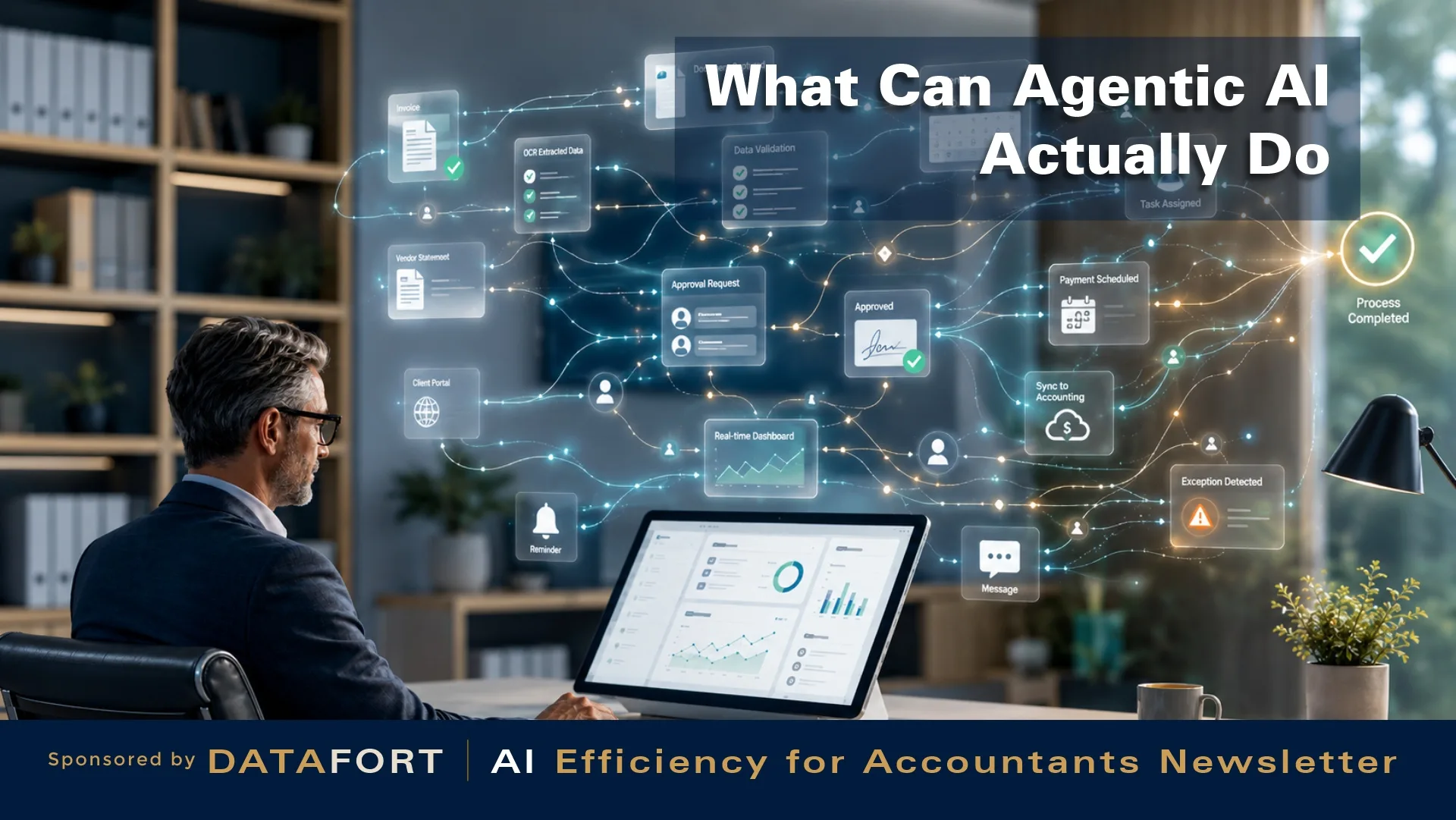
The simplest way to understand the difference is that, up until now, most of the AI people have encountered has been passive. You ask, it answers. However, an AI agent is software that can actually perform actions. Give the agent an objective, access to particular tools and defined permissions, and it can work out what actions to take in pursuit of that objective.
Imagine giving a system this instruction:
“Make sure clients A, B, C and E have supplied all the records we need by this specific date which is several working days before the quarterly reporting deadline.”
That is not a request to write an email. It is an objective.
The practice administrator can also define what the deadline is and, if it is a task that occurs on a specific schedule, let’s say monthly, they can set that parameter as a recurring task, making sure the request does not need to be made every time the calendar page flips to a new month. You would not normally want an agent still chasing missing records on the day a submission is due. The practice might require records to be completed several business days beforehand, giving staff time to compile the information and resolve anything unusual.
The agent can also be told when to stop trying to solve the problem itself and involve a person. If experience suggests that a client normally takes two days to respond, waiting until two days before the internal deadline to escalate would clearly be too late. The practice could instead require human intervention five working days before the end of the month, or earlier for clients and jobs known to require greater time to complete.
These are not decisions the agent has to make for itself. They form part of the operating rules established by the practice.
To achieve its objective, the agent needs to know which records are needed. It will need to check what information has already been received and identify what is missing or even partially provided. It might be given permission to compare this quarter’s documents with previous quarters to identify anomalies. It can then decide who needs contacting, prepare or send communications, monitor the responses, recognise when only part of the requested information has arrived and decide what needs to happen next. All of this can be scheduled automatically each monthso that staff can get on with other chores that require human skills and judgement.
An agent will understand that weekends and bank holidays are not ‘working’ days. Also, it can be given a working knowledge of expected response times and the practice’s own internal deadlines. The objective is not simply to chase documents. It is to get the right information inspected and into the practice’s working folders early enough for the work to be submitted in a timely way.
Depending on the authority the practice has given it, the agent might perform those actions itself, prepare them for approval or simply tell a member of staff what it recommends doing. It can also identify which information looks correct and which requires human attention before it is approved .
It may also work with other agents or systems. One might monitor incoming documents, another might deal solely with managing client communications, while a third keeps track of deadlines and exceptions. What matters is that the technology is no longer simply producing an answer. It is helping to move work towards an outcome.
The amount of authority given to an agent does not have to be all or nothing; it can be nuanced. One agent might observe a process and report what it finds. Another might recommend the next action, prepare it for sending but wait for approval. A third might be permitted to carry out routine actions automatically, provided they fall within clearly defined rules. The administrator decides where on that spectrum each process should sit.
A practice might, for example, be comfortable allowing an agent to send an established reminder when a routine document has not arrived, while requiring human approval before it sends anything involving an unusual transaction, a client matter that it has never observed before or a significant discrepancy. The same principle applies to access. An agent responsible for chasing missing records may need to see the document store, relevant deadlines and approved client contact information, but it has no reason to alter a tax return, initiate a payment or access information unrelated to the work it has been assigned.
This is why permissions become increasingly important as agents become more capable. An agent should have access to the information and tools required to perform its role, but no more. If a task does not require identifying information, the identifiers can be removed from the agent’s view systematically. If sensitive information is involved, the practice needs to make sure that the model, system architecture and data handling arrangements are appropriate to the job being undertaken.
There also need to be clearly defined points where the agent stops and involves a person. An unusual transaction may need interpretation. A discrepancy may need investigation. A client communication may be too sensitive to automate. An action that is difficult to reverse will require human approval, with a record of who approved the action. Those intervention points are designed into the process from the beginning rather than discovered after the system has encountered something nobody anticipated.
The objective is not to remove people from a process. It is to give staff more time to add value to the practice where human contact gives the greatest benefit to the business. If there is no need for people to spend time repeatedly checking routine steps, why not direct their attention instead towards the parts of the work where judgement, experience and client care genuinely matter? Efficiency will increase; so may customer and employee satisfaction, creating a superior working environment and a more stable company.
An appropriately designed agent can monitor and manage routine operations in the background. If the process is proceeding normally, routine work continues. If something falls outside the rules, the system brings the exception to the appropriate staff member, because it knows who is in charge of what processes. The same thing applies on the client side. The agent can be trained to contact one employee in a client’s office for payroll information and another for bank statements and a third for expense reports.
This is one of the reasons Agentic AI has the potential to be significantly more useful than the AI tools many software providers are adding to their service offerings. These agents are custom-built to add value to that particular practice based on the way the company works. And if the agent is structured properly, changes in the business, processes or functions can be accommodated, helping to make the system future-proof.
If there is a recurring process in your practice that consumes too much staff time, requires constant checking or repeatedly creates bottlenecks, it may now be possible to approach it differently. At DATAFORT, we start with the process that needs improvement rather than adding AI software to a business. We listen to what you are trying to improve or achieve and how the current process works. Then we look at where AI agents or software are the right solution to make the practical, needed difference.
If you have processes in mind you would like to improve in your business, bring that information to a short, no-obligation meeting and we can start there.
Visit the DATAFORT Website.
Use this link to book a brief introductory meeting.
Or to download a copy of MTD: Burden or Business Advantage, our handy e-guide on how AI could streamline the peaks and valleys of work that have resulted from the introduction of the Making Tax Digital initiative, leave your email address here.