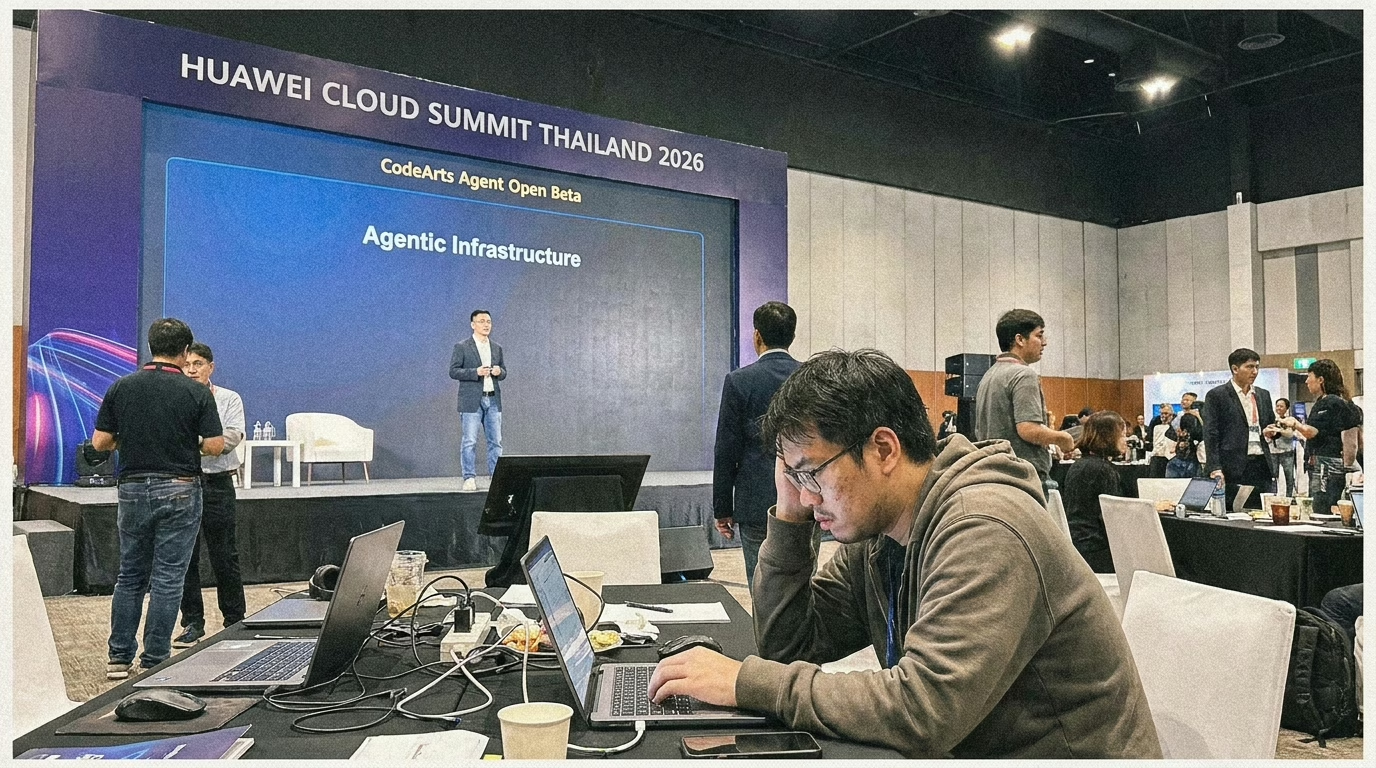
There is a universal rite of passage for every coder: the 3 a.m. stare-down with a bug that has more persistence than a Bangkok taxi driver during monsoon season. You fix one line, and three others break. It’s enough to make you wish your laptop could snap its fingers and mutter, “Sorted, boss, go back to sleep.” Well, grab your digital umbrella, because Huawei Cloud is bringing that wish-fulfillment to Thailand. At the Huawei Cloud Summit Thailand 2026, the Chinese tech giant announced its Agentic Infrastructure and launched the open beta of CodeArts Agent, signaling that the days of solitary coding may be numbered.
This rollout isn’t just a shiny new toy; it’s a robust digital ecosystem. Huawei’s Agentic Infrastructure rests on four pillars named by what sounds like a sci-fi director with a flair for acronyms. You’ve got the UnifiedBus-based AI Cluster Service churning out tokens, the Agentic Memory Storage Service providing petabyte-scale recall (because nothing kills momentum like forgetting your logic mid-sprint), AgentSphere serving as the runtime playground, and CCE VolcanoNext scheduling resources like a maestro conducting an orchestra of servers. Together, they form the backbone for developing and deploying AI agents that actually get things done.
I remember testing an early coding assistant once, asking it to optimize a database query. It cheerfully generated code that didn’t just optimize the query; it politely asked the database if it wanted to go for coffee. It was charming, but I needed results, not romance. Huawei’s CodeArts Agent seems to have learned its manners. Now in open beta in Thailand, it blends development environments with autonomous capabilities. It handles project-level code generation, unit tests, and R&D queries. Even better is the “Agent Team” mode, which lets multiple agents collaborate concurrently. It’s essentially a squad of digital elves working your codebase while you tackle the architecture. The platform also leverages Specification-Driven Development, ensuring code quality is baked in from the requirements stage to delivery, rather than bolted on as an afterthought.
Security, naturally, gets the VIP treatment. Huawei has upgraded protections with a model lifecycle security solution and “Data Capsule” technology. Think of Data Capsules as digital handcuffs for your information; if data tries to escape its authorized security zone, it instantly becomes invalid. Customers can also manage their own encryption keys in dedicated security zones, keeping data tighter than a drum at a festival.
The summit buzzed with local flavor, too. Thai organizations demonstrated AI use cases that go beyond the hype. We saw intelligent assistants helping the public sector serve citizens faster, banking institutions deploying LLMs for smarter coding workflows, and HR departments using AI-powered learning platforms to upskill workforces. The open beta is specifically designed to court Thailand’s vibrant developer community, inviting feedback to polish the gem before a wider release. With Huawei Cloud ranking third in Thailand’s IaaS market, operating three availability zones, and serving over 40 government agencies, the infrastructure is humming. As executives Sunny Shang and Surasak Wanichwatphibun noted, this is about empowering enterprises with AI-driven innovation. So, developers, the beta is your invitation. Just don’t ask your new Agent Team to make you dinner yet; even with petabyte memory, they still haven’t cracked the code for the perfect Pad Thai.