
In 2025, Meta founder Mark Zuckerberg pulled off a deal so big it made venture capitalists spit into their oat milk lattes: $14.3 billion for Scale AI’s people, including wunderkind Alexandr Wang, whose slice looked like about $5 billion. Critics clutched their pearls. Analysts adjusted their monocles. The internet muttered, “That price tag has a comma problem.” Yet tech investor Adam Khoo argued that greatness often looks like madness from the cheap seats. The real question, he said, is not what someone costs, but what they make possible.
The result has been less a tidy business case than a fireworks show. Wang’s team shipped the new Muse agent, a voice-first pocket companion called Muse Charm, and glasses that made Meta look late to the AI party and then arrived in a self-driving tuxedo. Investors suddenly noticed Meta’s AI products adding roughly $200 billion to its stock valuation. That turned a $5 billion hire into what looks, in hindsight, like buying a golden goose and asking the farmer not to include the pond.
I have a modest anecdote from my own life that captures this logic. Last winter I paid far too much for a dented espresso grinder that looked like it had survived a barista’s tantrum. Friends laughed. I told myself it was an investment in future mornings. The machine did produce good coffee, but the lesson stuck: sometimes the sticker price is not the story. The story is the mornings it saves, the focus it creates, and the small thrill of using something you nearly walked away from. In tech, that principle gets multiplied by billions, so a purchase that seems absurd in the boardroom can become a daily miracle on App Store charts.
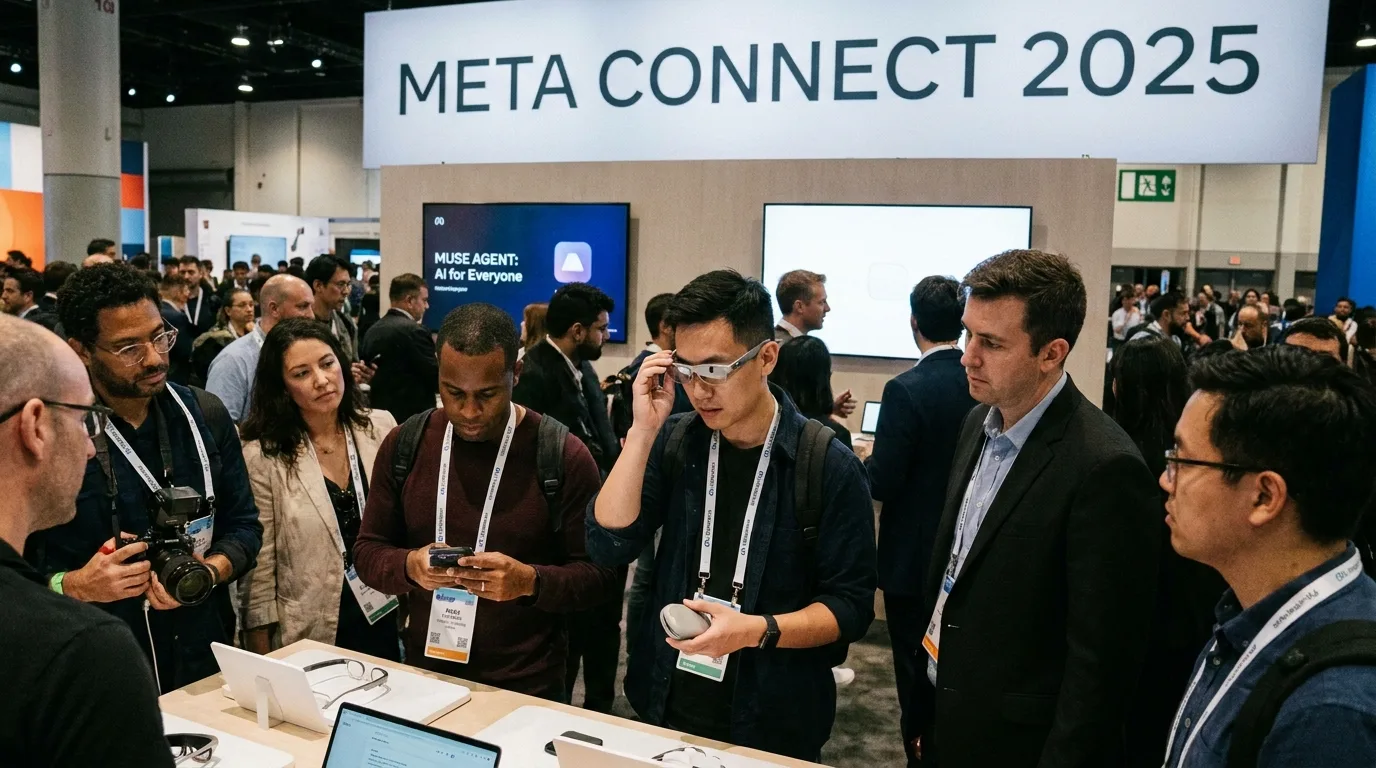
By Meta Connect, the spectacle had arrived. Zuckerberg staged a Steve Jobs-like surprise with the Muse Charm, a pocket-sized device made for chatting with the new agent. Then came the VR glasses, a 100-gram featherweight compared with the bulkier Quest 3, equipped with 5K micro-OLED displays, tethered puck processing, eye tracking, and hand tracking. The $1,299 hardware felt like a statement: personal superintelligence should fit on your face without turning your forehead into a workout. Alongside them, the third-generation Ray-Ban Meta Gen 3 glasses started at $249, while camera-free Ray-Ban Meta Audio glasses offered open-ear listening and voice-powered AI, like a whispering librarian in a stylish frame.
Wang, wearing camo Crocs like a battlefield commander from Silicon Valley, helped steer the presentation, while Muse soared to the top of Apple’s App Store. In its first 12 days across the US and Canada, it logged 2.8 million downloads, surpassing ChatGPT’s early pace with 1.8 million to 1.3 million, according to Sensor Tower. The lesson is not that talent is cheap; it is that talent can be a value furnace if pointed in the right direction. Meta looked late, then led. The deal looked silly, then sublime. And the $14.3 billion bet became a masterclass in seeing past the price tag to the future it can build.
The $14.3 Billion Bet That Made Meta Look Less Late and More Luminous
 Episode 41: Federated Learning: The AI Privacy Paradox
 Newsletter: FIRST RULE OF INTELLIGENT AUTOMATION: DON’T AUTO…
 Newsletter – Where Does Your Data Go?
 Episode 40: Supercharge Your Sales with AI Lead Scoring
 Build Versus Buy: How AI Is Upending Business Software
 Accountancy Newsletter: So, how did August 7, the first MTD …
 Accountancy Newsletter: So, how did August 7, the first MTD …
 Inside the AI Research Kitchen When Coding Agents Start Doin…
 Episode 39: Knowledge Management Reimagined: Cure Corporate …
 Episode 38: The AI Product Manager: Your Most Important Hire