Hello and welcome back to AI Solutions: The Pathway to Profit! It’s great to have you here with me again. You know, some of the most fascinating questions in technology are the ones that feel like a paradox, a real brain-bender. Today, we’re diving into one of my absolute favorites in the world of machine learning, a topic I think is not just clever, but truly elegant: Federated Learning.
Let me paint a vivid picture for you. Think about all the incredibly powerful information locked away in private datasets around the world. The text you type into your phone every day, your confidential medical records, your company’s sensitive financial data. Now, imagine trying to train a powerful AI model on all that rich information… without ever actually seeing it. Without ever moving it from its source. How can we possibly teach an AI with data we’re not allowed to touch? It sounds completely impossible, right?
Well, this is where a brilliant shift in perspective changes everything. Federated Learning isn’t just a cool theory; it’s a practical, powerful solution that is fundamentally reshaping how we resolve the critical conflict between data-hungry AI and essential user privacy. It’s a journey from “impossible” to “ingenious,” and it’s one worth taking together. So, let’s get into it.
The Bank Heist That Never Was: Understanding Federated Learning
When I’m trying to wrap my head around a new concept, I always find it helps to start with a great analogy. So, let’s imagine a group of competing banks. They all want to build a world-class AI model to detect fraudulent transactions, which would save them millions. The more data the model sees, the better it gets. But here’s the problem: no bank in its right mind would ever share its confidential customer transaction data with its competitors. Never. Ever.
The old paradigm, the one we’ve used for years, hits a brick wall here. The old way says: “Pool all your data in one central place, and we’ll train a master model.” For the banks, that’s a non-starter. But the new paradigm, Federated Learning, does something beautifully simple: it reverses the flow.
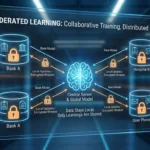
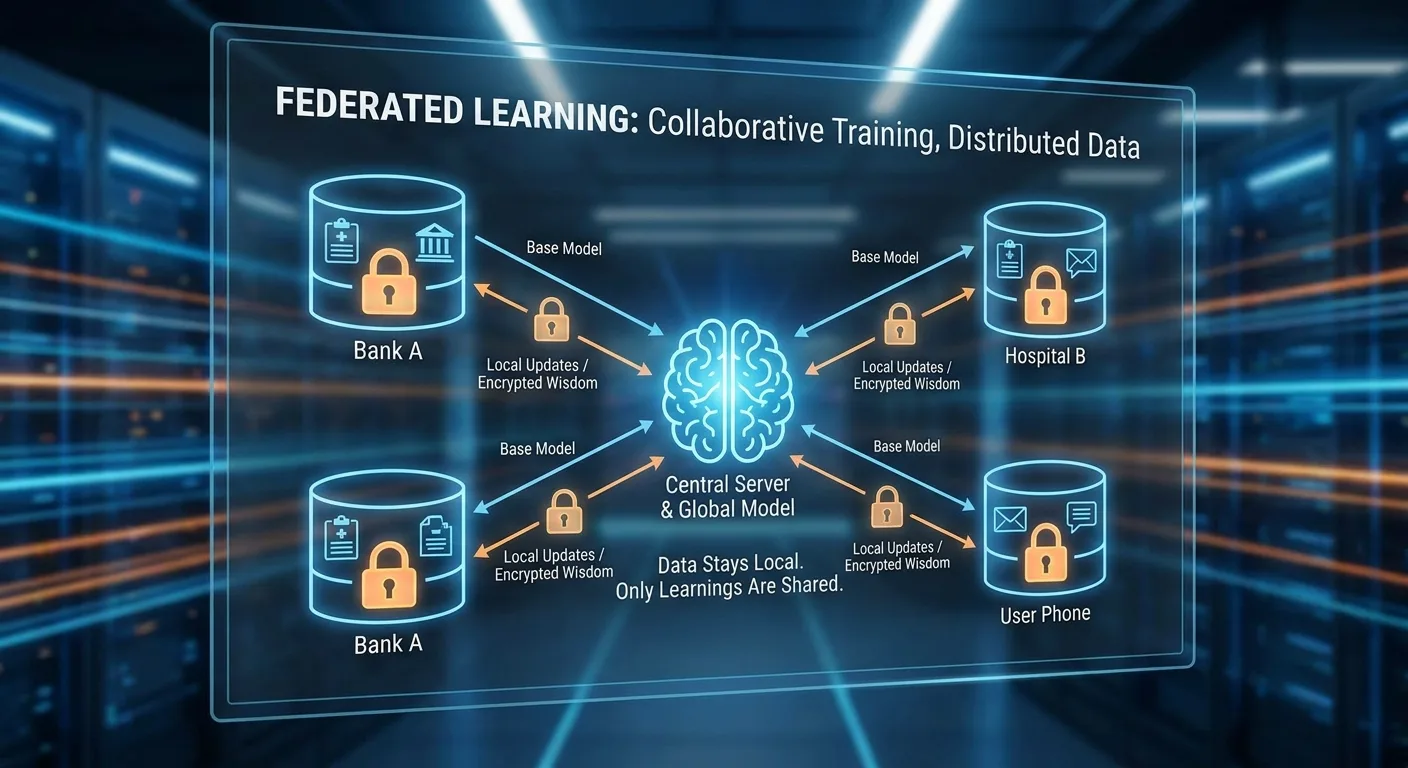
Instead of the sensitive data moving to a central model, a base model is sent out to each bank. Think of it as sending a junior detective to each bank branch. Each bank then trains this model locally, on its own private data, right there inside its own secure servers. The model learns from that bank’s unique fraud patterns, getting a little bit smarter. Then—and this is the truly elegant part—each bank sends back only the learnings. Not the data. Just the mathematical adjustments, the updated parameters, the distilled wisdom. It’s like the detective sends back a report saying, “Here’s what I learned about spotting fraud,” without ever revealing a single customer’s name or transaction.
A central server then intelligently combines all these little packages of wisdom from all the banks to create a new, vastly improved master model. This new super-detective, now armed with the collective experience of the entire industry, is then sent back out to the banks. They all get the benefit of a world-class model that none of them could have built alone, and not a single piece of sensitive customer data ever left the building.
A Continuous Conversation: The FL Cycle
So, how does this work in practice without getting lost in the technical weeds? I find it helpful to think of it as a continuous, cyclical conversation between a central server and millions of devices, like your own smartphone.
- The Send-Off: It all begins when a central server distributes a generic AI model—let’s call it a promising but inexperienced student—to millions of devices.
- Private Tutoring: On your phone, that model gets privately tutored. It fine-tunes itself using your local data, learning from your personal typing patterns to predict the next word you’ll write, for example. Your phone becomes its personal classroom, and your data is the textbook that never leaves the room.
- The Secret Note: This is the key. Once the model has learned a bit, it encrypts and sends only a small, summarized update of its learnings—not your actual words—back to the server. It’s the digital equivalent of passing a secret, coded note of insights.
- Collective Wisdom: The server receives thousands or millions of these small, anonymous updates. It can’t read any individual’s data, but it can aggregate all the updates to improve the central model. The student is now learning from the combined wisdom of millions of private tutors.
- Rinse and Repeat: This newly improved, smarter model is then sent back out to everyone, and the whole cycle repeats. With every single iteration, the collective intelligence gets smarter and more helpful for everyone.
It’s Not Science Fiction, It’s in Your Pocket
The best way to understand a concept is to see it in the real world, and this isn’t just a futuristic theory. You’re almost certainly using it every single day. That predictive text on your smartphone keyboard? The feature that suggests the next word you’re about to type, sometimes with spooky accuracy? That’s often Federated Learning at work. The model gets smarter and more personalized to you without sending your private messages, emails, or search queries to a central server. It learns right there, on your device.
But it goes so much further. In healthcare, hospitals across the globe can collaborate to train an AI model on medical images to detect diseases like cancer earlier and more accurately. This allows a hospital in Ohio to benefit from the learnings of a hospital in Japan, all while respecting stringent patient privacy laws like HIPAA. The shared learning is immense, yet the sensitive data never leaves the hospital’s secure servers.
And for business, this opens up entirely new frontiers. Imagine training a single, powerful sales prediction model across your entire retail franchise network, without ever centralizing sensitive sales data or customer lists from individual stores. The possibilities are just beginning to surface, and they are incredibly exciting.
Why Your Business Should Care: The Profit in Privacy
Okay, so the technology is elegant, but let’s talk about the “pathway to profit.” My take is that the business case isn’t just one road, but several, all branching out from this powerful idea of privacy-preserving AI:
- 1. Privacy as a Competitive Advantage: In today’s market, where users are more aware and concerned about their data than ever before, trust is the ultimate currency. Being able to build a product that is genuinely privacy-first isn’t just a compliance checkbox; it’s a massive competitive differentiator. It’s a feature you can market.
- 2. Unlocking Siloed Data: This technology grants you access to datasets that were previously untouchable—either because they were siloed in different departments, locked down by regulation, or simply too sensitive to risk moving. This leads to more robust, accurate, and valuable models because you’re learning from a much richer, more diverse pool of information.
- 3. Reducing Cost and Risk: The old way required creating and securing these enormous, centralized data lakes. This was expensive and created a single, high-stakes target for data breaches. My personal rule of thumb is that simpler architecture is often safer architecture. By keeping data decentralized, you can dramatically reduce your costs for storage and network bandwidth, and you fundamentally lower your risk of a catastrophic data breach. It’s an elegant solution to a painfully common problem.
No Silver Bullets: Navigating the Hurdles
Now, it’s important to be clear-eyed on this journey. My unbreakable rule is to acknowledge that every elegant solution comes with its own unique set of challenges. Federated Learning is a massive leap forward, but it’s not a magic silver bullet.
First, there’s a challenge we call statistical heterogeneity. In simple terms, the data on my phone is very different from yours. My typing style, my vocabulary, my apps—they are all unique to me. Trying to teach a single, global model with millions of these unique, non-uniform tutors can be tricky. It’s an active area of research to make sure the final model works well for everyone, not just the “average” user.
Then, there’s a practical hurdle: communication. While we aren’t sending the raw data, the model updates themselves can still be quite large. Sending these updates from millions of devices can clog up networks. The good news is that very clever engineers are developing brilliant compression and optimization techniques to manage this flow efficiently.
Finally, while it’s a huge step forward for privacy, it’s not entirely immune to very sophisticated attacks. This is an active frontier, where researchers are developing further safeguards, like differential privacy, to add mathematical guarantees that individual contributions can’t be reverse-engineered from the model updates. It’s all about building layers of trust.
The Road Ahead: Hyper-Personalization and Beyond
So, where does this journey take us next? The most powerful ideas rarely stand still, and we’re already evolving beyond just improving a single global model. The next wave, and what I am personally most excited about, is hyper-personalization.
Think of that global model—the one trained on wisdom from millions—as a powerful baseline, a shared foundation of knowledge. From that fantastic starting point, the model can then be rapidly and privately fine-tuned on your individual device, creating an experience tailored specifically and uniquely to you. The collective wisdom now directly serves the individual, creating a product that feels like it was designed just for you.
And it doesn’t stop there. We’re also seeing the rise of Federated Analytics, which uses these same privacy-preserving principles. It allows companies to gather aggregate insights—like what features are most popular or where users are getting stuck in an app—without ever collecting personally identifiable information. It’s a way to learn from the many while protecting the privacy of every single one.
Your Next Step on the Path
When we pull all these threads together, it’s clear that Federated Learning offers a profound paradigm shift. It enables us to build smarter, more capable AI by training on vast, distributed, and sensitive data while fundamentally respecting and protecting user privacy. It resolves the paradox we started with.
For anyone building products today, I truly believe you should be thinking about this as a key strategy for innovating responsibly. You’ll find that building this kind of trust with your customers isn’t just good ethics—it’s one of the most valuable and durable assets your business can have.
That’s all for today on AI Solutions: The Pathway to Profit! I hope this has sparked some new ideas for you.
Please join us next time for Episode 42, where we’ll be tackling a topic I get asked about all the time: “The Aspiring Startup: Using AI to Build Your MVP.” We’ll dive into how founders can leverage AI to validate ideas, build prototypes, and get to market faster than ever before. You won’t want to miss it!
Until then, what are your thoughts on Federated Learning? Can you see an application in your industry? Drop a comment below—I’d love to hear from you.