Volume 1 Edition 8 | by DATAFORT Founder Marcie D. Terman | 28 September 2026
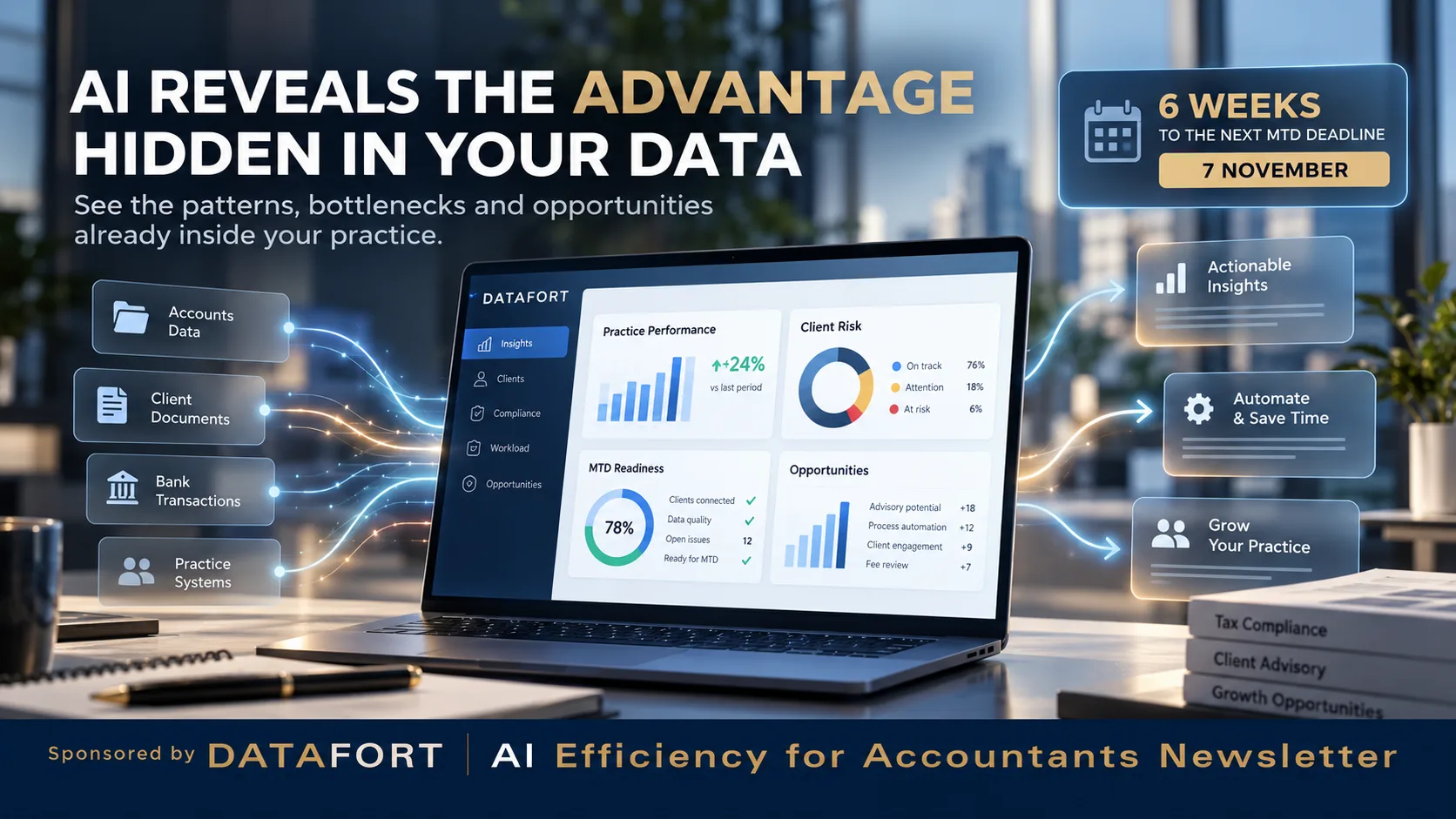
We are now six weeks from the next Making Tax Digital deadline on 5 November. As practices prepare for another cycle of requests, reminders, missing documents and client follow-up, there’s another facet of this information influx that I’d like you to consider.
It’s obvious if you think about it. Every one of those interactions with your clients creates information. Information with the primary purpose of meeting a business requirement or tax obligation. But as a data point in a larger context it presents useful insights about how your practice interacts with its customers.
I think it’s fair to say that it’s unlikely that a practice would have the time and resources to derive value from this information. But AI, with its near infinite capacity to analyse, filter and sort data, now makes it possible to ask – what else could this information tell you about your customers? Perhaps identify commercial opportunities and potentially create completely new forms of value for the businesses you serve? Well, let’s see.
START WITH WHAT THE PRACTICE ALREADY KNOWS
Some of the most useful information may be hiding in very ordinary activity.
Which clients consistently need chasing? Which requests cause the most confusion? Where do jobs stop moving? Which services require more staff intervention than expected? Where are qualified people repeatedly pulled into work that does not require their level of expertise?
Individually, none of these events looks especially important. Across hundreds or thousands of client interactions, however, patterns begin to emerge.
Take the client everyone describes as “always late”. One may actually respond promptly to WhatsApp but ignore email for a week. Another provides everything except one particular document. A third is repeatedly asked for information that the practice already has elsewhere.
These are not necessarily three difficult clients. They may reveal three different process problems.
AI can help expose that distinction. Instead of simply automating the chasing, you can begin asking why the chasing is necessary in the first place.
YOUR WORKFLOW SOFTWARE CAN LEARN FROM EXPERIENCE AND USE
Once patterns become visible, the process itself can start to change.
A client who regularly needs more notice could be contacted earlier. Another who responds reliably after one reminder need not receive three. If one communication channel consistently works better for a particular client, the workflow can reflect that rather than treating everyone identically.
In one accountancy workflow we have designed, standard reminder timings can apply across the practice while individual clients can have their own timing where experience shows it is appropriate. The same underlying system can therefore accommodate different client behaviour without staff having to remember every exception.
The principle is simple: use what you already know to make the next interaction work better.
YOUR PEOPLE ARE CREATING VALUABLE INFORMATION TOO
The data worth learning from is not limited to what clients do. Every time somebody in the practice corrects something, resolves an exception or makes a judgement, they are adding to the organisation’s knowledge.
Suppose a transaction is categorised incorrectly and an accountant corrects it. If the same type of transaction appears again next month, should somebody really have to solve exactly the same problem again?
Properly designed systems can retain confirmed examples and use them when similar cases arise in future. Over time, recurring human decisions can become part of the practice’s institutional knowledge rather than disappearing once the immediate piece of work is finished.
The accountant still provides the judgement where judgement is needed. The difference is that the business process software becomes better at remembering what its people have already taught it.
WHERE IS YOUR PROFESSIONAL TIME ACTUALLY GOING?
This is where the information becomes commercially interesting.
Most practices have a good idea of what their people cost. It is much harder to know how much valuable professional time is being absorbed by small pieces of friction scattered throughout the working day.
Checking whether a document has arrived may take only a few minutes. So might correcting an entry, locating missing information or finding out why a job has stopped progressing. None of these events appears significant on its own.
Multiply them across hundreds of clients and an entire year and the picture can look very different.
AI can help identify where the same interruptions recur, where hand-offs repeatedly fail and where supposedly exceptional intervention has quietly become part of the normal workflow.
The important question is not simply where does our time go?
It is, is that where we want our professional time to go?
TWO CLIENTS OF THE SAME SIZE CAN CONCEAL VERY DIFFERENT ECONOMICS
Two clients may pay the same annual fee while creating very different amounts of work for the practice.
One supplies information promptly, needs little intervention and moves smoothly through the process. The other generates repeated chasing, corrections, additional conversations and regular involvement from senior staff.
The revenue may be identical. The economics are not.
Most practices probably have an intuitive understanding of this already. But data allows you to move from intuition to evidence and, importantly, to ask why the difference exists.
Perhaps the client genuinely requires more service. Perhaps the fee needs reviewing. But perhaps the practice’s own process is creating some of the extra cost. Whatever the reason, it creates the opportunity to intentionally decide what to do to make your business more efficient, not simply guess why everyone seems to be working flat out when you didn’t expect it to be that way.
LET THE EXCEPTIONS FIND YOU
There is another useful change in perspective.
If most of the practice’s work is proceeding normally, people do not necessarily need more information about the work that is fine. They need to know where something has changed or where intervention is required.
Rather than expecting staff or managers to search through hundreds of cases looking for trouble, a system can surface overdue work, repeated exceptions, unusual behaviour or jobs that have stopped progressing.
That turns data from a passive record into something much more useful: a way of directing human attention to the places where it is most valuable.
AND THEN THERE IS THE INFORMATION YOU HOLD FOR YOUR CLIENTS
So far, we have mostly been looking at information generated by the relationship between the client and the practice: requests, reminders, corrections, timing and workflow.
But accountancy practices also hold large amounts of primary financial information provided by their clients. Revenue, costs, staffing levels, margins, debtor days, cash-flow movements and other measures can reveal something much bigger when viewed across a sufficiently broad client base.
Handled correctly, that opens an intriguing possibility.
A practice serving a meaningful number of businesses in a particular geography or sector may be sitting on information capable of showing changing business conditions before those changes appear in conventional published statistics. Are wage costs rising faster than turnover? Are payment periods lengthening? Are particular expenses increasing across an industry? Are businesses beginning to reduce recruitment or investment?
That kind of insight could potentially support useful client briefings, newsletters, benchmarking or richer advisory conversations.
But there is an extremely important qualification.
Client financial information is confidential, and anonymising it does not give a practice carte blanche to use it for another purpose. Any such use would need to be designed within the appropriate professional-confidentiality, contractual, data-protection and client-permission framework. Information would need to be genuinely anonymised and sufficiently aggregated that individual businesses could not reasonably be identified, and the practice would need to be satisfied that it had the right to use the underlying information in this way.
This is therefore not a suggestion that practices simply begin mining client accounts for marketing material.
It is a possible strategic direction for practices that deliberately put the appropriate permissions and safeguards in place.
Done properly, however, it is an exciting idea. A practice could potentially turn the breadth of information it already sees into insights that no individual client could derive from their own accounts alone.
The same data that helps you run the practice better may eventually help your clients run their businesses better too.
THE DATA ISN’T NEW. WHAT YOU CAN DO WITH IT IS.
None of this requires a practice to begin by asking, “What can AI do with all our data?”
A much more useful starting point is a business question.
Why do particular jobs repeatedly run late? Why does one service consume far more staff time than expected? Which clients need disproportionate intervention? Where do the same exceptions keep occurring? What do our customers repeatedly struggle with? What could we tell them that would genuinely help them make a better business decision?
Then ask whether the information needed to answer that question is already somewhere inside the practice.
Very often, it may be.
Accountancy practices occupy an unusual position. They combine financial information, client history, operational experience and professional judgement. AI makes it increasingly practical to connect those sources of information and discover value that previously required too much time and manual analysis to uncover.
The advantage may already be there. AI simply helps reveal it.
WANT TO EXPLORE WHAT AI COULD DO IN YOUR PRACTICE?
Our free guide, MTD: Burden or Business Advantage?, looks at practical ways accountancy practices can use AI and automation to deal with increasing workload while improving the way the practice operates.
If you would rather talk about the particular opportunities inside your own practice, book a short conversation with us. Bring one process, problem or idea and we can discuss what might realistically be possible.
For more practical ideas about applying AI to real business processes, follow DATAFORT on LinkedIn.
NEXT EDITION: WHAT IF EVERYONE GOT THE INFORMATION THEY ACTUALLY NEEDED?
A junior accountant, a practice manager and a partner may all be working from the same underlying business information, but what each of them needs to know can be very different.
In the next edition, we’ll look at how AI-enabled systems can help turn the same underlying information into something more useful for each person — surfacing the issues, exceptions and decisions relevant to what they actually need to do.
The opportunity may not be giving everybody more information. It may be getting the right information to the right person at the point where they can act on it.