
Let’s call it what it is: a silicon-driven bargain bin with rocket fuel in the tank. On July 9, SpaceXAI dropped Grok 4.5, a model that cares less about topping leaderboard charts and more about keeping your wallet from catching fire. It is the immediate offspring of Elon Musk’s $60 billion splurge on Cursor, an AI coding tool that handed SpaceXAI a master key to developer workflows.
I’ll never forget the Tuesday I spent staring at a tangled mess of Python while a premium AI model charged me enough to buy a decent espresso machine. I was debugging a stubborn recursive function, and every token felt like a copper penny dropping through a floorboard. Sound familiar? We’ve all been there, bargaining with chatbots while watching our credit cards bleed out one API call at a time. That’s exactly the friction Grok 4.5 aims to sand down.
Consider a lead engineer who recently swapped to the new model for a sprawling codebase migration. Instead of waiting for a slower, pricier rival to chew through repositories, he fed the whole stack into Grok 4.5. It crunched through iterative reviews and tool calls like a caffeinated squirrel on a hamster wheel, completing the heavy lifting at roughly ninety percent of the cost. Pizza was ordered, but the real victory was the budget line.
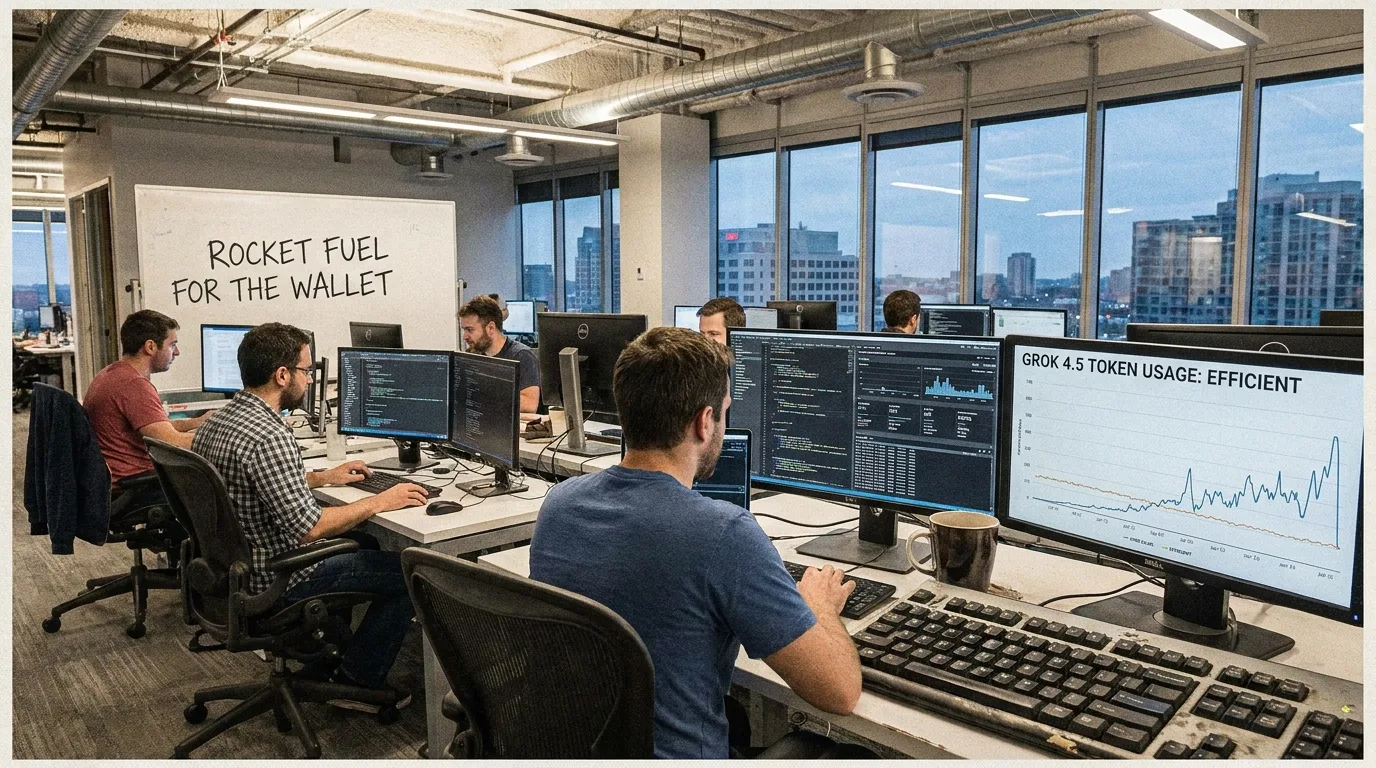
Priced at two dollars per million input tokens and six for outputs, the model targets enterprise workloads where volume eats value for breakfast. SpaceXAI isn’t hiding behind benchmark bragging rights; they’re leaning hard into token efficiency and raw speed. Internal pilots at Tesla and SpaceX have proven its mettle, especially when juggling multi-repo environments where real developer behavior rarely matches sterile testing suites. Musk himself told staff the performance roughly matches Claude Opus 4.7, only with better miles per gallon. The Cursor acquisition didn’t just buy a product; it bought a pipeline of genuine coding telemetry.
The road to cosmic coding efficiency isn’t paved with only clean commits. Earlier Grok iterations stumbled into regulatory quicksand over problematic outputs, prompting a shake-up that saw co-founders pack their bags and Musk admit the engine needed rebuilding. The closed-loop strategy of Colossus compute, Cursor training data, and live fire drills at SpaceX and Tesla forms a formidable moat. Yet moats flood if the bridge is brittle. A cheaper model only wins if it doesn’t force developers into endless retries.
The AI market has quietly pivoted from chasing raw intelligence to chasing practical economics, and Grok 4.5 bets that speed and frugality will outpace perfection in the boardroom. It’s a delicious gamble, suggesting the future of coding won’t be written by the smartest model, but by the one that lets you ship faster without mortgaging the company. Pass the snacks, fire up the terminals, and let the token countdown begin.
Code, Cash, and Cosmic Computing: The Grok 4.5 Gambit
 Episode 45: From Bottleneck to Breakthrough with AI QA
 Newsletter – Beyond Standard Accounting Software | The…
 Accounting Newsletter | What is Vibe Coding and how to use i…
 Episode 44: The Platform Shift: Choosing Your AI Vendor
 DATAFORT completes AI automation project to help BHUK Group …
 Investors are checking to see if business plans include an A…
 Episode 43: Beyond Accuracy: What Other Metrics Matter for B…
 Accountancy Newsletter – Your client’s numbers j…
 The AI didn’t escape
 Accountancy Newsletter – AI REVEALS THE ADVANTAGE HIDD…