Hello and welcome back to the blog! I’m so glad you’re here, because today we’re wading into some deep, important, and frankly, complicated waters. We’re tackling a topic that sits at the very heart of innovation and risk: AI and the Law.
Specifically, we’re going to navigate the legal minefield of copyright, intellectual property (IP), and liability in the age of AI. This is a landscape that is literally shifting beneath our feet, and for any business using or building AI tools, ignoring it is simply not an option.
So, where do we even begin? My approach in these situations is always to start with the fundamental questions. Simple, but profound. Can you truly copyright a piece of art that an AI generates? Who is responsible when an AI assistant provides financial advice that turns out to be disastrously wrong?
To find the answers, we need to go back to basics and look at the very nature of creation and ownership in this new era. Let’s get into it.
Who Owns the Output? The ‘Human Authorship’ Dilemma
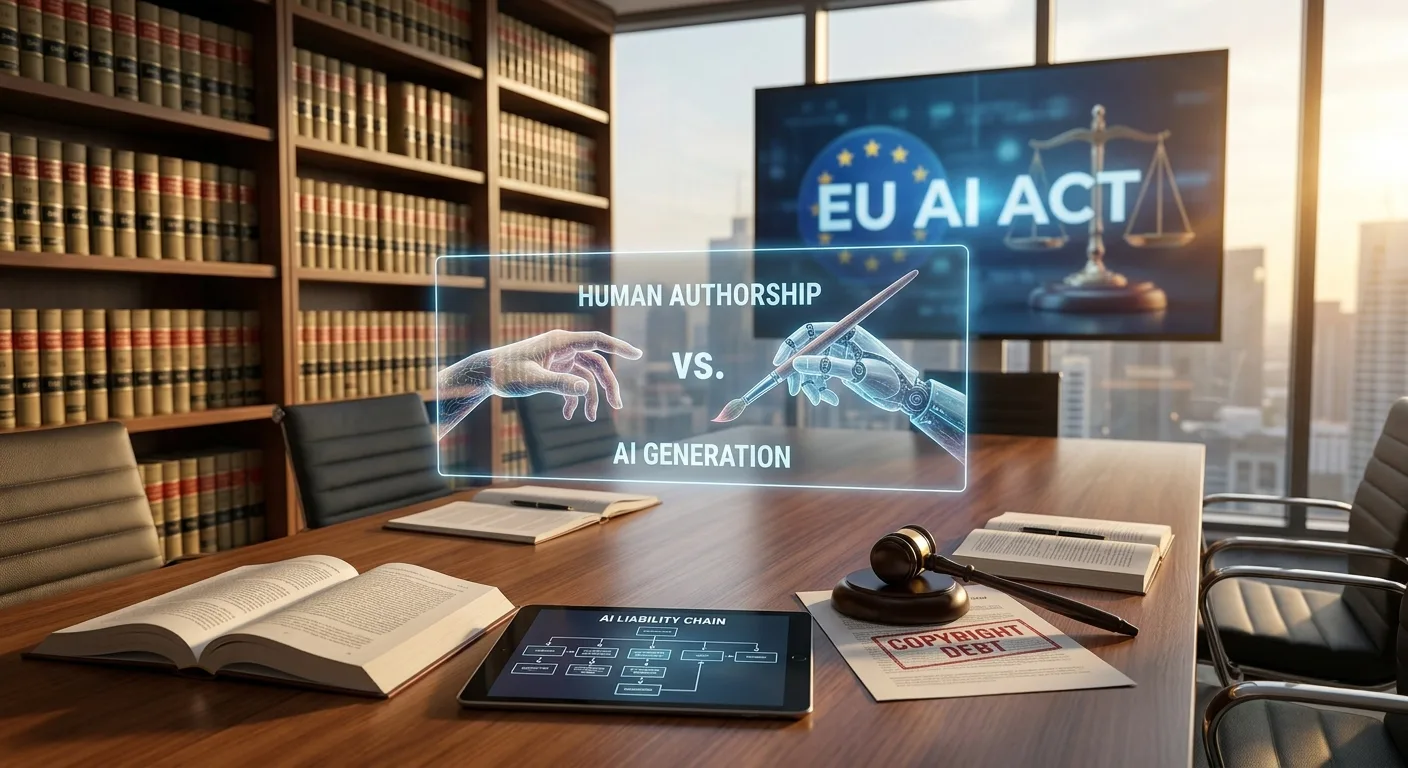
Let’s start with the thing the AI actually makes—the image, the block of text, the piece of code. For a very long time, copyright law has been built on a foundational principle: copyright protection requires human authorship. This is a position that legal bodies, like the U.S. Copyright Office, are holding quite firm on right now.
I like to frame this as a question of tool versus creator.
Let me paint a vivid picture for you. Think of a camera. A modern DSLR is an incredibly complex piece of technology, but no one argues the camera owns the photo. The photographer is the author. It’s their creative choices—the lighting, the composition, the exact moment the shutter clicks—that grant them the copyright. The camera is just the tool.
Now, apply that to AI. Are you using it like a camera, where you are making dozens of specific, creative choices to guide the output to a predetermined vision? Or are you giving it a simple prompt and letting the AI make the substantive creative decisions?
This distinction has profound consequences. Imagine your marketing agency uses an AI to generate a brilliant logo for a client’s campaign. If the human creative input was minimal, that logo might not be copyrightable. It could fall into the public domain, meaning any of your client’s competitors could legally use it. That’s a painfully common pitfall people are just now beginning to recognize.
The Ghost in the Machine: Where Does AI Get Its Knowledge?
Okay, so we’ve talked about the output. Now let’s shift our focus to the input. Where does a generative AI model get its knowledge? The answer is that it’s trained on vast datasets, often containing billions of data points scraped from the open web—including copyrighted articles, images, and books.
This is where the real friction begins. AI developers argue this is permissible under a legal doctrine called “Fair Use.” The idea is that using copyrighted material for a new, transformative purpose, like training a model, should be allowed. But creators and media companies are pushing back, arguing it’s just large-scale, unlicensed copying.
This very argument is being tested right now in several high-profile lawsuits. For you, as a business owner or user of these tools, this creates a potential risk I call “copyright debt.” The AI tool you are using today may have a legal challenge baked into its foundation. You’ve unknowingly inherited that risk, and understanding its potential impact is critical for your long-term strategy.
Can an AI Be an Inventor? Patents vs. Trade Secrets
Broadening our view beyond copyright, we run into an even more mind-bending question in the world of patents: can an AI be an inventor?
This isn’t just a theoretical debate for a sci-fi novel. The international legal system is grappling with this right now, sparked by a real-world case involving an AI named DABUS, which was listed as the sole inventor on several patent applications. The global response has been mixed and the debate is fascinating, but it’s also very much unsettled.
So what’s my practical advice for businesses innovating in this space? My personal rule of thumb is to lean into a more immediate and controllable strategy: trade secrets.
Your custom-built AI model, the proprietary dataset you’ve spent years curating—that is your competitive edge. Instead of trying to patent it, which requires public disclosure and ventures into murky legal territory, treat it as a closely-guarded secret. By doing this, you avoid the public filing and maintain complete control. In many cases, I believe this is the more viable and secure path forward.
When AI Fails: Tracing the Chain of Liability
Now, let’s turn our attention to what happens when things go wrong. This is the liability maze, and it’s where the legal questions become deeply human.
Imagine an AI diagnostic tool in a hospital misidentifies a disease, leading to severe consequences for a patient. Or a self-driving vehicle causes an accident. The immediate question is always, who is to blame?
What I like to do in these situations is trace the chain of liability, and what you’ll find is that it’s not a single link, but a complex web:
- The Developer: It could be the original developer who wrote the flawed code.
- The Data Provider: It could be the provider of the data it was trained on, if that data was biased or incomplete.
- The Deployer: It could be the company that deployed the AI system without sufficient testing or oversight.
- The End-User: And it could even be the end-user who operated it improperly.
Each step in this chain holds a potential share of the responsibility. We are seeing existing product liability laws being stretched and adapted for this new reality, but the core lesson is that the buck doesn’t stop easily.
My Unbreakable Rule: Never Skip the Terms of Service
Given all this complexity, I want to bring it back to something you can control today. My unbreakable rule for any business adopting new technology, especially AI, is this: read the fine print.
When you’re considering a new AI platform, it is so tempting to just scroll to the bottom and click ‘Agree’ on the Terms of Service. Please, pause and resist that urge. Treat this with the same legal rigor you would apply to any major software procurement.
Here’s what you need to look for:
- Indemnification: If you are sued for copyright infringement because of something the AI produced, will the provider step in to defend you? This is huge.
- Data Privacy: How is your data being used? Is it being used to train their future models?
- IP Ownership: This is the big one. Who owns the intellectual property of the outputs you generate using their service? Is it you, or is it them?
Making this review a deliberate part of your process isn’t just a technical decision; it’s a fundamental part of your risk mitigation strategy.
Preparing for Tomorrow: The Regulatory Horizon
Finally, let’s cast our gaze forward. There is a regulatory wave forming, and it’s essential to understand the direction it’s heading. You’ll hear a lot about major legislative efforts like the EU AI Act.
My advice isn’t to get bogged down in the specific clauses of today’s draft, but to understand the direction of travel. The core principles driving these regulations are transparency, accountability, and a risk-based approach. This means higher-risk AI systems (like those in healthcare or finance) will face much stricter rules.
So, how do you prepare? You get ahead of the curve. It is incredibly valuable to start implementing an internal AI ethics framework now. And crucially, you should maintain clear, deliberate documentation of your AI usage and your decision-making processes. This isn’t just about future compliance; it’s about building trust and resilience for what’s to come.
This has been a dense topic, I know, but navigating it proactively is what separates thriving businesses from those that get caught by surprise. Proactive legal diligence is no longer just good practice—it’s essential.
Thank you for taking the time to walk through this complex landscape with me today!
Join me next time, when we will explore “Personalized Pricing: The Power and Peril of AI-driven Dynamic Pricing.” I want to leave you with a question to think about: how does a company use AI to determine the exact price that you, specifically, are willing to pay? And where do we draw the line between smart business and digital discrimination?
As always, I’d love to hear your thoughts or questions in the comments below!